Each drawer below is one NURS-FPX9030 assessment. Where a sample is live, read it in full, true APA form with the reasoning annotated. Where it is not, request it free: send your assessment number and the scoring guide from your courseroom, and a custom sample written to your exact criteria arrives in 24 to 48 hours. Searches like "NURS FPX 9030 assessment 2 example", "NURS FPX 9030 sample paper", and "NURSFPX9030 sample" all land here, because this page is the drawer they belong in.
What NURS-FPX9030 is really about
NURS-FPX9030 asks the question the whole sequence has been building toward: did it work, and how do you know? The genre is outcomes evaluation, and its raw material is the comparison your earlier courses made possible, baseline from planning, post-intervention data from implementation, analyzed with methods sized to a quality improvement project rather than a clinical trial. Run charts, descriptive statistics, pre and post comparison, sometimes a simple significance test where the data supports one. Where a framework genuinely organizes the analysis, Donabedian's structure, process, and outcome triad is the one evaluators reach for, cited to the primary source. The discipline is matching claims to data: no more certainty than the numbers earn, no less clarity than they allow.
Evaluation writing also has an emotional layer nobody warns doctoral students about: the results may be modest, mixed, or flat, and the paper still has to be excellent. FlexPath courserooms grade the quality of the evaluation, not the size of the effect. A rigorous analysis of an intervention that moved one measure slightly, with honest limitations and a defensible sustainability argument, outscores a triumphant summary that overclaims. Strong NURS-FPX9030 papers treat unexpected results as findings, connect them back to the fidelity record from implementation, and let the limitations section do real work instead of ritual apology. That posture, results reported straight, meaning argued carefully, is exactly what the dissemination course will need next.
What NURS-FPX9030’s assessments ask for
Current courserooms typically walk the evaluation in stages, with your scoring guide deciding the final shape. Early work often sets the analytic frame: measures restated exactly as planned, data sources confirmed, analysis methods justified for a practice project. Middle work usually delivers the analysis itself, baseline against post-intervention, displayed in tables or run charts a committee can read, with statistical choices explained rather than performed. Later work tends to interpret: what the results mean for the practice problem, what limits the claims, whether the change can sustain after the project ends, and what the site should do next. Criteria reward alignment above technique; the measure evaluated must be the measure proposed, and every conclusion must trace to a number the paper actually shows.
Where students lose points in NURS-FPX9030
The most painful discovery in NURS-FPX9030 is an evaluation plan with nothing to compare. Students arrive ready to analyze and find no baseline was captured back in planning, so the paper is reduced to describing post-intervention numbers floating free of any before. The fix belongs two courses earlier; here, all that remains is an honest workaround using historical site data, framed as the limitation it is. The second loss is claim inflation, writing improvement language over a change too small or too confounded to carry it, which faculty read as a misunderstanding of evidence. The third is analysis theater: importing inferential statistics a three-month practice project cannot support, when a clean run chart and descriptive comparison would have scored higher because they fit the design.
The NURS-FPX9030 drawers
NURS-FPX9030 Assessment 1 analysis plan a practice project can support example
Opening work typically fixes the analytic frame, naming the planned measures and defending an analysis a practice project can support. On request, free, 24-48h.
NURS-FPX9030 Assessment 2 before and after presented for a committee example
Middle work typically runs the numbers: the planned measure compared before and after, displayed so a committee reads the change at a glance. On request, free, 24-48h.
NURS-FPX9030 Assessment 3 findings interpreted and bounded example
Closing work usually interprets and bounds the findings: meaning for practice, limitations argued precisely, sustainability weighed on the evidence. On request, free, 24-48h.
Your courseroom shows something else?
Capella revises courses; assessment counts and titles shift between versions. Send what your courseroom shows and the desk matches it exactly.
Using a NURS-FPX9030 sample the right way
Read a NURS-FPX9030 sample twice. First pass, follow the numbers: find the baseline, find the post measure, watch how the comparison is displayed and how far the interpretation dares to go. Second pass, follow the criteria: mark where each scoring guide requirement is answered and how limitations are argued as analysis rather than apology. Then build your own evaluation from your project's actual dataset, matching your analytic method to your design. If your data situation is complicated, missing baseline, small numbers, say so when you request the free custom sample; the desk writes to the scoring guide and the situation you actually have.
How these samples are written
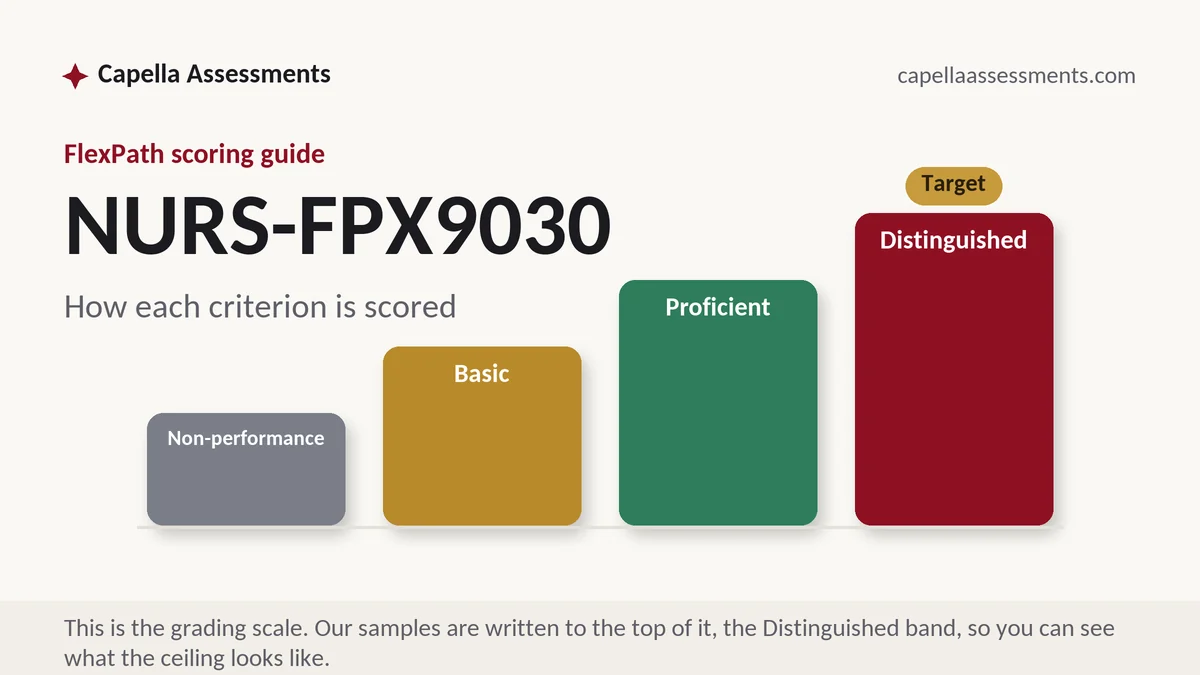
Samples here follow one discipline: the scoring guide is the outline, every criterion gets its section, the Distinguished description decides the depth, and the APA layer ships exact. Because Capella updates courses over time, your free custom sample is drafted against the scoring guide you send, not against an archive.
NURS-FPX9030 questions, answered
I never collected baseline data. Can a NURS-FPX9030 sample show how to evaluate anyway?
Yes, within honest limits. A sample can model the recoverable paths, historical chart data as a proxy baseline, process measures collected during implementation, or a descriptive evaluation with the gap named plainly as a limitation. What no sample will do is fabricate a before-number. Send your scoring guide and what data you actually hold; the first custom sample is free and arrives in 24-48h.
My project results were flat. Will a NURS-FPX9030 sample help me write that up without failing?
Flat results are writable, and courserooms score the evaluation, not the effect size. A sample can show the structure: report the comparison exactly, examine fidelity and dose as explanations, argue limitations with precision, and recommend what the site should try next. That paper can reach Distinguished. What sinks submissions is dressing a flat result in improvement language the numbers contradict.
Will a NURS-FPX9030 sample use my real project data, and what about my practicum log?
A custom sample is written around your project type and scoring guide, modeling analysis and interpretation; you run the actual numbers on your own dataset. Your practicum log, hours, and preceptor attestations are never part of any sample, since those are records only you can truthfully produce. The written evaluation is the layer a model can teach, and it teaches it well.