Send the exact assignment or rubric from your classroom and a custom sample written to it lands in 24 to 48 hours, the first one free. PM-FPX4000 is Capella’s Foundations of Project Management Domains course. It centers on holding one project across every knowledge domain at once, so a change in one shows up in the others. Searches like "pm fpx 4000 assessment 3 assignment example", "PMFPX4000 sample paper", and "PM-FPX4000 assessment samples" land on this page.
What PM-FPX4000 is really about
PM-FPX4000 is a survey course that is not scored as a survey. Each domain has its own course later in the sequence, so this one is not asking for depth in any single area; it is asking whether you can hold them together on one project. The submissions that stall write seven short sections that could be shuffled without loss, each accurate, none connected. The submissions that score keep one project in view and let the domains talk to each other: the schedule compresses, so the resource plan changes, so the quality checks that were going to catch defects get dropped, so the risk exposure rises. That chain is the thing being assessed, and it cannot be produced by covering the domains in order.
Breadth also sets the depth. Because every domain has to appear, none of them can be developed the way its own course will develop it, and the skill is knowing what the shortest defensible version of each looks like. A scope statement here is a paragraph with acceptance criteria in it, not a full baseline. A risk section is three real exposures with owners, not a register of twenty. Choosing what to leave out is part of what the criteria measure, and papers that go deep on the one domain the writer finds comfortable, then thin out, lose more than they gain. Pick a project with enough moving parts that procurement and people are genuinely present rather than invented to fill a heading.
What PM-FPX4000’s assessments ask for
Assessments typically ask you to take a project and produce a compact treatment of the domains across it. That means a defined deliverable with acceptance criteria, a phased schedule at a level someone could check, an order-of-magnitude cost view with its assumptions stated, quality expectations someone could verify, the roles and who they report to, the exposures that would actually derail the work, and what is bought rather than built. Where the criteria ask for integration, they want a stated dependency: name the decision in one domain and the consequence in another. Several versions also ask which domain you judge highest risk on this project and why, which is answered by ranking rather than by reporting that all domains matter.
Where students lose points in PM-FPX4000
The dominant loss is the sectioned paper with no project running through it, where each domain is defined and then illustrated with a different example. Second is the domain left as a heading, usually procurement or quality, filled with a sentence saying it will be managed appropriately. Third is depth spent unevenly, so scope runs three pages and risk gets a line. Marks also go for schedules with no durations, for cost figures with no basis, for roles listed without decision rights, and for integration claimed in a closing paragraph that names no actual dependency. Papers also lose ground when the project chosen is too small to have all the domains in it, which forces invented procurement and a team of one.
The PM-FPX4000 drawers
PM-FPX4000 Assessment 1 project brief example
Assessment 1 typically frames one project and the domains it will have to cross. On request, free, 24-48h.
PM-FPX4000 Assessment 2 domain analysis example
Assessment 2 often works the domains individually at the depth this course allows. On request, free, 24-48h.
PM-FPX4000 Assessment 3 integrated plan summary example
Assessment 3 usually shows the dependencies where one domain changes another. On request, free, 24-48h.
Your classroom shows something else?
Capella University revises courses; assessment counts and deliverables shift between terms. Send what your classroom shows and the desk matches it exactly.
Using a PM-FPX4000 sample the right way
Read a sample for proportion before anything else. Notice how many words each domain gets and how the writer signals depth without spending it, then find the two or three sentences where one domain reaches into another, because those are what the integration criteria are looking for. Skim the definitions; they belong to the whole field. Then rebuild it around a project big enough to need a vendor and a team, since a project without either forces you to fake two domains. Watch how the sample states assumptions rather than dodging the numbers, which is what keeps a compact treatment honest instead of vague.
How these samples are written
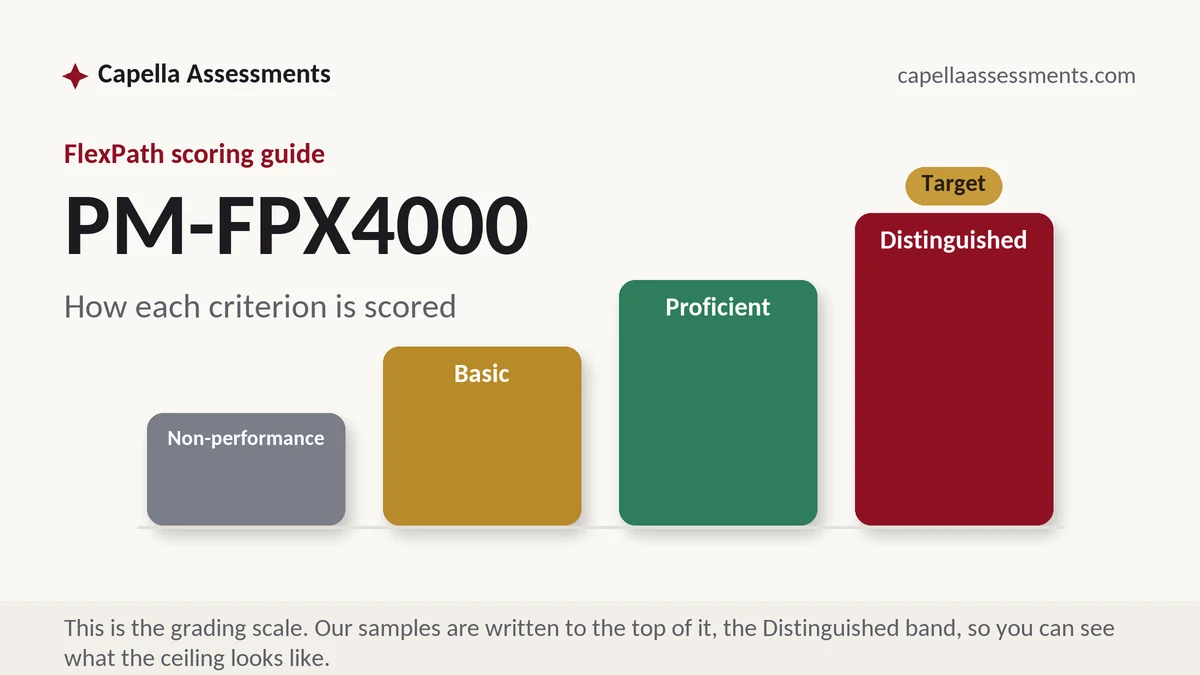
Every sample in this drawer is written the same way our custom ones are: the scoring guide decoded criterion by criterion, a subject-matched writer drafting to the Distinguished column, APA checked line by line, and the reasoning annotated so the paper teaches while it shows. Capella revises scoring guides, so a custom request is always written to the guide in YOUR courseroom, never from a stale template.
PM-FPX4000 questions, answered
How deep does each domain need to go in PM-FPX4000?
Shallow enough to fit, deep enough to be checkable. One or two paragraphs per domain, each containing something specific: an acceptance criterion, a duration, an assumption behind a figure, a named owner. What loses marks is a domain covered in a sentence of intent. What also loses marks is one domain developed at the expense of the rest.
Should I use the same project for every assessment in the course?
Where the instructions allow it, yes. Carrying one project across the shelf lets each assessment build on the last and gives the integration criteria something to grip. Switching projects between assessments means re-establishing context every time and losing the dependencies that make the work look like project management rather than a set of exercises.
Can I get a PM-FPX4000 sample written to my own scoring guide?
Yes. Send the assessment instructions and the scoring guide from your courseroom, and the desk writes the sample against those criteria rather than a generic outline. First custom sample is free and returns in 24-48h. If your section names a specific project scenario, say so, and the sample is built on that scenario instead of ours.