Send the exact assignment or rubric from your classroom and a custom sample written to it lands in 24 to 48 hours, the first one free. PSY-FPX6025 is Capella’s Child Psychology course. It centers on the psychology of childhood itself, where behavior must be observed before it is interpreted and norms describe ranges rather than deadlines. Searches like "psy fpx 6025 assessment 3 assignment example", "PSYFPX6025 sample paper", and "PSY-FPX6025 assessment samples" land on this page.
What PSY-FPX6025 is really about
Children are the one population psychologists study mostly from the outside, and PSY-FPX6025 grades the discipline that fact requires. A four-year-old cannot narrate her working memory, so the field reads behavior, play, drawing, gaze, tantrum, and infers, and the graduate skill is keeping the observation and the inference in separate sentences. Scoring guides reward papers that describe what a child in a scenario actually does before saying what it means, and that hold interpretations to the developmental literature rather than to adult intuition, which reliably misreads children as small adults. Milestones get the same treatment: the research gives ranges with wide normal variation, and a paper that writes them as deadlines has already made its first unwarranted diagnosis.
The parenting literature is where graduate papers most visibly separate from undergraduate ones. Correlations between caregiving style and child outcome run in both directions, children shape their parents while being shaped, and heritable temperament sits under both sides of the equation, so causal stories told confidently in one direction misreport the field. Culture widens the caution: much of the classic research was normed on narrow populations, and practices that predict one outcome in one community predict differently elsewhere. Strong submissions carry these qualifications into their conclusions instead of a limitations paragraph. And the boundary holds everywhere: scenario children are composites, atypical development is discussed through research rather than diagnosed, and no real child's behavior gets interpreted on the page.
What PSY-FPX6025’s assessments ask for
Assessments in this course generally hand you childhood material and grade the reading of it. Scenario versions typically present a described child, behavior, context, family situation, and ask for a developmental analysis: what is typical for the age range, what theories illuminate the pattern, what an appropriately cautious professional would consider next. Domain versions take one strand, language, attachment, play, self-regulation, and want the research synthesized and applied to how children of a given age actually function. Applied versions, common later in the shelf, aim the analysis at adults who serve children, guidance for a classroom, a program critique, a parent education outline, scored on evidence surviving the translation. In many sections the criteria explicitly reward observation kept distinct from interpretation, the course's signature demand.
Where students lose points in PSY-FPX6025
The adultomorphic reading is this course's characteristic error, a child's behavior explained by adult motives, defiance where the literature sees regulation still under construction, manipulation where it sees learned contingency. Second is the milestone-as-deadline paper, normal variation written as delay, which tends to cascade into implied diagnosis the assessment never requested. Third is one-way parenting causality, caregiver behavior written as the sole author of child outcome with temperament and child effects invisible. Papers also lose for observation and inference fused into single sentences no grader can untangle, for theories of childhood cited but never pointed at the scenario, for cultural narrowness in the evidence left unremarked, and for applied pieces that quietly begin instructing a specific family instead of informing the adults the assessment named.
The PSY-FPX6025 drawers
PSY-FPX6025 Assessment 1 developmental domain synthesis example
Assessment 1 typically synthesizes research on one strand of childhood functioning across early ages. On request, free, 24-48h.
PSY-FPX6025 Assessment 2 child scenario analysis example
Assessment 2 often reads a composite child's behavior against norms, theory and context. On request, free, 24-48h.
PSY-FPX6025 Assessment 3 practitioner guidance piece example
Assessment 3 usually translates childhood research for the adults who teach or care for children. On request, free, 24-48h.
Your classroom shows something else?
Capella University revises courses; assessment counts and deliverables shift between terms. Send what your classroom shows and the desk matches it exactly.
Using a PSY-FPX6025 sample the right way
Open a PSY-FPX6025 sample and sort its sentences into two piles, what the child did and what it means, and notice how cleanly they separate. That separation is the habit your scoring guide is buying, and a worked page teaches it faster than any instruction could. Watch too how age-range claims arrive with their variation attached. Then analyze a different scenario or domain in your own paper, since a borrowed child teaches you nothing about reading the one your assessment supplies. The sample's lasting value is calibration: how much interpretation the evidence permits, and where a graduate writer stops.
How these samples are written
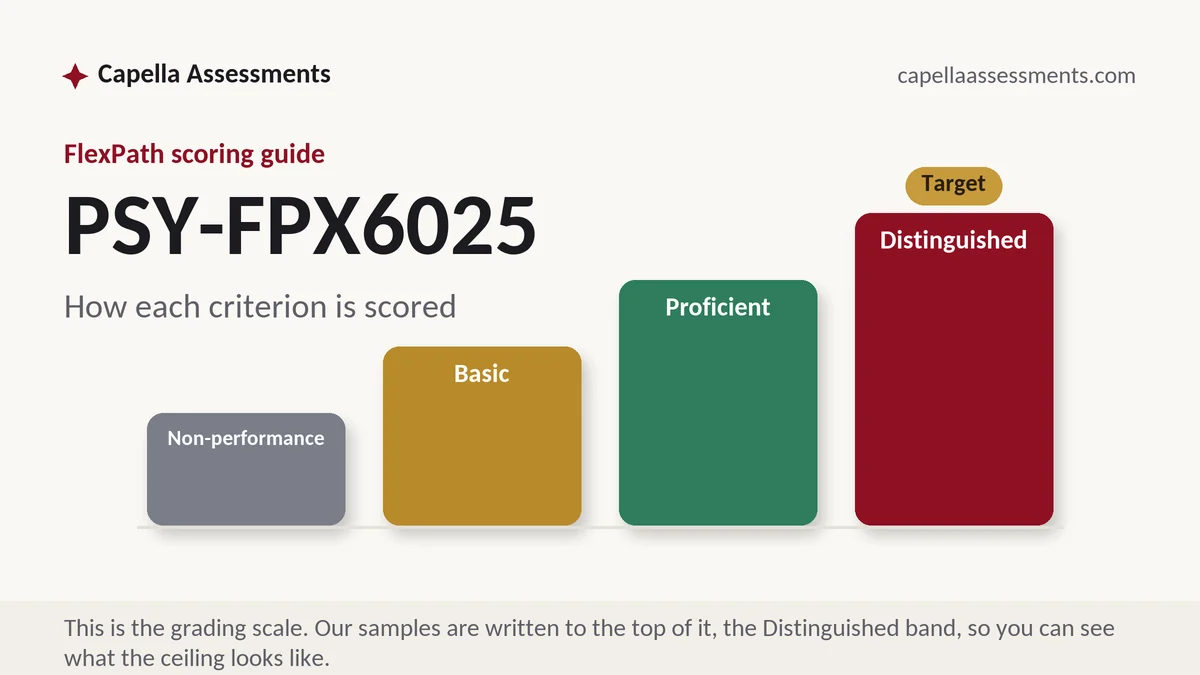
Every sample in this drawer is written the same way our custom ones are: the scoring guide decoded criterion by criterion, a subject-matched writer drafting to the Distinguished column, APA checked line by line, and the reasoning annotated so the paper teaches while it shows. Capella revises scoring guides, so a custom request is always written to the guide in YOUR courseroom, never from a stale template.
PSY-FPX6025 questions, answered
Can I request a PSY-FPX6025 Assessment 1 example?
You can; it is drafted against the documents you provide, the instructions, the scoring guide, and the scenario if your section uses one, and generally lands within 24-48h at no cost for a first request. Child psychology sections differ in whether they lead with theory, domains or scenario analysis, so the matched documents matter more than the course name.
My assessment includes observing a child. Can a sample cover that?
The write-up, yes; the observation, no. Any observing your section requires happens in your world under your arrangements, with whatever permissions your instructions specify, and the notes are your record. What a sample models is everything after: how observed behavior is documented neutrally, connected to developmental research, and interpreted at the caution the criteria reward.
What if the child in my scenario shows possible signs of a disorder?
Write what a responsible non-clinician writes: the observed pattern, what the research says about typical variation at that age, and the fact that evaluation belongs to qualified professionals. Assessments plant such details to test exactly this restraint, and papers that leap to a label lose where papers that describe, contextualize and refer gain.