Send the exact assignment or rubric from your classroom and a custom sample written to it lands in 24 to 48 hours, the first one free. PSY-FPX6030 is Capella’s Adolescent Psychology course. It centers on the adolescent years examined as development rather than pathology, with identity, peers and risk explained through contested current research. Some program versions carry this course as PSYC-FPX2720; the same drawers apply. Searches like "psy fpx 6030 assessment 3 assignment example", "PSYFPX6030 sample paper", and "PSY-FPX6030 assessment samples" land on this page.
What PSY-FPX6030 is really about
Every culture hands its students a theory of adolescence before any course does, and PSY-FPX6030 is graded partly on unlearning it. Storm-and-stress is the oldest claim in the field and the research supports only a qualified version: conflict and risk rise on average, modestly, for some adolescents, in some domains, while most teenagers pass through the years on reasonable terms with their families. Graduate papers state findings at that resolution. The same discipline applies to the developing-brain story, where maturational imbalance models are influential, contested and easy to overstate, and where a paper that writes brain immaturity as a settled explanation for teenage behavior has traded an active scientific debate for a headline.
The productive half of the course reads adolescence as work being done rather than trouble being caused. Identity development, autonomy renegotiation and the reorientation toward peers are tasks with literatures behind them, and assessments reward papers that treat a described teenager's behavior as task pursuit under constraints, sometimes clumsy, rarely senseless. Peer influence gets its graduate treatment here too: the effect is real, strongest in specific conditions the research has mapped, and protective as often as it is risky, since peers also transmit norms that keep adolescents safe. Context does heavy analytic work throughout, because adolescence runs differently across cultures, decades and family circumstances, and papers that write one suburban script as the human default lose exactly where the criteria ask for evidence.
What PSY-FPX6030’s assessments ask for
In current courserooms, assessments tend to assign either an adolescent phenomenon or an adolescent-serving setting. Phenomenon versions take identity, peer relations, risk behavior or family renegotiation and ask what the research establishes, usually with a stereotype to test on the way, and score how precisely findings are stated, average effects kept distinct from individual predictions. Setting versions hand you a school policy, a program for teenagers or a composite case and ask what adolescent science implies for it, which requires choosing findings sturdy enough to build on. Some sections include a developmental comparison, what changes between early and late adolescence and why it matters for practice. Whatever the format, criteria concentrate on evidence discipline applied to a population everyone believes they already understand.
Where students lose points in PSY-FPX6030
Stereotype confirmation is the standing hazard: storm-and-stress asserted as universal, teenagers written as hormone-driven or brain-limited, claims the paper's own cited studies do not make. Second is neuroscience overreach, imbalance models reported as settled mechanism and then stretched into explanations for any behavior the scenario contains. Third is risk treated as irrationality, when the literature more often shows reasoning intact and valuation different, a distinction that changes every applied recommendation downstream. Papers also lose for peer influence written only as danger, for identity theory floated with no adolescent attached, for cultural and cohort variation ignored in universal claims, and for applied sections that recommend programs no cited finding supports. The grade in this course tracks precision about a population the culture prefers to caricature.
The PSY-FPX6030 drawers
PSY-FPX6030 Assessment 1 stereotype versus evidence essay example
Assessment 1 typically tests a common belief about adolescence against what studies report. On request, free, 24-48h.
PSY-FPX6030 Assessment 2 adolescent case analysis example
Assessment 2 often conceptualizes a composite teenager's behavior as development operating in context. On request, free, 24-48h.
PSY-FPX6030 Assessment 3 applied research brief example
Assessment 3 usually advises a school or program from findings strong enough to hold. On request, free, 24-48h.
Your classroom shows something else?
Capella University revises courses; assessment counts and deliverables shift between terms. Send what your classroom shows and the desk matches it exactly.
Using a PSY-FPX6030 sample the right way
Read a PSY-FPX6030 sample against your own assumptions and count the corrections. Each place the paper states a smaller, more conditional finding than you expected is a place the course's grading lives, and collecting those moments tunes your ear faster than rereading instructions. Notice also how applied claims choose their evidence, leaning on replicated findings and saying so. Then write about a different phenomenon or setting, because the field's territory is broad and the calibration, not the topic, is what transfers. An example built to your section's scoring guide additionally shows how much weight your courseroom puts on the applied turn.
How these samples are written
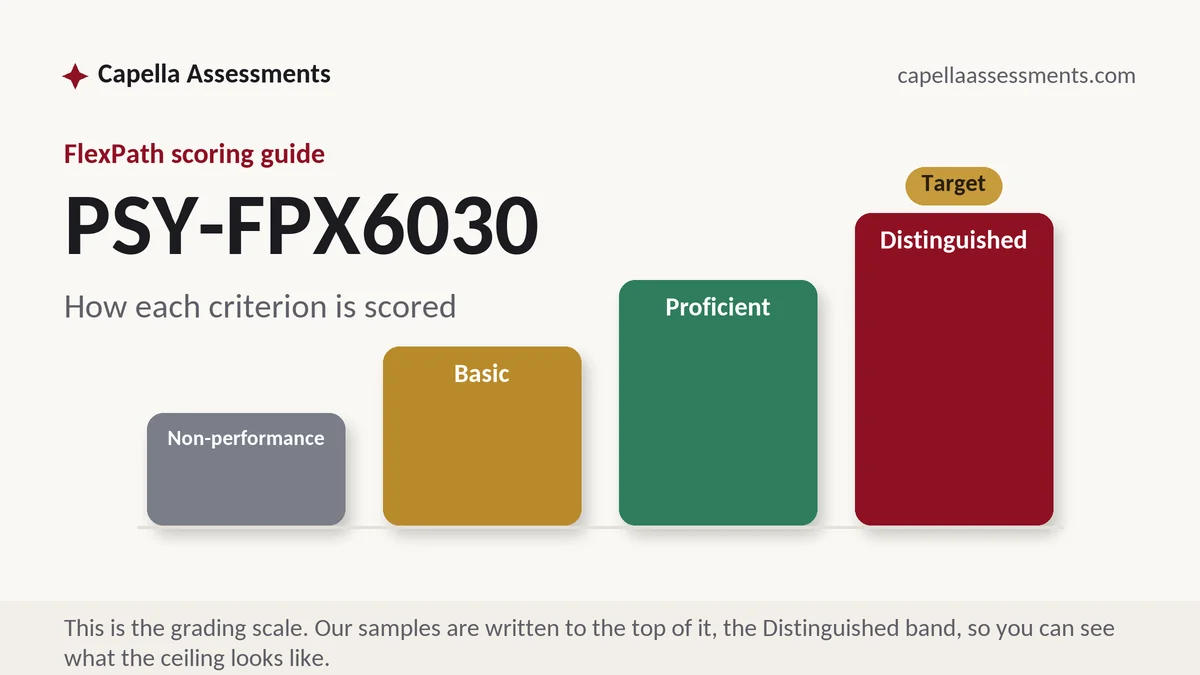
Samples here follow one discipline: the scoring guide is the outline, every criterion gets its section, the Distinguished description decides the depth, and the APA layer ships exact. Because Capella updates courses over time, your free custom sample is drafted against the scoring guide you send, not against an archive.
PSY-FPX6030 questions, answered
How soon can a PSY-FPX6030 sample be in my hands?
Once the courseroom instructions and scoring guide arrive, the usual delivery is 24-48h, and a first custom sample costs nothing. Mention whether your section runs this course at the graduate level with an applied setting attached, because the same catalog name appears elsewhere, and the sample should match the criteria you will actually be scored on.
Can I use my own teenage years as evidence in this paper?
As a question generator, yes; as support, no. Your adolescence is one case from one cohort in one context, and the criteria score claims about adolescents in general, which need research behind them. Where instructions invite personal connection, use it to frame what you then check against the literature, and let the studies decide what stands.
Do I need to cover adolescent brain development?
Cover it where your criteria call for biological perspectives, and handle it as current science: maturational models have real evidence and real critics, and effect sizes rarely justify the sweeping claims popular coverage makes. A paragraph that presents the models, their support and their limits earns more than a page of confident neuromyth ever will.