Send the exact assignment or rubric from your classroom and a custom sample written to it lands in 24 to 48 hours, the first one free. PSY-FPX6810 is Capella’s Principles of Sport Psychology course. It centers on the foundational constructs of sport psychology, arousal, motivation, confidence, and attention, and what each one predicts about performance. Searches like "psy fpx 6810 assessment 3 assignment example", "PSYFPX6810 sample paper", and "PSY-FPX6810 assessment samples" land on this page.
What PSY-FPX6810 is really about
Sport carries more folk psychology than almost any other domain, and PSY-FPX6810 spends much of its length replacing it. Everyone who has played or coached knows about clutch performers, momentum, and wanting it more, and none of those phrases survives contact with the research. In their place the course installs constructs that can be defined and tested: arousal and its curvilinear relationship with performance, anxiety split into cognitive and somatic components, motivation separated into orientations that predict different behavior under failure. The writing job is translation with a spine. A paper takes a performance situation everyone recognizes, drops the broadcast vocabulary, and explains the same events in terms that connect to evidence, which turns out to explain them better.
Because the course reasons through athletes, the athletes have to come from somewhere, and the sound practice is to build them. A composite athlete, a point guard whose shooting collapses in the fourth quarter, a swimmer who trains brilliantly and races tight, gives a paper everything analysis needs with nobody's privacy at stake, and it keeps the writer out of the diagnosis business. Nothing in this course qualifies anyone to assess a real person, and papers that read like evaluations of a named teammate miss both the ethics and the assignment. The judgment being trained is selection among explanations: deciding whether a collapse under pressure is an arousal story, an attention story, or a confidence story, and committing to the case.
What PSY-FPX6810’s assessments ask for
PSY-FPX6810 assessments typically start with the field and end with a case. An opening piece in many sections maps what sport psychology is, where it came from, and what its practitioners actually do, scored on accuracy about a profession students often know only from documentaries. The middle usually asks for constructs applied: explain a performance problem through arousal or anxiety theory, or compare motivational orientations and say what each predicts about an athlete's response to losing. A closing assessment often asks for an integrated analysis of one performance scenario, several constructs coordinated into a single account rather than listed. Sources are expected to be scholarly, and the scoring guide in most versions distinguishes writers who explain mechanisms from writers who relabel behavior with technical words.
Where students lose points in PSY-FPX6810
The first loss in this course is broadcast language surviving into graduate prose, papers built on mental toughness and killer instinct with citations sprinkled over the top. Second is relabeling, where an athlete who misses free throws is said to have performance anxiety and the paper treats the new name as an explanation. Third is the case analysis about a real, recognizable person, a teammate or a famous athlete described in diagnostic tones, which raises problems no citation can fix. Marks also go for arousal theory stated without its inverted relationship to performance, for motivation treated as a quantity someone simply has more of, and for scenarios where every construct in the syllabus makes an appearance. One mechanism argued closely beats five mentioned, in this courseroom and most others.
The PSY-FPX6810 drawers
PSY-FPX6810 Assessment 1 field overview essay example
Assessment 1 commonly maps what sport psychology studies and what its practitioners are trained to do. On request, free, 24-48h.
PSY-FPX6810 Assessment 2 construct application paper example
Assessment 2 typically explains one performance problem through arousal, anxiety, or motivation theory. On request, free, 24-48h.
PSY-FPX6810 Assessment 3 integrated athlete case example
Assessment 3 often coordinates several constructs into one account of a composite athlete's season. On request, free, 24-48h.
Your classroom shows something else?
Capella University revises courses; assessment counts and deliverables shift between terms. Send what your classroom shows and the desk matches it exactly.
Using a PSY-FPX6810 sample the right way
Use a PSY-FPX6810 sample to hear the register before you write in it. The difference between a coach's account of a slump and a psychologist's is audible within a paragraph, and imitating the second is faster than deriving it. Watch how the composite athlete is introduced with just enough history to analyze, and how one construct is chosen and defended while the others are explicitly set aside. When your own assessment opens, send its instructions and the scoring guide across, and a custom sample written to them comes back free the first time, generally within 24-48h.
How these samples are written
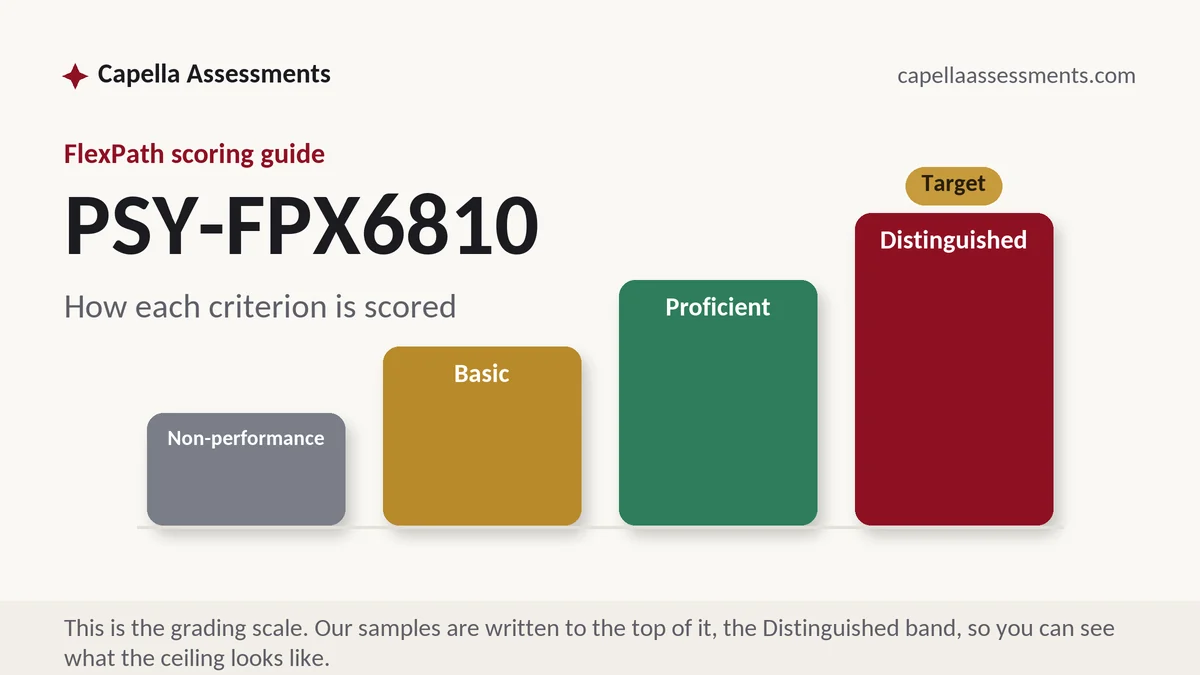
Every sample in this drawer is written the same way our custom ones are: the scoring guide decoded criterion by criterion, a subject-matched writer drafting to the Distinguished column, APA checked line by line, and the reasoning annotated so the paper teaches while it shows. Capella revises scoring guides, so a custom request is always written to the guide in YOUR courseroom, never from a stale template.
PSY-FPX6810 questions, answered
Do I need to be an athlete to write well in PSY-FPX6810?
No, and distance can help. Athletes bring vivid scenarios and also bring the folk explanations the course exists to replace, so they spend energy unlearning. What the criteria measure is whether a performance situation gets explained through researched constructs, and anyone can build a composite athlete to carry that analysis. Playing history supplies color, not credit.
Can I analyze my own athletic experience in these papers?
Usually yes, if your section's instructions allow it, and it works best treated as data rather than testimony. Describe the situation the way you would describe anyone's, apply the construct, and let the theory disagree with how it felt at the time, since that gap is often the most interesting part. Avoid making other real people, coaches or teammates, analyzable characters.
Is there a PSY-FPX6810 Assessment 3 example I can read first?
Yes. Send over the instructions and the scoring guide your courseroom shows for that assessment, and a matching sample comes back, the first one free of charge, normally inside 24-48h. It will analyze an invented athlete, which is exactly the modeling you want, since the reasoning transfers to whatever scenario your section assigned.