Send the exact assignment or rubric from your classroom and a custom sample written to it lands in 24 to 48 hours, the first one free. PSY-FPX6820 is Capella’s Performance Enhancement in Sports course. It centers on the techniques of performance enhancement and the reasoning that matches each one to a specific athlete's problem. Searches like "psy fpx 6820 assessment 3 assignment example", "PSYFPX6820 sample paper", and "PSY-FPX6820 assessment samples" land on this page.
What PSY-FPX6820 is really about
PSY-FPX6820 looks like a toolbox course and is actually a reasoning course wearing one. The tools themselves, imagery, goal setting, self-talk, arousal regulation, pre-performance routines, can be learned from any trade paperback, and papers that stop at describing them earn exactly what description earns. What the assessments measure is the match: given an athlete whose performance breaks in a particular way, which technique addresses that break, why would it, and what does the research say happens when it is used for this purpose? Imagery has one of the deeper evidence bases in the field, but evidence for improving execution is not evidence for managing anxiety, and a writer who cites it interchangeably has read the abstracts and not the findings.
The capstone genre in most sections is the mental skills program, a structured plan that takes one athlete from assessed need to technique to practice schedule to a way of knowing whether anything improved. That last element separates graduate work from magazine work. A program that ends at do visualization has no way to fail, and plans that cannot fail cannot be evaluated, which the scoring guide notices. The athlete in these programs is built, not borrowed: a composite with a specified sport, level, and problem. Where a scenario shades toward clinical territory, disordered eating, depression, trauma, the professional answer is referral, and papers that have their performance consultant treat those conditions are making an ethical error the criteria are entitled to punish.
What PSY-FPX6820’s assessments ask for
Expect the assessments in PSY-FPX6820 to move from technique to program. Early pieces typically take one or two methods, imagery and goal setting are common assignments, and ask for the research behind them: what the technique is understood to do, under what conditions, for which performance demands. A middle assessment usually introduces an athlete scenario and asks for a matched intervention, where the criteria reward the fit between problem and technique more than enthusiasm for either. The later work in many sections is the full program, needs assessment through evaluation plan, written so a reader could implement it session by session. Scoring guides here tend to ask directly for scholarly support per technique, which quietly eliminates the self-help sources most drafts start from.
Where students lose points in PSY-FPX6820
Papers in this course lose points by prescribing before diagnosing, a full technique package delivered to an athlete whose actual problem was never established. Second is the evidence-free how-to, paragraphs of instruction on building an imagery script with nothing showing why imagery is the right call. Third is goal setting reduced to an acronym, filled in mechanically without the research on goal difficulty and feedback that makes the technique work. Marks also go for programs with no evaluation component, for self-talk interventions that amount to think positive, for clinical problems treated instead of referred, and for composite athletes so thin that no matching judgment was possible. The scoring guide reads a program the way a skeptical coach would: what is this for, and how will we know.
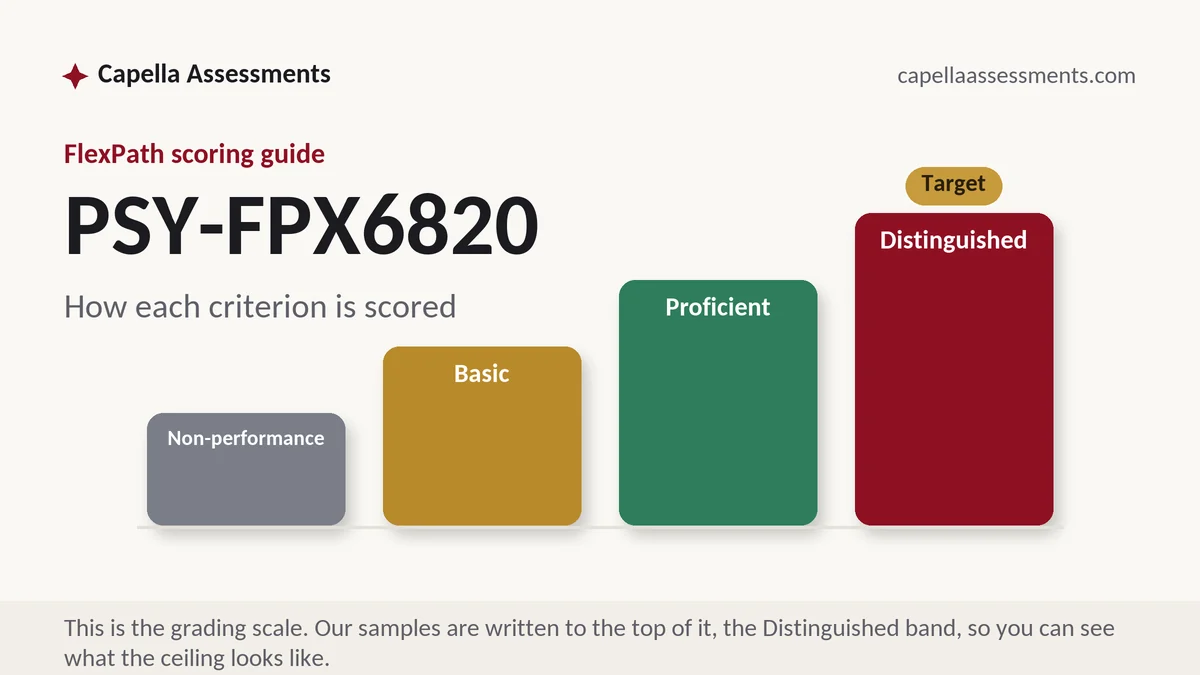
The PSY-FPX6820 drawers
PSY-FPX6820 Assessment 1 technique evidence paper example
Assessment 1 typically examines what the research lets one or two techniques claim. On request, free, 24-48h.
PSY-FPX6820 Assessment 2 matched intervention plan example
Assessment 2 often pairs a composite athlete's specific problem with the method built for it. On request, free, 24-48h.
PSY-FPX6820 Assessment 3 mental skills program example
Assessment 3 usually plans techniques, practice, and an evaluation an athlete could actually follow. On request, free, 24-48h.
Your classroom shows something else?
Capella University revises courses; assessment counts and deliverables shift between terms. Send what your classroom shows and the desk matches it exactly.
Using a PSY-FPX6820 sample the right way
A PSY-FPX6820 sample is best read as a chain of because sentences. This athlete shows this problem, because of that the program leads with this technique, because of the evidence it is practiced this way, and because improvement must be visible it is measured like this. Copy the chain, not the content, since your scenario will differ. Notice also where the sample declines to act and refers instead, because that restraint is scored. To see the genre against your own criteria, send the instructions and scoring guide in; the first custom sample is written free and usually lands within 24-48h.
How these samples are written
Samples here follow one discipline: the scoring guide is the outline, every criterion gets its section, the Distinguished description decides the depth, and the APA layer ships exact. Because Capella updates courses over time, your free custom sample is drafted against the scoring guide you send, not against an archive.
PSY-FPX6820 questions, answered
How do I pick which technique to build my PSY-FPX6820 paper around?
Start from the problem in your scenario, not from the technique you find most interesting. Ask what specifically breaks, execution, focus, arousal, confidence, and then ask which method has evidence against that kind of break. If two qualify, choose the one whose research you can discuss more precisely. The criteria reward the reasoning that connects them more than the choice itself.
Is there a PSY-FPX6820 example of the full mental skills program?
Yes. Provide the assessment instructions and the scoring guide from your section, and a custom sample is built to them, free for the first request and typically returned in 24-48h. It runs a composite athlete from needs assessment through evaluation, so use it for structure and for how evidence is cited per technique, then design around your own scenario.
Can my program borrow from the sports books coaches actually read?
Read them for scenarios and language athletes recognize, but do not let them carry your claims. The scoring guide in most sections asks for scholarly support, and popular books rarely say where their methods came from or when they fail. A clean division works: trade sources may illustrate, peer-reviewed sources must justify. Papers that reverse those roles read confident and score Basic.