Send the exact assignment or rubric from your classroom and a custom sample written to it lands in 24 to 48 hours, the first one free. PSY-FPX7610 is Capella’s Tests and Measurements course. It centers on whether psychological tests measure what they promise, argued from reliability, validity, and norming evidence. Searches like "psy fpx 7610 assessment 3 assignment example", "PSYFPX7610 sample paper", and "PSY-FPX7610 assessment samples" land on this page.
What PSY-FPX7610 is really about
PSY-FPX7610 trains a suspicion that doctoral psychologists are expected to carry for life. Instruments arrive wrapped in persuasive materials, publisher pages, glowing practitioner reviews, decades of habit, and the course teaches writers to walk past all of it to the technical evidence: how reliability was estimated and on whom, what validity evidence exists for this use with this population, when the norms were gathered and from what sample. Context does most of the work. A reliability coefficient that would be admirable for a broad personality inventory can be inadequate for a decision made about one person, and a test with strong evidence for research use can carry none for the high-stakes purpose a scenario proposes. Judging that fit is the course.
Writing about tests has a boundary the rest of psychology does not impose. Test items are protected, by copyright and by test security ethics, because an instrument leaks validity every time its content circulates, so papers in this course describe what a measure covers, cite its manual and the review literature, and never reproduce the items themselves. Samples on this shelf hold that line without exception, and it costs nothing analytically, since the psychometric argument runs on published evidence rather than on quoted content. The other ethical thread is fairness: whether scores carry the same meaning across groups, what a dated or narrow norming sample does to interpretation, and who is qualified to administer what. Doctoral sections tend to score that reasoning as heavily as the statistics.
What PSY-FPX7610’s assessments ask for
Assessments in PSY-FPX7610 typically move from concepts to verdicts. Expect early work explaining the psychometric ideas themselves, forms of reliability, sources of validity evidence, standardization and norming, marked on whether the writer can say what each concept protects a test user from. The course's centerpiece in many sections is a test critique: one published instrument examined against its manual and the independent review literature, ending in a defensible judgment about what the test can be trusted to do. A companion assessment usually poses a selection problem, choosing among candidate measures for a stated purpose and population, where the reasoning matters more than the winner. Ethics of testing, security, competence, fair use with diverse groups, either carries its own assessment or its own criterion, and in current courserooms it is never optional.
Where students lose points in PSY-FPX7610
The classic loss in this course is the critique written from the publisher's catalog, enthusiasm quoted as evidence and no independent source anywhere. Second is coefficient worship, numbers reported as good or strong with no argument about whether they are good for this use, on these people, at these stakes. Third is the boundary broken, sample items reproduced to make a point, which fails an ethics criterion outright and cannot be revised away. Marks also go for validity treated as one thing a test either has or lacks, for norms accepted without a look at the sample behind them, for selection papers that pick the familiar instrument and reason backwards, and for verdicts that refuse to commit. A critique that ends with more research is needed has evaluated nothing.
The PSY-FPX7610 drawers
PSY-FPX7610 Assessment 1 psychometric concepts paper example
Assessment 1 typically explains reliability, validity, and norming as protections for the test user. On request, free, 24-48h.
PSY-FPX7610 Assessment 2 published test critique example
Assessment 2 often evaluates one instrument against its manual and the independent review literature. On request, free, 24-48h.
PSY-FPX7610 Assessment 3 test selection rationale example
Assessment 3 usually defends choosing one measure over rivals for a stated purpose and population. On request, free, 24-48h.
Your classroom shows something else?
Capella University revises courses; assessment counts and deliverables shift between terms. Send what your classroom shows and the desk matches it exactly.
Using a PSY-FPX7610 sample the right way
A PSY-FPX7610 sample earns its keep by showing evidence hierarchy in action. Notice which sources the critique leans on, manual first, independent reviews close behind, publisher marketing nowhere, and how every judgment sentence names the evidence it stands on. Notice equally what is absent: not one test item appears, and the analysis never suffers for it. That pairing, full evaluation with zero reproduction, is the professional skill this course certifies. To see it run against your own assessment, send the instructions and the scoring guide across; the first custom sample is written at no charge and generally lands in 24-48h.
How these samples are written
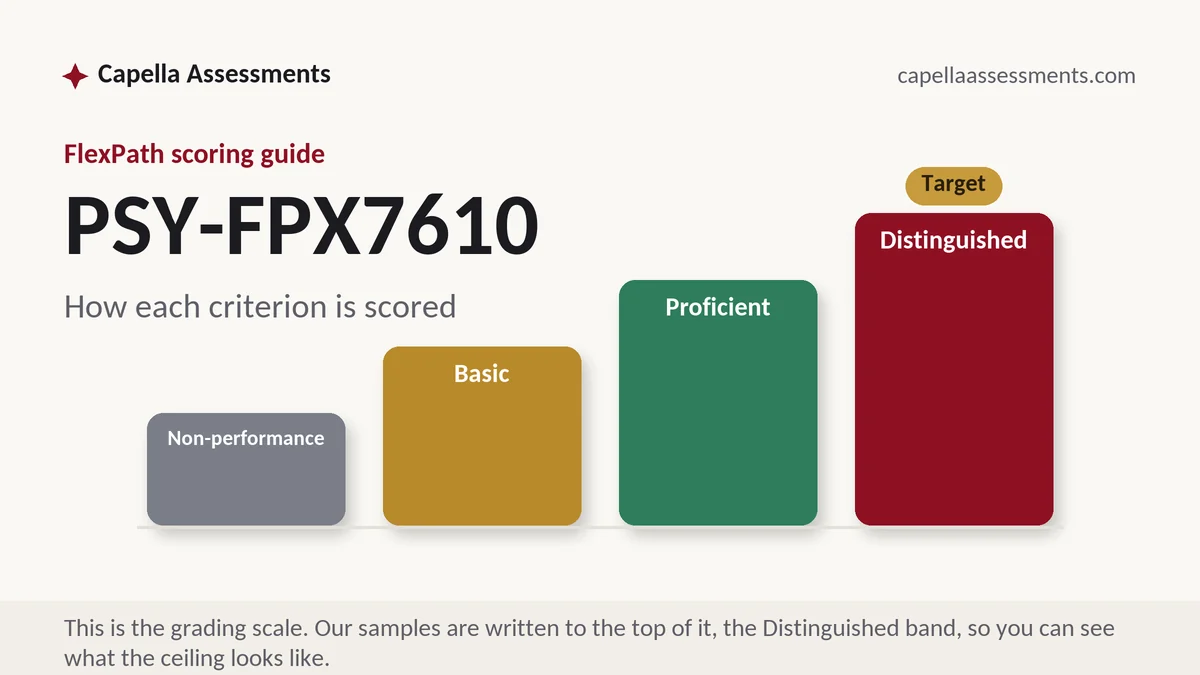
Every sample in this drawer is written the same way our custom ones are: the scoring guide decoded criterion by criterion, a subject-matched writer drafting to the Distinguished column, APA checked line by line, and the reasoning annotated so the paper teaches while it shows. Capella revises scoring guides, so a custom request is always written to the guide in YOUR courseroom, never from a stale template.
PSY-FPX7610 questions, answered
Which test should I choose for my PSY-FPX7610 critique?
Choose one with an independent review trail, not just a manual. Instruments covered in the Mental Measurements Yearbook or the journal literature give you sources to weigh against the publisher's account, which is where critique actually happens. A brand-new or obscure measure leaves you arguing with the manual alone. Confirm your section's rules, since some restrict the list or require approval.
Can a PSY-FPX7610 sample include items from the test it evaluates?
No, and the refusal is the point. Protected instruments stay protected: samples describe constructs and formats, cite the manual and independent reviews, and reproduce nothing item-level, which is the same standard your own paper will be held to. The evaluation loses no force this way. If an assessment seems to require quoted items, reread it; sections ask for description, not disclosure.
How fast can I get a PSY-FPX7610 sample once my assessment opens?
Send the instructions and the scoring guide from your courseroom and the turnaround is normally 24-48h, with the first custom sample free. Faster requests help when the critique is due in stages, since reading a finished evaluation before you commit to an instrument can save you from choosing one whose evidence base cannot support the judgment your paper must make.