Send the exact assignment or rubric from your classroom and a custom sample written to it lands in 24 to 48 hours, the first one free. PSYC-FPX3210 is Capella’s Human Lifespan Development course. It centers on tracing how people change from infancy through late adulthood and what each major developmental theory predicts along the way. Searches like "psyc fpx 3210 assessment 3 assignment example", "PSYCFPX3210 sample paper", and "PSYC-FPX3210 assessment samples" land on this page.
What PSYC-FPX3210 is really about
The span of PSYC-FPX3210 is the whole of a human life, and the scoring guides manage that breadth by grading depth at whatever point you land. A strong paper does not tour the stages. It takes a period, adolescence, the transition to parenthood, late adulthood, and asks what Erikson, Piaget or an attachment account actually predicts there, then holds the prediction against research on real cohorts. Theory stops being a set of names to memorize and becomes an instrument that says something checkable about eight-year-olds or eighty-year-olds. That is the move the criteria reward, and it is the difference between a paper about development and a summary of a chapter about development.
The evidence in this field has a shape worth learning early. Cross-sectional studies compare different people at different ages and quietly mix age effects with generational ones; longitudinal studies follow the same people and take decades to do it. Papers that name which design sits under a claim, and what that design can and cannot show, read as research literate, which is what the upper criteria measure. The other habit is harder: your own childhood is not data. Personal experience can open a question, and some assessments invite it, but the criteria score what the literature shows about people in general, and a paper that generalizes from one remembered life loses exactly where it feels most persuasive.
What PSYC-FPX3210’s assessments ask for
Assessments typically hand you a developmental period or theme and ask for analysis with theory and research behind it. Expect to describe what characterizes the period physically, cognitively and socioemotionally, to apply at least one named theory to it, and to support claims with published findings rather than common knowledge. Some versions work through a case, a described child or adult whose behavior wants explaining; others ask you to compare two theories on the same territory or to follow one domain, such as attachment or identity, across several periods. In many sections the final assessment integrates the span, asking what a lifespan perspective changes about how a single behavior is read. The criteria consistently weight application and evidence over coverage.
Where students lose points in PSYC-FPX3210
The stage tour costs the most marks: every period visited, nothing analyzed, a paper that is all itinerary. Second is autobiography as evidence, a remembered childhood offered where the criterion asked for research on cohorts. Third is theory confusion at the edges, Piaget credited with psychosocial stages or Erikson with conservation, which examiners in this course see often enough to read for. Marks also go for age-graded claims stated without a design behind them, for cross-sectional findings written as though they tracked change in individuals, for the nature-nurture question answered as a slogan on one side, and for socioemotional development left thin because the physical and cognitive strands were easier to source.
The PSYC-FPX3210 drawers
PSYC-FPX3210 Assessment 1 development profile example
Assessment 1 commonly characterizes one period across physical, cognitive and socioemotional domains. On request, free, 24-48h.
PSYC-FPX3210 Assessment 2 theory application paper example
Assessment 2 often puts a named developmental theory to work on case material. On request, free, 24-48h.
PSYC-FPX3210 Assessment 3 lifespan synthesis essay example
Assessment 3 usually follows one theme, such as identity or attachment, across several periods. On request, free, 24-48h.
Your classroom shows something else?
Capella University revises courses; assessment counts and deliverables shift between terms. Send what your classroom shows and the desk matches it exactly.
Using a PSYC-FPX3210 sample the right way
Use a PSYC-FPX3210 sample to see scale handled. Notice how quickly it narrows from the lifespan to a period, and from the period to a claim a theory makes about it. Watch the sentence where a finding is tagged cross-sectional or longitudinal and the conclusion adjusts to fit. Then pick a different period or a different theoretical lens for your own paper, because the narrowing is the transferable part and the territory is wide enough that no two papers need to meet. What the sample cannot give you is the criterion match in your section, which is why it is written to your scoring guide, not to a generic course.
How these samples are written
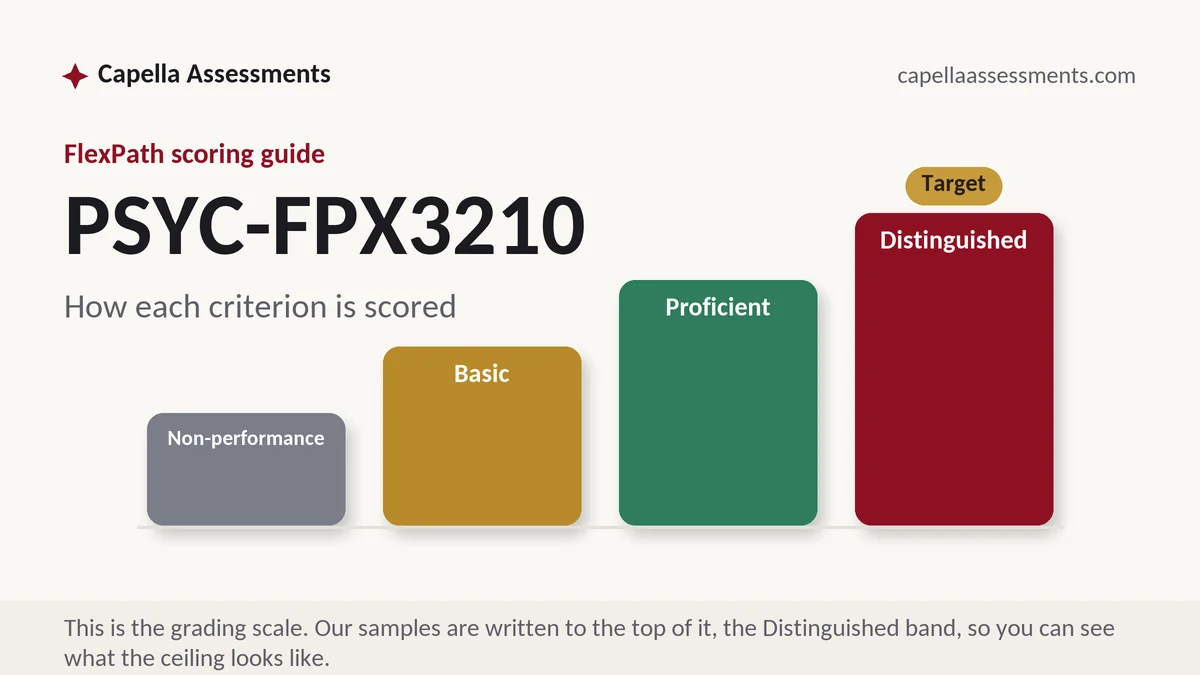
Every sample in this drawer is written the same way our custom ones are: the scoring guide decoded criterion by criterion, a subject-matched writer drafting to the Distinguished column, APA checked line by line, and the reasoning annotated so the paper teaches while it shows. Capella revises scoring guides, so a custom request is always written to the guide in YOUR courseroom, never from a stale template.
PSYC-FPX3210 questions, answered
How fast can I get a PSYC-FPX3210 sample?
The turnaround is usually 24-48h once your assessment instructions and scoring guide arrive, and the first custom sample is free. Speed matters less than the match: a paper written to your section's actual criteria, on the period your instructions name, shows you the expected shape far better than a fast generic essay on development ever could.
Do I have to cover every stage of the lifespan?
Only if your instructions say so, and most do not. The criteria usually reward depth at one period over coverage of all of them, because analysis is what is being scored. Where an assessment does span the whole lifespan, it is generally asking for one theme traced through, not a stage-by-stage inventory. Read the scoring guide before deciding the paper's scope.
Can I use my own children or my own childhood as examples?
As illustration, sometimes; as evidence, no. Some assessments explicitly invite a personal or observed example to anchor the analysis, and used that way it works. The claims themselves still need research behind them, because one life cannot establish what is typical. Check your instructions, and keep any real person you describe unidentifiable.