Send the exact assignment or rubric from your classroom and a custom sample written to it lands in 24 to 48 hours, the first one free. PSYC-FPX4101 is Capella’s History, Systems, and Contemporary Psychology course. It centers on reading psychology's schools as competing answers to shared questions and tracing their reach into what psychologists do now. Searches like "psyc fpx 4101 assessment 3 assignment example", "PSYCFPX4101 sample paper", and "PSYC-FPX4101 assessment samples" land on this page.
What PSYC-FPX4101 is really about
PSYC-FPX4101 is mistaken for a memory exercise, names and dates in order, and graded as an analysis course, which is the gap most submissions fall into. The systems in this course were arguments: about what psychology should study, what counts as evidence, and whether the mind is a legitimate scientific object. A strong paper keeps the argument alive, showing what structuralism claimed that functionalism denied, what behaviorism refused to discuss and why the cognitive revolution made discussing it respectable again. Chronology then becomes scaffolding instead of content. The criteria reward papers where a school's position could be stated by someone who held it, and where its decline is explained by pressures rather than by fashion.
The contemporary half of the title carries the harder criteria. It is not enough to end each section with a sentence noting that echoes remain; the assessment wants the line traced into present practice, behavioral principles operating inside modern therapy, psychoanalytic ideas surviving in attenuated forms the original school would barely recognize, cognitive frameworks structuring the research your other courses cite. Context matters too, and the strongest submissions read the systems inside their historical moment, including who was included in and excluded from the discipline's early history, handled as analysis rather than as ornament. Sources should reach past the textbook to primary or historical scholarship where the criteria ask for depth, because a survey chapter cannot adjudicate an argument.
What PSYC-FPX4101’s assessments ask for
Assessments generally ask you to compare systems, trace development, or connect a historical school to contemporary psychology, and sometimes all three across the shelf. Expect to characterize each school by its core claims, its method and its notion of evidence, to compare schools on shared questions rather than in sequence, and to argue continuity or break with support. Some versions center a single system and its arc; others assign a contemporary practice or debate and ask where it came from. In many sections the final assessment synthesizes, asking what the discipline's history implies about where it is going, which is scored on the quality of the throughline rather than on prediction. Criteria across versions weight argument, accuracy and connection over coverage of every name.
Where students lose points in PSYC-FPX4101
The timeline paper takes the largest loss, accurate, sequenced and argument-free, a corridor of portraits nobody speaks in. Second is caricature, behaviorism reduced to rats, psychoanalysis to one couch, which turns comparison into shadowboxing. Third is the missing present, history recounted without a single traced line into contemporary practice, forfeiting the criteria the course is named for. Marks also go for schools compared on different dimensions so nothing meets, for anachronism, judging early systems by standards they predate, for the discipline's exclusions ignored where the criteria raise them, and for textbook-only sourcing on assessments that ask for depth. Papers that merely admire the history score under papers that argue with it.
The PSYC-FPX4101 drawers
PSYC-FPX4101 Assessment 1 school of thought analysis example
Assessment 1 typically characterizes one system through its claims, method and evidence standard. On request, free, 24-48h.
PSYC-FPX4101 Assessment 2 comparative systems essay example
Assessment 2 often sets two schools against the same questions and adjudicates. On request, free, 24-48h.
PSYC-FPX4101 Assessment 3 contemporary connection paper example
Assessment 3 usually traces historical systems into present research and practice. On request, free, 24-48h.
Your classroom shows something else?
Capella University revises courses; assessment counts and deliverables shift between terms. Send what your classroom shows and the desk matches it exactly.
Using a PSYC-FPX4101 sample the right way
Read a PSYC-FPX4101 sample for its throughlines, the questions that persist while answers change, because the throughline is what converts sequence into analysis. Watch each school get characterized strongly enough that its position could be defended, then challenged by the next on stated grounds. Notice where the paper lands in the present and how specific the landing is. Then choose different schools or a different contemporary endpoint for your own work; the century of material offers more pairings than any two papers need to share. What a matched sample adds is your section's balance between historical depth and contemporary connection, which scoring guides weight differently across courserooms.
How these samples are written
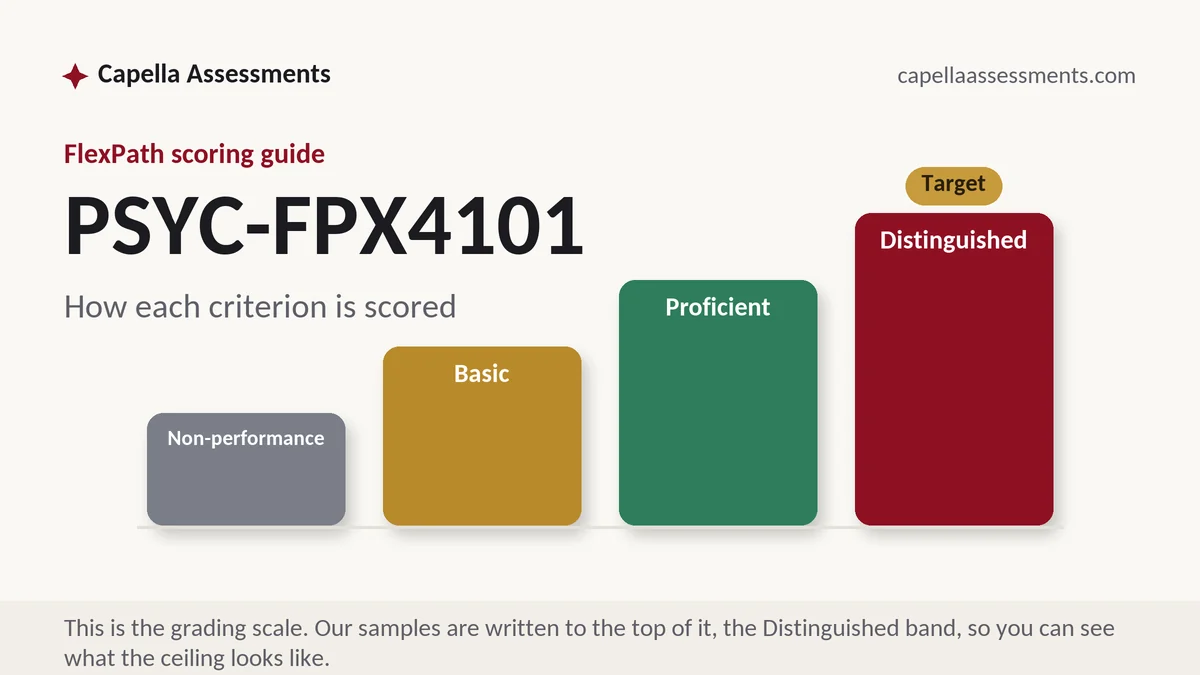
Every sample in this drawer is written the same way our custom ones are: the scoring guide decoded criterion by criterion, a subject-matched writer drafting to the Distinguished column, APA checked line by line, and the reasoning annotated so the paper teaches while it shows. Capella revises scoring guides, so a custom request is always written to the guide in YOUR courseroom, never from a stale template.
PSYC-FPX4101 questions, answered
Is there a PSYC-FPX4101 Assessment 3 example I can look at?
Yes, produced against the instructions and scoring guide you send rather than drawn from a file of old essays, and normally delivered within 24-48h, first request free. Final assessments in this course tend to be synthesis pieces, so the sample is built to show integration across systems, which is where the criteria concentrate their weight.
How many schools of psychology should one paper cover?
As many as your instructions name and no more than the argument can hold. Two systems compared closely on shared questions consistently outscore five summarized in sequence, because comparison is what the criteria measure. Where an assessment does require breadth, give the schools a common set of dimensions so the sections speak to each other rather than past each other.
Do I need primary sources for a history course?
Check your scoring guide; requirements vary by section. Where depth is asked for, reading a school through its own texts or through historical scholarship strengthens the paper visibly, because textbook summaries flatten the disagreements the assessment wants you to work with. Even one primary voice per system, quoted briefly and accurately, changes how the analysis reads.