Send the exact assignment or rubric from your classroom and a custom sample written to it lands in 24 to 48 hours, the first one free. PSYC-FPX4110 is Capella’s Positive Psychology course. It centers on treating wellbeing as a measurable research area with real but modest effects, not as encouragement in academic dress. Searches like "psyc fpx 4110 assessment 3 assignment example", "PSYCFPX4110 sample paper", and "PSYC-FPX4110 assessment samples" land on this page.
What PSYC-FPX4110 is really about
No course in the major sits closer to the self-help shelf, and none is easier to fail by sounding like it. PSYC-FPX4110 scoring guides consistently reward the move the popular versions skip: asking how a construct is measured before asking what improves it. Subjective wellbeing, gratitude, optimism and flow all have instruments, operational definitions and psychometric arguments behind them, and a paper that opens with the measurement question immediately reads a level above one that opens with a definition of happiness. From there the evidence can be weighed honestly, which in this field means reporting that intervention effects are typically real, typically modest, and typically fragile across samples, a sentence that earns more than any amount of enthusiasm.
The field's own history is part of the material. Positive psychology announced itself as a corrective and then spent years absorbing corrections, replication struggles around some of its flagship findings, criticism of its early claims about ratios and formulas, ongoing argument about whether its interventions outperform placebo-grade attention. The criteria at this level expect you to know that arc and use it, evaluating a gratitude or strengths intervention against the current literature rather than the founding rhetoric. Cultural boundedness matters here too, since what counts as flourishing is not uniform across populations, and papers that carry that limit into their conclusions demonstrate exactly the calibrated register the course is quietly grading for.
What PSYC-FPX4110’s assessments ask for
Assessments generally ask you to analyze a wellbeing construct, evaluate an intervention, or design an application with the research base in view. Construct versions want measurement discussed, the main findings characterized fairly, and limits stated. Intervention versions want the evidence weighed, effect sizes and follow-up durability included where the literature reports them, and a recommendation scaled to what the studies actually found. Application versions, common as final assessments, ask you to bring positive psychology to a setting, a workplace, a school, a personal domain, and are scored on whether the plan stays tethered to evidence when the temptation is to inspire. Across versions in current courserooms, a respectful, non-clinical register is expected wherever wellbeing shades toward mental health.
Where students lose points in PSYC-FPX4110
The self-help paper is the signature loss, warm, quotable and unfalsifiable, with claims no study could contradict and none is asked to support. Second is the founding-rhetoric problem, early field claims repeated as settled findings when the replication record has complicated them. Third is the missing measurement question, constructs discussed for pages with no mention of how anyone quantifies them. Marks also go for intervention effects reported without size or durability, for cultural limits ignored in universal-sounding conclusions, for wellbeing advice drifting toward clinical territory the assessment did not ask for, and for sources drawn from trade books when the journal literature is the whole point of writing in this field at this level.
The PSYC-FPX4110 drawers
PSYC-FPX4110 Assessment 1 construct evaluation essay example
Assessment 1 typically examines how one wellbeing construct is defined, measured and evidenced. On request, free, 24-48h.
PSYC-FPX4110 Assessment 2 intervention review example
Assessment 2 often weighs the research behind a named positive psychology intervention. On request, free, 24-48h.
PSYC-FPX4110 Assessment 3 applied wellbeing plan example
Assessment 3 usually brings the evidence into a specific setting with claims kept modest. On request, free, 24-48h.
Your classroom shows something else?
Capella University revises courses; assessment counts and deliverables shift between terms. Send what your classroom shows and the desk matches it exactly.
Using a PSYC-FPX4110 sample the right way
Read a PSYC-FPX4110 sample for temperature control, the way it stays warm enough for the subject and cool enough for the evidence. Notice the measurement question arriving early, effect sizes doing the evaluative work, and conclusions that would survive a skeptical reader. Then apply the same controls to a different construct or setting in your own paper, because the field is wide and your section's scoring guide, not the sample's topic, sets what yours must cover. The transferable part is the calibrated register, claims sized to studies, and that is precisely the skill the popular literature on this subject will never teach you.
How these samples are written
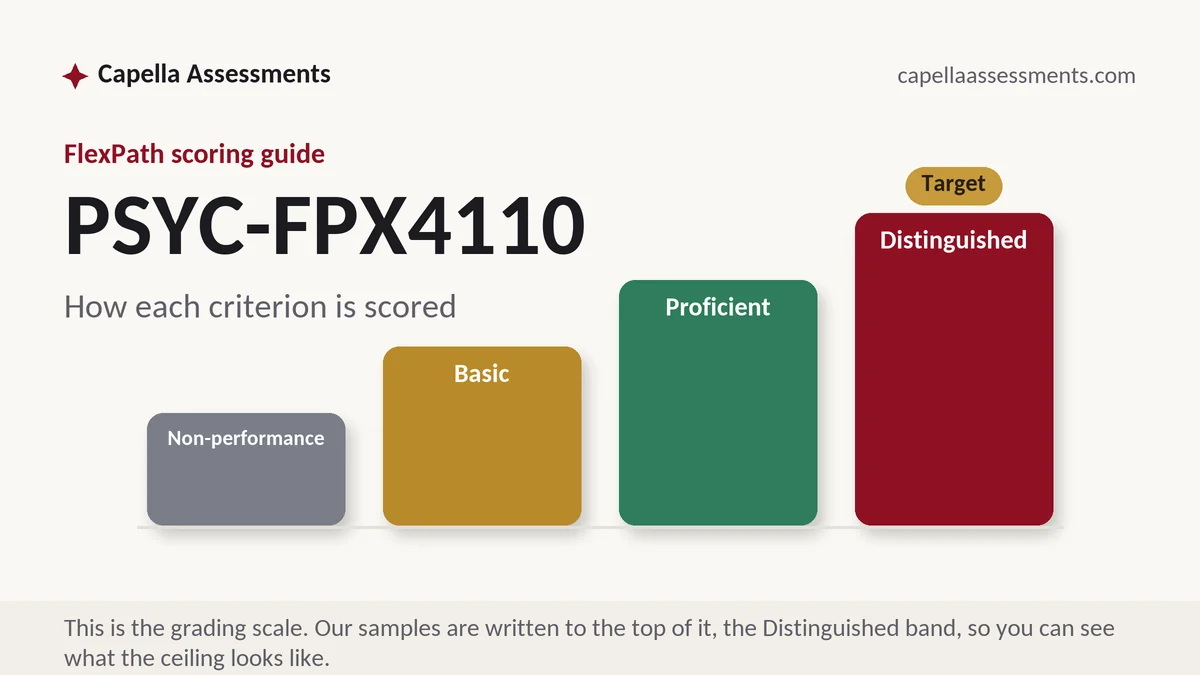
Samples here follow one discipline: the scoring guide is the outline, every criterion gets its section, the Distinguished description decides the depth, and the APA layer ships exact. Because Capella updates courses over time, your free custom sample is drafted against the scoring guide you send, not against an archive.
PSYC-FPX4110 questions, answered
How do I request a PSYC-FPX4110 sample paper?
Send the assessment instructions and scoring guide from your courseroom, name any setting your section's application requires, and a matched example comes back within 24-48h in most cases, without charge the first time. Positive psychology criteria vary widely between sections, some empirical, some applied, so the match to your documents matters more here than in most courses.
Can I say a positive psychology intervention works?
You can report what the evidence shows, with its size attached. Several interventions have support in meta-analytic work, with effects that are generally modest and vary by population and follow-up length. A claim written that way satisfies the evidence criteria; an unqualified declaration that gratitude journaling transforms wellbeing belongs to the trade literature and gets scored accordingly.
Is it a problem that this field has replication issues?
For the field, an ongoing argument; for your paper, an opportunity. Assessments at this level reward students who know which findings have held, which have shrunk and which remain contested, because that knowledge is research literacy in action. Citing the replication record where it is relevant strengthens almost any evaluation this course asks you to make.