Send the exact assignment or rubric from your classroom and a custom sample written to it lands in 24 to 48 hours, the first one free. PSYC-FPX4900 is Capella’s Psychology Capstone Project course. It centers on bringing the whole psychology program to bear on one question, with synthesis and evidence discipline scored above coverage. Searches like "psyc fpx 4900 assessment 3 assignment example", "PSYCFPX4900 sample paper", and "PSYC-FPX4900 assessment samples" land on this page.
What PSYC-FPX4900 is really about
A capstone is not a longer course paper, and PSYC-FPX4900 scoring guides read for the difference. The courses behind you each taught a competency in isolation; this project is graded on whether they operate together without being announced. Theory frames the question, methods literacy decides which studies deserve weight, statistics reads their findings honestly, and ethics shapes what the project will and will not claim, all inside one argument about one focused psychological problem. The failure the criteria catch most reliably is the inventory, a paper that name-checks each prior course the way a resume lists jobs. Integration is shown by use: the reader should see a psychologist thinking, not a transcript summarizing itself.
Restraint is the other capstone competency, and it is scored harder here than anywhere earlier in the program. After sustained work on a topic, the pull is to conclude beyond the evidence, and a synthesis that claims more than its reviewed studies support fails at exactly the level the degree was building toward. Strong projects weigh their sources rather than count them, reconcile findings that disagree instead of quoting past the conflict, and write limitations as analysis, what the evidence base cannot yet say and why, rather than as ritual modesty. The literature review is an argument with a shape, organized by what is known and contested, and the conclusion is its verdict, sized precisely.
What PSYC-FPX4900’s assessments ask for
In current courserooms the capstone sequence typically moves from proposal to execution to presentation of a sustained project on a question you choose within program guidelines. Early assessments ask you to define the problem, justify its psychological significance, and plan the work. The central assessments want the project itself, most often an integrative review or applied analysis, with sources evaluated methodologically rather than summarized, competing findings adjudicated, and theory doing visible work. Late assessments usually ask you to present or translate the project for an audience and to reflect on the competencies it demonstrates, tied to program outcomes. Across the sequence, the criteria reward coherence of the whole over polish of any part, because the whole is what a capstone certifies.
Where students lose points in PSYC-FPX4900
Capstone losses are architectural before they are local. The survey project fails first, a broad topic toured instead of a focused question argued, which makes synthesis impossible from the outset. Second is the inventory of competencies, prior coursework cited as topics covered rather than used as instruments. Third is the overclaimed conclusion, a verdict the reviewed evidence cannot carry, penalized here precisely because everything in the program argued against it. Marks also go for literature reviews organized study-by-study instead of by finding, for methodological quality ignored in source selection, for disagreement between studies quoted around rather than resolved, and for reflection sections that assert growth without evidence from the project itself. At this level, the criteria read the argument's discipline as the achievement.
The PSYC-FPX4900 drawers
PSYC-FPX4900 Assessment 1 capstone proposal example
Assessment 1 typically defines the question, its significance and the plan for the project. On request, free, 24-48h.
PSYC-FPX4900 Assessment 2 integrative project paper example
Assessment 2 often delivers the sustained review or applied analysis itself. On request, free, 24-48h.
PSYC-FPX4900 Assessment 3 presentation and reflection piece example
Assessment 3 usually translates the project for an audience and evidences program outcomes. On request, free, 24-48h.
Your classroom shows something else?
Capella University revises courses; assessment counts and deliverables shift between terms. Send what your classroom shows and the desk matches it exactly.
Using a PSYC-FPX4900 sample the right way
Read a PSYC-FPX4900 sample for architecture rather than content: how narrow the question is, how the review is organized by findings and their quality, where earlier competencies surface as tools, and how far short of certainty the conclusion deliberately stops. Those decisions are the capstone, and they transfer to any topic; the material does not. Your project should ask a question the sample never touches, chosen from your own interests within your section's guidelines, because a capstone's value to you and its credibility to a grader both come from the same place. A matched example mostly teaches proportion, how much space each component earns, which guidelines alone rarely convey.
How these samples are written
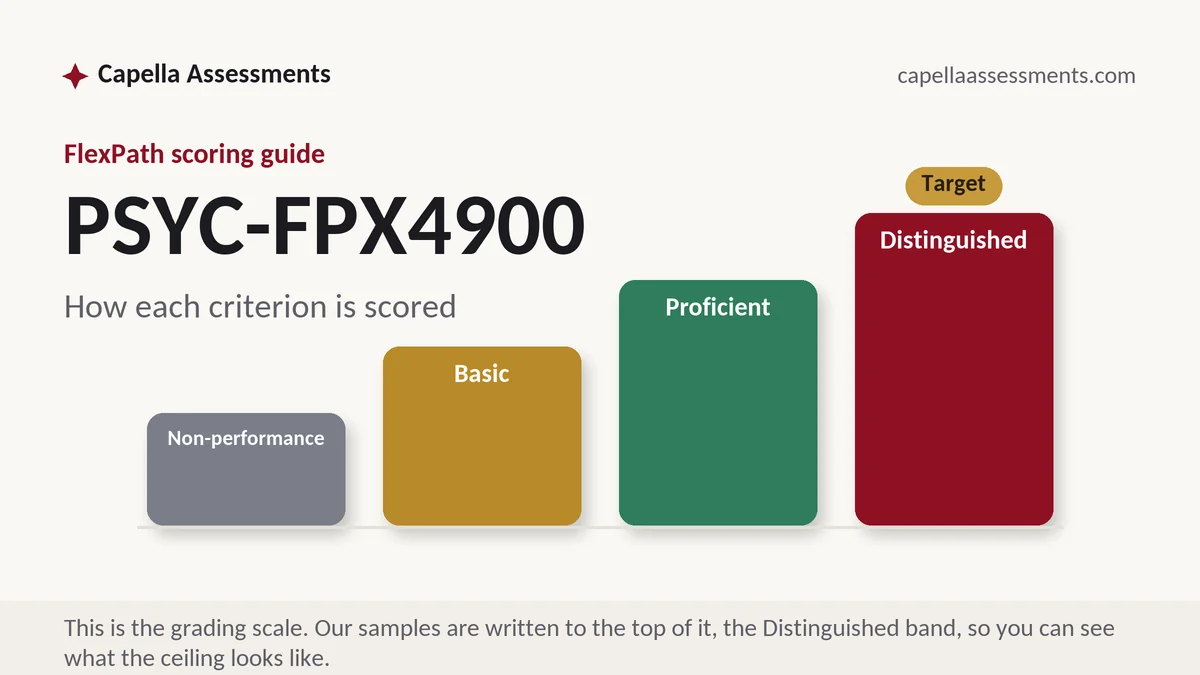
Samples here follow one discipline: the scoring guide is the outline, every criterion gets its section, the Distinguished description decides the depth, and the APA layer ships exact. Because Capella updates courses over time, your free custom sample is drafted against the scoring guide you send, not against an archive.
PSYC-FPX4900 questions, answered
How fast can I get a PSYC-FPX4900 capstone sample?
Capstone samples follow the same 24-48h window in most cases, free on first request, written to the project guidelines and scoring guide your section provides. Send the assessment you are on, proposal, project or presentation stage, because each is scored differently, and a sample matched to the wrong stage of the sequence teaches the wrong lessons.
How is the capstone graded differently from earlier papers?
On integration and discipline more than on any single skill. The criteria look for prior competencies used together, sources weighed by methodological quality, disagreements in the literature resolved rather than avoided, and conclusions held inside the evidence. A technically clean paper that never synthesizes will score below a rougher one that genuinely argues one question through.
Can I reuse work from my earlier psychology courses?
Your section's policy and Capella's academic honesty rules decide what may be reused, so check before importing anything. What the capstone rewards in any case is not recycled text but earlier learning redeployed, a methods eye applied to new sources, a theory reused as a lens on a new question. Bring the competencies forward; let the words be new.