Send the exact assignment or rubric from your classroom and a custom sample written to it lands in 24 to 48 hours, the first one free. RSCH-FPX7864 is Capella’s Quantitative Design and Analysis course. It centers on running and interpreting the standard quantitative tests, from correlation through ANOVA, in the language a dissertation will require. Searches like "rsch fpx 7864 assessment 3 assignment example", "RSCHFPX7864 sample paper", and "RSCH-FPX7864 assessment samples" land on this page.
What RSCH-FPX7864 is really about
The work of RSCH-FPX7864 happens in two places: in the software, where provided datasets get analyzed with the standard tests, and on the page, where the output becomes prose a scholar could publish. Most learners have trouble in the second place. The software will produce a table for anyone; the criteria ask which numbers in it matter, what the test assumed about the data, and what may now be claimed at the stated alpha, no more and no less. A results paragraph in this course is a genre with rules, statistic, degrees of freedom, probability, effect size, direction, and the scoring guide checks the rules the way an editor would. Interpretation earns marks; enthusiasm about significance loses them.
The sequence typically builds from descriptive statistics and correlation through group comparisons to regression, one family of tests per assessment, each on data the courseroom supplies. That supplied data is the point: the course isolates analysis and reporting so that design questions wait for their own courses. A sample here shows the shape of that reporting, how an assumption check is documented, how a null result is written without apology, how the table and the paragraph beneath it split the labor. The analysis of your own dissertation data, like the data itself, your participants and your IRB submission, remains your work and is never drafted for you. What transfers from a sample is the discipline of saying exactly what a test showed.
What RSCH-FPX7864’s assessments ask for
Assessments generally follow a fixed rhythm: load the provided dataset, state the hypotheses, check the assumptions for the named test, run it, and report. Expect a correlation assessment early, group comparisons through t-tests and ANOVA in the middle, and in many sections a closing assessment on regression or on choosing among tests. The reporting criteria are usually the strictest part of the scoring guide: exact statistical notation, an effect size with its interpretation, and a plain-language sentence stating what the finding means for the scenario attached to the data. Where an assumption fails, the criteria want the failure named and handled, not hidden. Screenshots or pasted tables typically accompany the narrative, and the narrative is expected to stand on its own if the tables were removed.
Where students lose points in RSCH-FPX7864
Losses here are precise. The uninterpreted output leads: a correct table pasted, a paragraph that restates its cells, and no sentence saying what may now be concluded. Second is the significance-only reading, where a p-value below the threshold is treated as importance and the effect size sits unreported one column away. Third is the assumption skipped, normality and variance never checked, which turns every downstream number into a guess wearing decimals. Points also go to hypotheses stated after the test rather than before it, to the wrong test chosen for the measurement level, to notation that drifts from the required style, and to conclusions that quietly promote an association into an effect, a promotion no test in this course can authorize.
The RSCH-FPX7864 drawers
RSCH-FPX7864 Assessment 1 correlation analysis example
Assessment 1 typically reports descriptives and correlation with the output read precisely. On request, free, 24-48h.
RSCH-FPX7864 Assessment 2 group comparison write-up example
Assessment 2 often runs t-tests or ANOVA and writes the finding in exact notation. On request, free, 24-48h.
RSCH-FPX7864 Assessment 3 regression results section example
Assessment 3 usually builds a regression and bounds what the model may claim. On request, free, 24-48h.
Your classroom shows something else?
Capella University revises courses; assessment counts and deliverables shift between terms. Send what your classroom shows and the desk matches it exactly.
Using a RSCH-FPX7864 sample the right way
Put a sample beside your own draft and compare the results paragraphs sentence by sentence. Where the sample names the test, the statistic and the effect size in one motion, mark whether yours does, and where the sample declines to conclude beyond the data, notice the wording that does the declining. Those sentences are reusable as architecture even though your numbers and your dataset will differ. Run the analysis yourself in the software before reading the sample's tables, because recognizing correct output teaches more than copying it. The first custom sample is free, matched to the dataset and scoring guide your courseroom actually uses, and returned within 24-48 hours.
How these samples are written
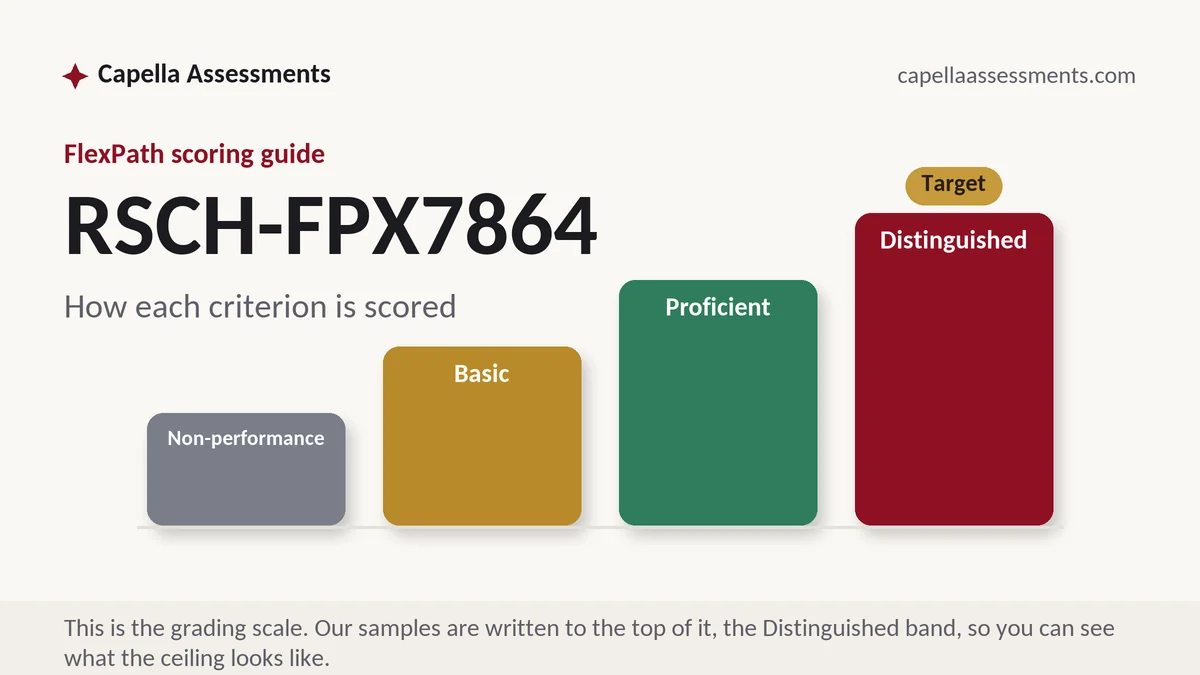
Samples here follow one discipline: the scoring guide is the outline, every criterion gets its section, the Distinguished description decides the depth, and the APA layer ships exact. Because Capella updates courses over time, your free custom sample is drafted against the scoring guide you send, not against an archive.
RSCH-FPX7864 questions, answered
Can an RSCH-FPX7864 example use the dataset my section provides?
Yes, and it should. Send the dataset, the assessment instructions and the scoring guide, and the sample runs the required analysis on those exact variables, so every table you see corresponds to numbers you can reproduce yourself in the software. That correspondence is what makes a statistics sample worth studying. First custom sample free, returned within 24-48 hours.
My last statistics course was years ago. Will a doctoral sample assume too much?
The samples are written to be read by someone returning to statistics, because that describes most doctoral learners in this course. Nothing is skipped as obvious: the hypothesis is stated, the assumption checks are shown, and every symbol in the results notation gets used consistently enough to be learned by pattern. Rust responds quickly to seeing one analysis done completely.
Do RSCH-FPX7864 samples include the assumption checks or only the main test?
Always the checks, because scoring guides in this course usually carry a criterion for them and because skipping them is the most expensive shortcut in quantitative work. The sample documents what was checked, what the result was, and what would have changed had a check failed, which is the part most write-ups omit and most graders look for.