Send the exact assignment or rubric from your classroom and a custom sample written to it lands in 24 to 48 hours, the first one free. BHA-FPX2002 is Capella’s Evolution of Healthcare Delivery in the United States course. It centers on explaining a feature of today's delivery system by the decisions and legislation that produced it. Searches like "bha fpx 2002 assessment 3 assignment example", "BHAFPX2002 sample paper", and "BHA-FPX2002 assessment samples" land on this page.
What BHA-FPX2002 is really about
The trap in BHA-FPX2002 is that it looks like a history course and is scored like an analysis course. Listing the milestones of American healthcare accurately earns very little, because the criteria ask what those milestones explain. A strong paper picks something a reader can see in a hospital today, a payer mix, an ownership pattern, a regulatory burden, and traces it back to the decisions that created it. History becomes evidence rather than content, and dates appear because they anchor a causal claim rather than because they belong on a timeline. The scoring guides reward that move explicitly and punish the alternative, because a chronology can be assembled from any survey text while a causal argument has to be built.
That shift changes what a source is for. A textbook chapter establishes the sequence, but the marks live in the connection between the sequence and the present situation, so citations belong at the causal claims. It also changes the shape of the paper: instead of moving forward through decades, the strongest submissions start from the current feature and work backward to the moment it became inevitable. Because this is an early bachelor's course, formatting and citation mechanics carry real weight in the scoring guide, and they are the cheapest marks in the course to lose. Where a claim is contested among historians or economists, saying so is treated as strength rather than hedging, since an argument that acknowledges its own soft joints reads as considered.
What BHA-FPX2002’s assessments ask for
Assessments generally ask you to identify a development in healthcare delivery and explain its ongoing consequences. That means naming the development precisely, establishing when and why it happened with sources, and then showing what it produced that a healthcare manager still deals with. Where the criteria ask for comparison, the comparison has to be structured rather than impressionistic, using the same dimensions on both sides. Most versions also want a forward-looking element: what the trajectory suggests about the next decade, argued from what the history actually shows rather than from general optimism about technology or reform. Where a source disagrees with the account you are giving, addressing it directly earns more than omitting it, because the criteria reward a defended reading over an uncontested one.
Where students lose points in BHA-FPX2002
Points go first to the timeline paper, which is accurate, well sourced and never argues anything. Second is the consequence asserted rather than traced, where a development is described and its modern effect stated with no mechanism between them. Third is the source used for atmosphere, cited at the end of a paragraph that makes several distinct claims. Beyond those, marks go for developments chosen so broadly that nothing specific can be said, for comparisons that change dimensions halfway through, and for APA errors in a course whose scoring guide reads them closely because the program is still building the habit. Papers also lose marks for describing consequences at the level of the country when the assessment asked about an organization, which leaves a healthcare manager nothing they could act on.
The BHA-FPX2002 drawers
BHA-FPX2002 Assessment 1 historical analysis example
Assessment 1 typically establishes one development and the conditions that produced it. On request, free, 24-48h.
BHA-FPX2002 Assessment 2 comparative analysis example
Assessment 2 often sets two eras or two systems against the same dimensions. On request, free, 24-48h.
BHA-FPX2002 Assessment 3 trends paper example
Assessment 3 usually asks what the trajectory implies for healthcare management now. On request, free, 24-48h.
Your classroom shows something else?
Capella University revises courses; assessment counts and deliverables shift between terms. Send what your classroom shows and the desk matches it exactly.
Using a BHA-FPX2002 sample the right way
Read a sample for its direction of travel. Notice that the paper starts from something visible today and works back, rather than starting in 1965 and working forward, and watch where a citation is placed to support a causal step rather than a fact. Then build your own from a development that genuinely interests you, because the historical material is widely available and the argument is what the criteria measure. What transfers is the shape: present feature, historical cause, mechanism between them, and consequence a manager would recognise. Notice too how little space the sample gives to background before it argues, which is the difference between a paper that reads as analysis and one that reads as a report.
How these samples are written
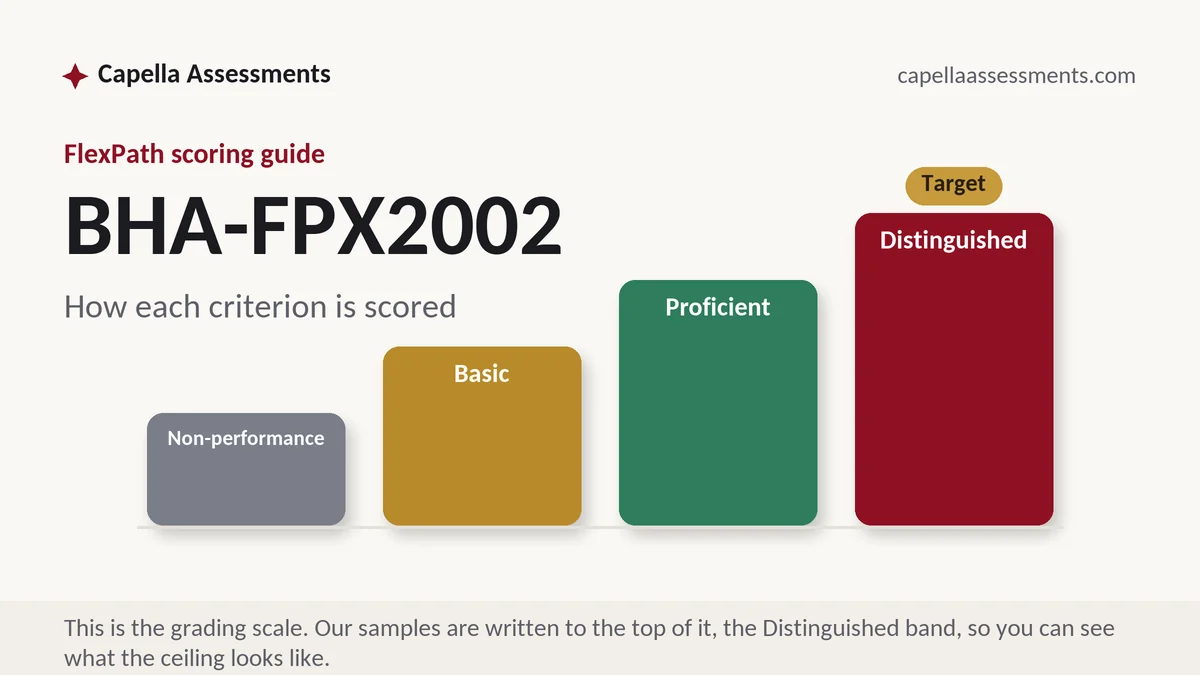
Samples here follow one discipline: the scoring guide is the outline, every criterion gets its section, the Distinguished description decides the depth, and the APA layer ships exact. Because Capella updates courses over time, your free custom sample is drafted against the scoring guide you send, not against an archive.
BHA-FPX2002 questions, answered
How far back does the history need to go?
Only as far as the causal chain requires. A paper that reaches 1965 because Medicare genuinely explains the feature under discussion is doing the work; one that opens with colonial almshouses because it feels thorough is padding. Depth of causation earns marks, breadth of chronology does not. A tight causal chain reaching back two decades will outscore a broad sweep reaching back two centuries.
Can I write about something from my own workplace?
Yes, and it usually produces a sharper paper. A billing pattern, a staffing model or a regulatory burden you actually deal with gives the analysis a concrete endpoint. Keep the organisation unidentifiable and describe the feature rather than the employer. Describe the process rather than the place, and the paper stays both specific and appropriately anonymous.
Is a textbook an acceptable source here?
For the sequence of events, generally yes, and the scoring guide usually permits it. Where the paper makes a causal claim about consequences, stronger sourcing helps, because that is the part being marked. Place citations at the claims rather than at the ends of paragraphs. Where the claim is contested, a second source arguing the other way strengthens rather than weakens the paper.