Send the exact assignment or rubric from your classroom and a custom sample written to it lands in 24 to 48 hours, the first one free. BHA-FPX3008 is Capella’s Financial Management for Healthcare Organizations course. It centers on reading a healthcare budget closely enough to say which operational decision produced each variance. Searches like "bha fpx 3008 assessment 3 assignment example", "BHAFPX3008 sample paper", and "BHA-FPX3008 assessment samples" land on this page.
What BHA-FPX3008 is really about
BHA-FPX3008 is the first course in the program where a paper can be marked wrong rather than weak. A budget that does not foot, a variance calculated against the wrong base, a margin that ignores payer mix: these are errors a scorer can find in thirty seconds, and no amount of good writing recovers them. So the arithmetic comes first and gets checked. What separates a strong submission from a merely correct one is the second half, where the numbers are interpreted. A variance is not an explanation, it is a question, and the criteria reward the answer rather than the observation that a line came in over.
Interpretation in healthcare finance means connecting a figure to a decision somebody made. Overtime that ran hot because a vacancy went unfilled is a staffing decision. Supply cost per case that drifted is a purchasing or a practice pattern decision. The strongest papers name the decision and say who owns it, because that is what turns a finance document into something a manager can act on. Where the assessment involves recommendations, they should follow from the specific variances identified rather than from general principles about cost control, and each should say what it would save and over what period. Where the assessment supplies several periods, the trend matters more than any single month, since one bad month is noise and three in the same direction is a management problem.
What BHA-FPX3008’s assessments ask for
Assessments generally supply financial data and ask you to analyze it. That means computing what the instructions require accurately, presenting it so a reader can follow the calculation, and then explaining what it shows about how the department is being run. Where budgeting is the focus, expect assumptions to be stated explicitly, since a budget without visible assumptions cannot be evaluated. Variance work wants both the figure and the driver. Most versions close with recommendations, which are scored on whether they address the variances the analysis actually found and whether their financial effect is estimated rather than asserted. Where the criteria ask for a comparison against benchmark, the source of the benchmark matters, because a national figure applied to a department with a different case mix will mislead in a direction the paper should name.
Where students lose points in BHA-FPX3008
The most expensive errors are arithmetic, because they are unambiguous and they undermine everything built on them. Second is the variance reported without a driver, which describes the number the reader can already see. Third is the recommendation with no figure attached, proposing to reduce overtime or renegotiate supply contracts without saying by how much or what that yields. Marks also go for budgets whose assumptions are invisible, for analyses that ignore payer mix where it clearly drives the result, and for tables presented without any narrative, leaving the interpretation criteria unaddressed even though the data is all present. Papers also lose marks for rounding inconsistently across a table, which looks minor and signals to a scorer that the figures were assembled rather than computed.
The BHA-FPX3008 drawers
BHA-FPX3008 Assessment 1 budget analysis example
Assessment 1 typically works a departmental budget and the assumptions behind it. On request, free, 24-48h.
BHA-FPX3008 Assessment 2 variance report example
Assessment 2 often asks which operational decision produced each variance. On request, free, 24-48h.
BHA-FPX3008 Assessment 3 financial recommendation example
Assessment 3 usually wants actions with their financial effect estimated. On request, free, 24-48h.
Your classroom shows something else?
Capella University revises courses; assessment counts and deliverables shift between terms. Send what your classroom shows and the desk matches it exactly.
Using a BHA-FPX3008 sample the right way
Read a sample for the join between the table and the prose. Watch how each figure that matters gets a sentence saying what produced it, and notice that the recommendations quantify their own effect rather than gesturing at savings. Check the arithmetic as you read, because doing that once on a worked example builds the habit that protects your own submission. Then run your own numbers, since the calculation is the part the scoring guide can verify and the part a sample cannot do for you. Watch as well for how the sample labels its assumptions inside the table rather than burying them in prose, which is what lets a reader audit the calculation quickly.
How these samples are written
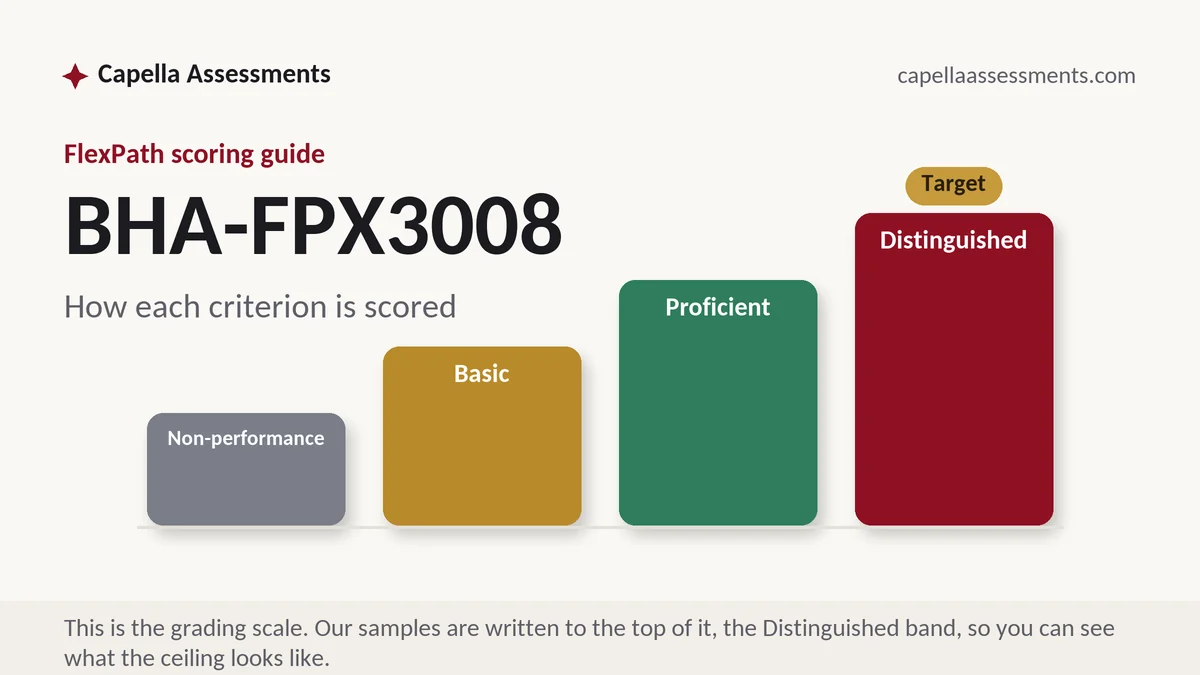
Every sample in this drawer is written the same way our custom ones are: the scoring guide decoded criterion by criterion, a subject-matched writer drafting to the Distinguished column, APA checked line by line, and the reasoning annotated so the paper teaches while it shows. Capella revises scoring guides, so a custom request is always written to the guide in YOUR courseroom, never from a stale template.
BHA-FPX3008 questions, answered
How much do I need to show the calculations?
Enough that a reader could reproduce them. Most scoring guides award marks for presentation as well as accuracy, so a table with labelled rows and a stated base beats a figure asserted in a sentence. Showing the work also means a small arithmetic slip costs one line rather than the whole analysis.
What if the data seems incomplete?
State the assumption you are making and proceed. Incomplete data is normal in these assessments and often deliberate, and a stated assumption is markable while a silent one is not. What loses marks is quietly inventing a figure or abandoning the calculation because something was missing.
How specific should the recommendations be?
Specific enough to carry a number and an owner. Reducing overtime is not a recommendation; filling two vacancies to remove a stated volume of overtime, with the resulting change estimated, is one. The criteria are usually written to separate those two answers. An owner matters as much as a number, since a saving nobody is accountable for is an estimate rather than a plan.