Send the exact assignment or rubric from your classroom and a custom sample written to it lands in 24 to 48 hours, the first one free. BUS-FPX1011 is Capella’s Management Fundamentals course. It centers on turning the four management functions into choices a named manager made in a situation with real constraints. Searches like "bus fpx 1011 assessment 3 assignment example", "BUSFPX1011 sample paper", and "BUS-FPX1011 assessment samples" land on this page.
What BUS-FPX1011 is really about
BUS-FPX1011 arrives early enough that many students have never written a graded business paper, and the criteria are built with that in mind. They read structure, headings and APA mechanics closely, and they also read for something easier to miss: whether a management concept ever touches a situation. Planning, organizing, leading and controlling can each be defined in two sentences from any introductory text, and defining them buys the entry price at best. What satisfies the criterion is a manager who had to decide something, a constraint that made the decision hard, and a function used to explain what that manager did or should have done instead. Concept first with the situation appended is the shape that stalls at Basic.
The other habit this course builds is separating management from leadership, because students who merge the two write half a paper. Getting a schedule to hold, a budget to survive contact with reality and a standard to be met is management work, and it can be measured. Persuading somebody to want the outcome is different work resting on different evidence. Assessments here usually want the measurable half, which is why the controlling function is the one most often skipped and most often worth marks: what gets checked, against what standard, how often, and what happens when the number comes back wrong. A paper that plans and organizes and never says how anyone would know it worked has left a criterion open.
What BUS-FPX1011’s assessments ask for
Assessments generally ask you to examine a management situation and apply course concepts to it. That means describing an organization or a scenario in enough detail that a decision is genuinely constrained, selecting the functions or theories that account for what happened, and saying what a manager should do next. Where the criteria address the manager's role, they want activities named at the level of a working day rather than at the level of a definition. Many versions require a recommendation, scored on whether a supervisor could begin it on Monday without asking a follow-up question. A theory of motivation or structure earns its place here by predicting something about the situation on the page, not by being summarized accurately.
Where students lose points in BUS-FPX1011
The most common loss is the definitions paper, which explains each function accurately and leaves the situation as decoration. Second is the situation with no friction in it, picked because it was easy to describe, where nothing was at stake and no function had any work to do. Third is the missing control step, a plan proposed with no measure, no interval and no trigger, which leaves a reader unable to say whether it succeeded. Marks also go for recommendations aimed at everybody rather than at a role, for the word effective standing where a number belonged, and for citation and formatting slips, which cost more here than later because early criteria read mechanics line by line and those marks are the cheapest in the program to keep.
The BUS-FPX1011 drawers
BUS-FPX1011 Assessment 1 management analysis example
Assessment 1 typically puts one situation under the four functions and names the constraint. On request, free, 24-48h.
BUS-FPX1011 Assessment 2 planning memo example
Assessment 2 often asks what a manager would do next and by when. On request, free, 24-48h.
BUS-FPX1011 Assessment 3 control and evaluation report example
Assessment 3 usually wants the measure, the interval and the response when it fails. On request, free, 24-48h.
Your classroom shows something else?
Capella University revises courses; assessment counts and deliverables shift between terms. Send what your classroom shows and the desk matches it exactly.
Using a BUS-FPX1011 sample the right way
Read a sample for the point where a function stops being a definition. Find the sentence saying what the manager checked and what would have followed if the check came back badly, since the control step is where most submissions run thin. Skim the opening theory, which will match whichever text your section assigned. Then rebuild the paper around a workplace you have watched closely, because the constraint is the part nobody can borrow and it is what makes every later claim specific. Notice as well how little room the sample gives to background before the analysis starts.
How these samples are written
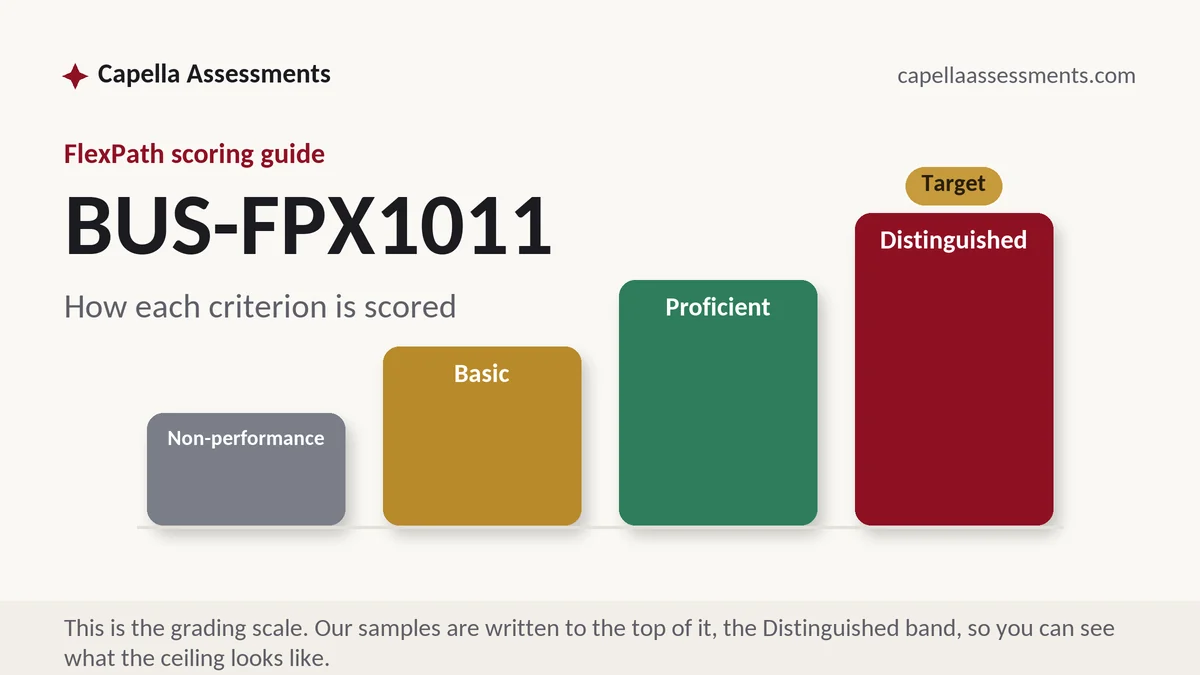
Every sample in this drawer is written the same way our custom ones are: the scoring guide decoded criterion by criterion, a subject-matched writer drafting to the Distinguished column, APA checked line by line, and the reasoning annotated so the paper teaches while it shows. Capella revises scoring guides, so a custom request is always written to the guide in YOUR courseroom, never from a stale template.
BUS-FPX1011 questions, answered
Do I need a real company for BUS-FPX1011?
Not always, though a real one makes the paper easier to write and harder to fault. A workplace you know supplies the constraint, the reporting line and the standard that an invented firm never quite has. Keep the employer unidentifiable and describe roles rather than individuals. Where your instructions supply a scenario, use that instead, since the criteria will be applied to those facts.
How much theory should the paper contain?
Less than you expect, and all of it working. One theory used to explain a decision satisfies more criteria than four summarized in sequence, because the criterion is written around application. Introduce a concept at the moment it explains something rather than in a block near the front, and the paper stops reading as a study guide with an example stapled to the end of it.
Is there a BUS-FPX1011 Assessment 2 example I can read?
Yes. Send the assessment instructions and whichever scoring guide your section posted; the first custom sample carries no charge and normally lands inside 24-48h. It answers the criteria you were actually handed rather than a generic management template, so you can see where the marks in your own version sit before you start drafting.