Send the exact assignment or rubric from your classroom and a custom sample written to it lands in 24 to 48 hours, the first one free. BUS-FPX2007 is Capella’s Introduction to Business Perspectives course. It centers on reading one business decision from the marketing, operations, finance and people sides until the trade-off between them is visible. Searches like "bus fpx 2007 assessment 3 assignment example", "BUSFPX2007 sample paper", and "BUS-FPX2007 assessment samples" land on this page.
What BUS-FPX2007 is really about
An introductory survey invites a paper with a paragraph for each function, and BUS-FPX2007 gives that shape very little. The criteria are written around a business as a system whose parts pull against each other, so the assessments reward a writer who can show the pull. Cutting the price wins customers for marketing, ruins the margin for finance and floods a line that operations cannot staff. Extending payment terms closes sales and starves cash. A paper that names those tensions is doing what the course was designed to teach, and it can only do so if the writer commits to one decision instead of touring a firm. The functions are the lens here, and the decision is the subject.
The second thing this course tests is whether a student can write about a business without repeating what the business says about itself. Annual reports, careers pages and press releases are the easiest sources to find and the weakest to argue from, because every line in them was written to flatter. Assessments asking about ethics, sustainability or social responsibility are especially exposed to that, since a stated commitment is not evidence of a practice. The stronger move is to look for something observable: a price, a policy, a product change, a filing. Because this course is early in the program, source quality and citation placement are read closely, and an uncited claim about a named company is an avoidable loss.
What BUS-FPX2007’s assessments ask for
Assessments generally ask you to examine a business or a business decision and explain it through the functional areas the course covers. That means identifying the decision, saying what each affected function would want, and resolving the conflict rather than reporting it. Where the criteria address the external environment, they usually want the specific force that touches this firm rather than a survey of economic, social and technological conditions. Many versions ask about the form of ownership or the structure, which is scored on the consequences of that form for control, liability and finance. Several sections close with a career element, answered best by naming what somebody in a specific role actually does with a working day.
Where students lose points in BUS-FPX2007
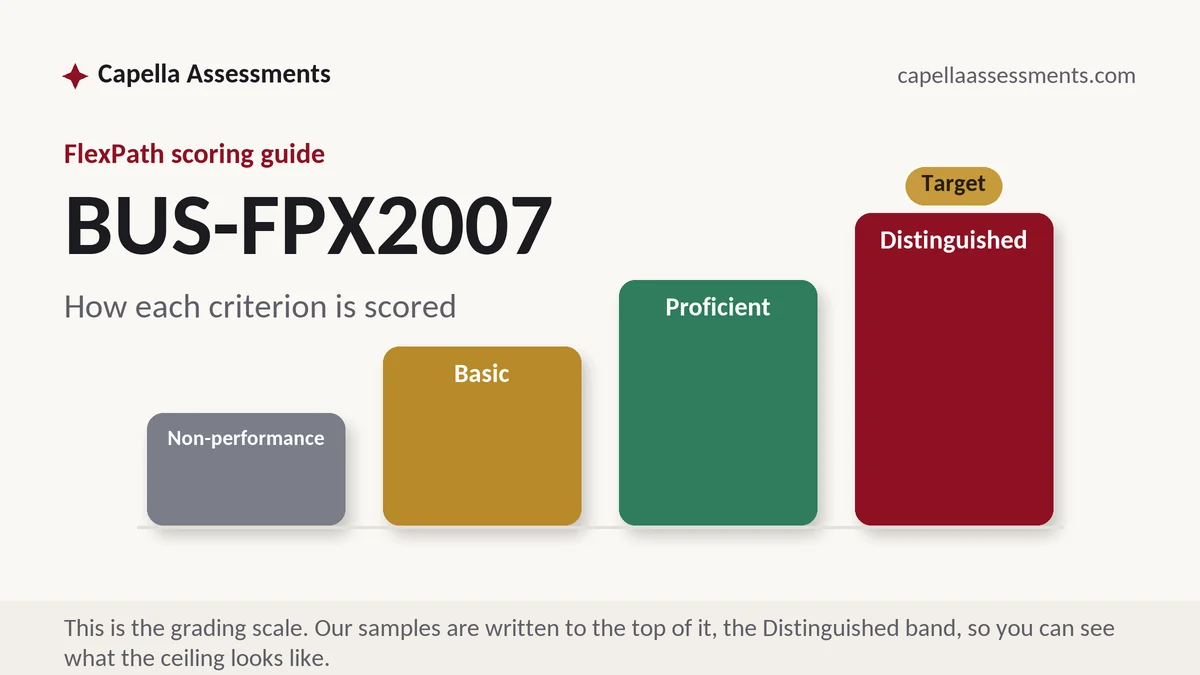
The dominant loss is the tour of the company: history, mission, products, competitors, all accurate and no argument anywhere in it. Second is the functional round-up, where each area gets a fair paragraph and none of them is allowed to disagree with the others. Third is the source problem, a paper built entirely on what the firm publishes about itself, so every conclusion arrives pre-approved. Marks also go for external forces listed without being connected to this business, for structure described without saying who ends up liable or who gets to decide, and for the mechanical layer, where an early scoring guide reads title page, headings and reference formatting attentively and takes marks that stronger content cannot win back.
The BUS-FPX2007 drawers
BUS-FPX2007 Assessment 1 business analysis example
Assessment 1 typically frames one firm and the decision the rest of the paper argues about. On request, free, 24-48h.
BUS-FPX2007 Assessment 2 functional comparison example
Assessment 2 often sets two functions against each other over the same choice. On request, free, 24-48h.
BUS-FPX2007 Assessment 3 recommendation report example
Assessment 3 usually asks which case wins and what the firm does next. On request, free, 24-48h.
Your classroom shows something else?
Capella University revises courses; assessment counts and deliverables shift between terms. Send what your classroom shows and the desk matches it exactly.
Using a BUS-FPX2007 sample the right way
Read a sample for the argument between two functions. Find the paragraph where what marketing wants costs operations something, and watch the writer settle it instead of letting both claims stand. That resolution is the move the criteria are measuring. Then check where each citation sits, because sources here belong at the claims about the company rather than in a block of background near the front. Build yours around a firm whose numbers or filings you can actually reach, since an argument about a business you cannot see is limited to whatever that business chose to say.
How these samples are written
The method behind every paper on this shelf: criteria first, structure from the criteria, evidence current, APA exact, and annotations that show which paragraph answers which criterion. Send your courseroom's scoring guide with a request and the custom sample matches it exactly, revisions included.
BUS-FPX2007 questions, answered
Which company should I write about?
One you can find evidence about beyond its own website. Public filings, pricing you can observe, product changes reported by somebody other than the firm, and coverage nobody commissioned all give you something to argue from. A famous name with a thin public record makes a harder paper than a smaller firm you can actually examine, whatever the brand recognition suggests.
Do I need to cover every functional area?
Follow the instructions, and where they leave it open, use the functions your decision actually touches. Two areas in genuine conflict demonstrate more understanding than five described in turn, because the criterion is about how a business fits together rather than about coverage. Areas with nothing to say about your decision are better handled in a clause than given a section of their own.
Can I submit a BUS-FPX2007 sample as my own paper?
No. The sample exists to be read: you study how the decision gets framed, how the functions are set against each other and where the sources land, then write your own analysis of a company you picked. What you hand in has to be your work. If you want one built against your own criteria, the first is free.