Send the exact assignment or rubric from your classroom and a custom sample written to it lands in 24 to 48 hours, the first one free. BUS-FPX2021 is Capella’s Business Law Fundamentals course. It centers on deciding a business dispute by naming the governing rule and showing which facts in the scenario meet or break it. Searches like "bus fpx 2021 assessment 3 assignment example", "BUSFPX2021 sample paper", and "BUS-FPX2021 assessment samples" land on this page.
What BUS-FPX2021 is really about
Every business law paper that stalls does the same thing: it explains the legal system. Sources of law, the difference between civil and criminal liability, the structure of the courts, all correct and none of it responsive to a scenario. BUS-FPX2021 is scored on the opposite motion. A fact pattern arrives, and the paper has to identify what is genuinely in dispute, state the rule that governs it in a sentence, and then do the part carrying the marks: point at the facts that satisfy or defeat each requirement of that rule. A contract question turns on whether an offer, an acceptance and consideration can each be located in the story you were handed.
The second discipline is conclusion. Undergraduate legal writing goes soft at the end, because a hedge feels safer than a decision, so papers close by saying the outcome would depend on the circumstances. The circumstances were supplied. The criteria expect an answer, with the weakness in that answer named rather than used as cover: this requirement is the arguable one, and here is what the other side would say about it. Where a case or statute is cited, currency and jurisdiction matter, since a state rule applied without naming the state and a case cited without its holding are both marked as unsupported. Citation formatting is read closely in courses at this level.
What BUS-FPX2021’s assessments ask for
Assessments generally supply a business scenario and ask what the law would do with it. That means separating the legal issues from the commercial complaints, stating the rule for each issue, applying it to the specific facts, and concluding. Where contracts are the subject, expect formation, performance, breach and remedy to be handled as separate questions rather than blended into one discussion of fairness. Where employment, agency or liability is in scope, the criteria usually ask who is responsible and on what basis, which requires the relationship to be classified before anything else follows. Many versions add a preventive element: what the business should change in its documents or its practice so the same dispute does not recur.
Where students lose points in BUS-FPX2021
The largest loss is background: pages on the legal system while the scenario waits. Second is the rule stated and never applied, where a paper defines consideration and then decides the case on what seems fair. Third is the conclusion that refuses to conclude. Marks also go for issues invented that the facts never raise, for remedies described in general when the question asked what this plaintiff would actually recover, and for authority handled loosely, a statute named without the provision that governs, a case cited for something it does not hold, or a rule from another state applied without noticing. Formatting and citation errors take a further slice, since early criteria read mechanics carefully.
The BUS-FPX2021 drawers
BUS-FPX2021 Assessment 1 case analysis example
Assessment 1 typically identifies the issues in a scenario and states the governing rules. On request, free, 24-48h.
BUS-FPX2021 Assessment 2 contract dispute memo example
Assessment 2 often works formation, breach and remedy as three separate questions. On request, free, 24-48h.
BUS-FPX2021 Assessment 3 liability and prevention brief example
Assessment 3 usually asks who is responsible and what the business should change afterward. On request, free, 24-48h.
Your classroom shows something else?
Capella University revises courses; assessment counts and deliverables shift between terms. Send what your classroom shows and the desk matches it exactly.
Using a BUS-FPX2021 sample the right way
Read a sample for the joints between rule and fact. Take each requirement of the rule and check that the paper has pointed at a specific line of the scenario for it, since that pointing is the analysis and it is what most submissions leave implied. Then read the conclusion and notice that it commits, with the weak requirement identified rather than hidden. Build yours on the fact pattern your section supplies, because these assessments usually issue one and the answer has to follow those facts rather than a similar case you found while reading around.
How these samples are written
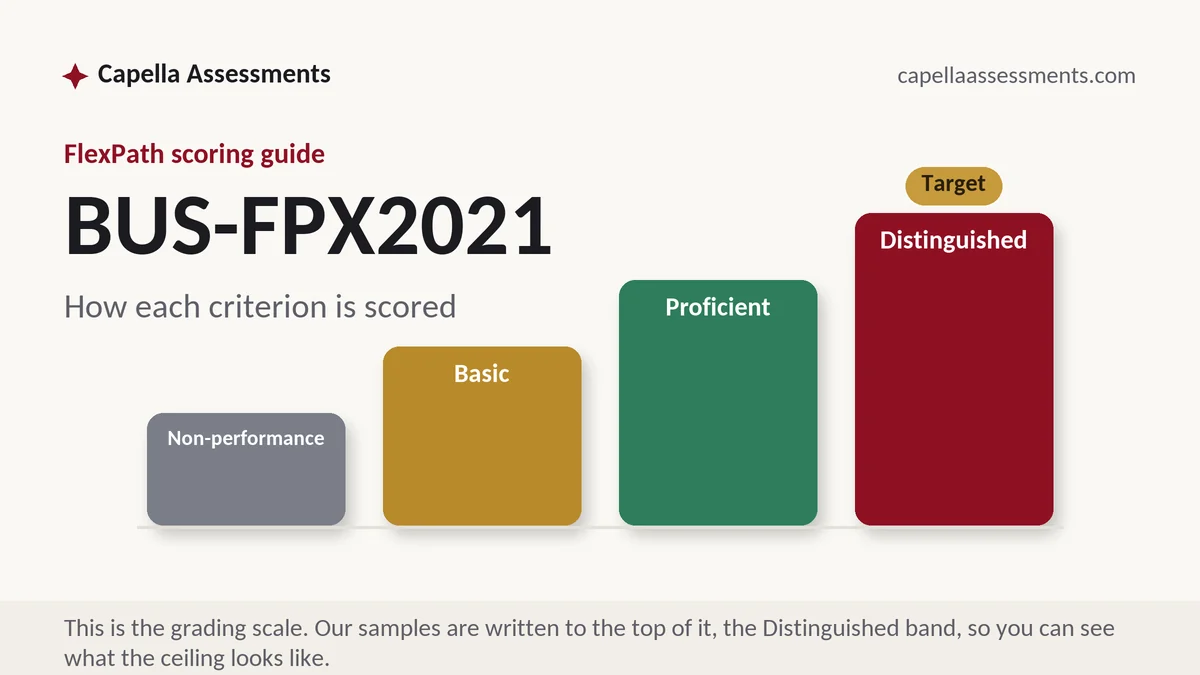
Samples here follow one discipline: the scoring guide is the outline, every criterion gets its section, the Distinguished description decides the depth, and the APA layer ships exact. Because Capella updates courses over time, your free custom sample is drafted against the scoring guide you send, not against an archive.
BUS-FPX2021 questions, answered
Do I need to cite actual cases or statutes?
Where the instructions ask for authority, yes, and it belongs at the rule rather than at the subject. A statute named on its own establishes very little; the section imposing the requirement establishes the rule you are applying. If you use a case, state what it held in one line so a reader can see why it governs the facts in front of you.
How certain does my conclusion have to be?
Certain enough to be wrong. The criteria reward a stated outcome with the arguable requirement identified, and they give very little to a paper leaving everything to the circumstances. Say which way it goes, name the element that could be contested, and give the other side its best sentence. That reads as judgment rather than as risk taken carelessly.
Is there a BUS-FPX2021 Assessment 3 example I can look at?
Yes. Send the fact pattern with your scoring guide and the first custom sample is produced free, usually back inside 24-48h. Sections differ in which scenario they issue, so a model built on yours shows how a rule gets matched to those particular facts, which is where the marks in this course concentrate.