Send the exact assignment or rubric from your classroom and a custom sample written to it lands in 24 to 48 hours, the first one free. BUS-FPX2062 is Capella’s Finance Fundamentals course. It centers on valuing a future amount today, defending the rate used to get there, and comparing ratios against something that gives them meaning. Searches like "bus fpx 2062 assessment 3 assignment example", "BUSFPX2062 sample paper", and "BUS-FPX2062 assessment samples" land on this page.
What BUS-FPX2062 is really about
Accounting looks backward at what a business did; finance looks forward at what a dollar arriving later is worth today, and BUS-FPX2062 is where that switch happens. The mechanics are unforgiving in a useful way. A present value computed with the wrong number of periods, an annual rate applied to monthly payments, a cash flow discounted twice: these produce answers that are incorrect rather than thin, and the paragraph explaining the decision inherits the error. What makes the course harder than it looks is that the arithmetic depends on judgment. The rate you discount at is an assumption about risk, and two defensible rates can turn the same project from acceptable to rejected, so the criteria expect the choice stated rather than assumed.
Ratio work has a parallel problem. A current ratio of 1.4 is neither good nor bad until it sits beside last year, a competitor or an industry figure, and that comparison is the part the criteria are reading. Students frequently compute a page of ratios accurately and then write a paragraph repeating them in sentences, which earns the calculation marks and leaves the interpretation criterion with nothing to read. The other habit worth building early is grouping: liquidity, profitability, leverage and efficiency answer different questions, and a firm can look strong on one group while the group beside it explains why trouble is coming. Presentation carries marks too, since a table with no labeled periods is difficult to award anything for.
What BUS-FPX2062’s assessments ask for
Assessments generally give you financial data or a project and ask what a decision maker should do with it. That means computing what the instructions specify, present value, future value, payback, net present value or a set of ratios, and displaying the work so a reader can follow the inputs. The analysis section then has to reach a recommendation: fund it, decline it, extend the terms, hold the position. Where cost of capital or risk enters, the criteria expect the assumption named and justified rather than adopted silently. Many versions ask you to compare two options, scored on whether they were compared on the same basis, over the same horizon, with the same rate applied to both.
Where students lose points in BUS-FPX2062
The errors costing most are mechanical: periods and rates mismatched, an annuity treated as a lump sum, a comparison run over different horizons so the longer project wins by arithmetic rather than on merit. After those, the reliable loss is the ratio left uninterpreted or compared against nothing at all. Marks also go for a discount rate that appears with no explanation behind it, for recommendations ignoring the figure the paper just produced, and for risk mentioned as a closing caution instead of being built into the analysis. Papers also lose marks for confusing profitability with liquidity, arguing that a firm earning well cannot be short of cash, which the statements in front of the writer usually contradict.
The BUS-FPX2062 drawers
BUS-FPX2062 Assessment 1 time value calculation example
Assessment 1 typically discounts or compounds cash flows with every input declared. On request, free, 24-48h.
BUS-FPX2062 Assessment 2 ratio analysis example
Assessment 2 often compares one firm against a period or a rival on the same basis. On request, free, 24-48h.
BUS-FPX2062 Assessment 3 investment recommendation example
Assessment 3 usually funds or declines a project and names the assumption that would reverse it. On request, free, 24-48h.
Your classroom shows something else?
Capella University revises courses; assessment counts and deliverables shift between terms. Send what your classroom shows and the desk matches it exactly.
Using a BUS-FPX2062 sample the right way
Read a sample for its inputs. Before checking any answer, find where the rate, the horizon and the periods were declared, since those three decide everything downstream and they are what most submissions leave implicit. Then look at how the recommendation is worded: it should name the option, the figure that decided it and the assumption that would reverse it. Recompute one calculation yourself as you go, since a figure you have rebuilt is one you can defend in the paragraph beneath it. Then build your own around the data your assessment supplies, because a borrowed answer attached to different inputs is visible immediately.
How these samples are written
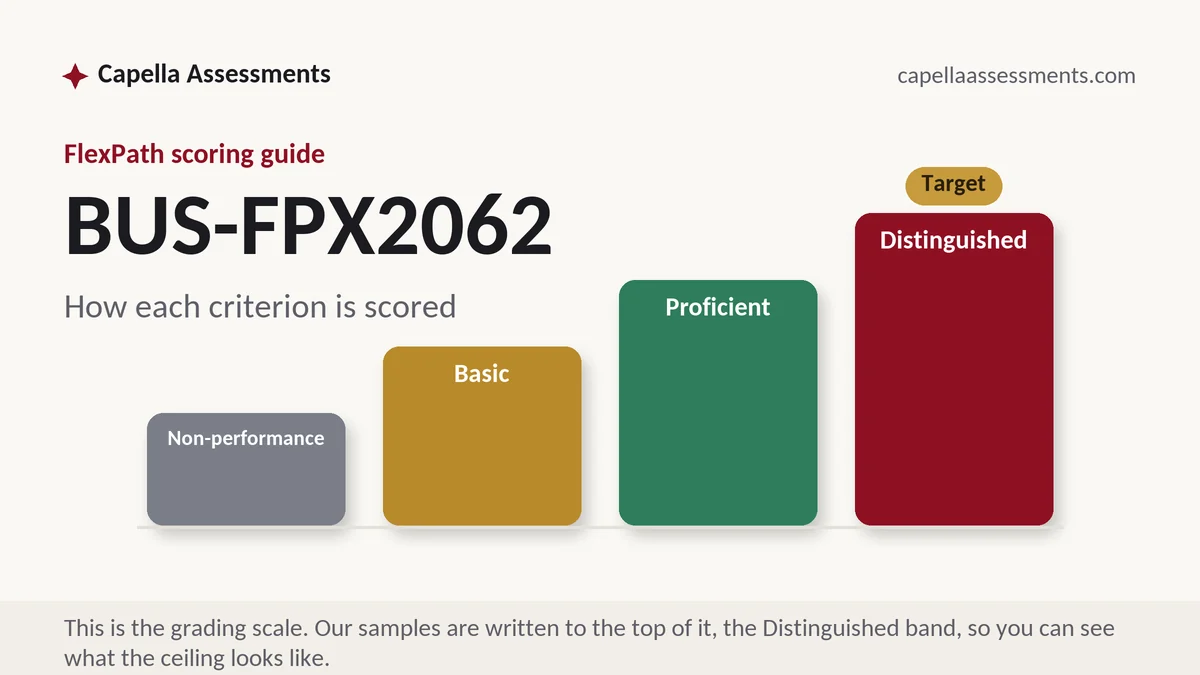
Samples here follow one discipline: the scoring guide is the outline, every criterion gets its section, the Distinguished description decides the depth, and the APA layer ships exact. Because Capella updates courses over time, your free custom sample is drafted against the scoring guide you send, not against an archive.
BUS-FPX2062 questions, answered
Where do I get a discount rate?
From the instructions where they give one, and from a stated argument where they do not. A rate borrowed from a comparable firm, an assumed cost of borrowing, or a required return set by the scenario are all defensible if you say which you used and why. What loses marks is a percentage appearing inside a formula with no origin, since the whole recommendation rests on it.
Do the ratios need an industry comparison?
Something to compare against is what makes them mean anything, and industry data is the usual choice. Where you cannot find a reliable figure, compare across periods for the same firm and say that is what you are doing. A ratio reported alone tells a reader only that a calculation was performed, which is not what the analysis criteria are asking.
Can somebody write a BUS-FPX2062 example against my own numbers?
Yes. Send the assessment instructions, the scoring guide and the data you were issued, and the first custom sample comes back free, usually in 24-48h. It is built on those figures so you can see how the calculation, the table and the recommendation fit together before producing your own version of each.