Send the exact assignment or rubric from your classroom and a custom sample written to it lands in 24 to 48 hours, the first one free. BUS-FPX4065 is Capella’s Income Tax Concepts and Strategies course. It centers on reaching a defensible tax position from actual authority and saying which planning choices are lawful, timely and worth making. Searches like "bus fpx 4065 assessment 3 assignment example", "BUSFPX4065 sample paper", and "BUS-FPX4065 assessment samples" land on this page.
What BUS-FPX4065 is really about
Tax is the one accounting subject where the answer is written down somewhere and the difficulty is finding it. BUS-FPX4065 is therefore about authority as much as arithmetic. A conclusion supported by the code, a regulation or a ruling is worth something; the same conclusion supported by a blog post is worth nothing, even when it happens to be right. The course also rests on two distinctions that decide most outcomes: when income is recognized, and what character it has. A gain taxed this year at ordinary rates and the same gain taxed next year at capital rates is one economic event with two different results, and most of what planning means in practice is choosing between them lawfully.
The strategy half of the course is where papers most often become uncomfortable, and the discomfort is productive. Arranging affairs to pay less tax is lawful and expected; concealing or misrepresenting facts to the same end is not, and the boundary is a matter of disclosure and substance rather than intention. Assessments reward writers who state that boundary plainly and then stay on the right side of it visibly. The other habit worth building early is the year. Almost every planning move in the subject is a timing decision, and a recommendation with no year attached cannot be evaluated, because the rate, the threshold and sometimes the rule itself will differ.
What BUS-FPX4065’s assessments ask for
Assessments hand you facts about a taxpayer and ask what follows. That means classifying each item, applying the rule that governs it with a citation the reader could check, computing the result, and stating what remains uncertain. Where a planning question appears, the criteria want alternatives compared with numbers rather than a preference asserted, and they want the assumption about future rates or income made visible. Entity questions ask which structure suits these facts and why, which is rarely about tax alone. Where an ethical dimension is included, expect to be asked where the line sits and what disclosure would keep the position defensible. Every figure is expected to carry the tax year it belongs to.
Where students lose points in BUS-FPX4065
The first loss is the position asserted with no authority, a correct answer that the reader has no way to verify. Second is the citation supplied without application, a code section named in parentheses beside a sentence it does not actually support. Third is the planning recommendation with no year and no rate, which cannot be evaluated and often could not be implemented. Marks also go for confusing avoidance with evasion in either direction, for treating a deduction as available without checking the limits attached to it, for ignoring the taxpayer's other income when it changes the bracket, and for conclusions stated with a certainty the underlying facts do not support.
The BUS-FPX4065 drawers
BUS-FPX4065 Assessment 1 taxable position with authority example
Assessment 1 typically classifies each item and cites the provision that decides it. On request, free, 24-48h.
BUS-FPX4065 Assessment 2 computation and return work example
Assessment 2 often produces the figures and marks where the facts stop supporting them. On request, free, 24-48h.
BUS-FPX4065 Assessment 3 planning strategy memo example
Assessment 3 usually compares two lawful timings and attaches a year to each. On request, free, 24-48h.
Your classroom shows something else?
Capella University revises courses; assessment counts and deliverables shift between terms. Send what your classroom shows and the desk matches it exactly.
Using a BUS-FPX4065 sample the right way
Read a sample for its citations and then check one. Open the section it names and confirm it says what the paper claims, because that exercise teaches more about this subject in ten minutes than a chapter will. Notice how the strong samples separate the computation from the conclusion, and how they mark the point where the facts run out. Build yours on the facts your assessment supplies without adding convenient ones, since inventing a detail that changes the treatment is the quickest way to produce a confident answer to a question nobody asked.
How these samples are written
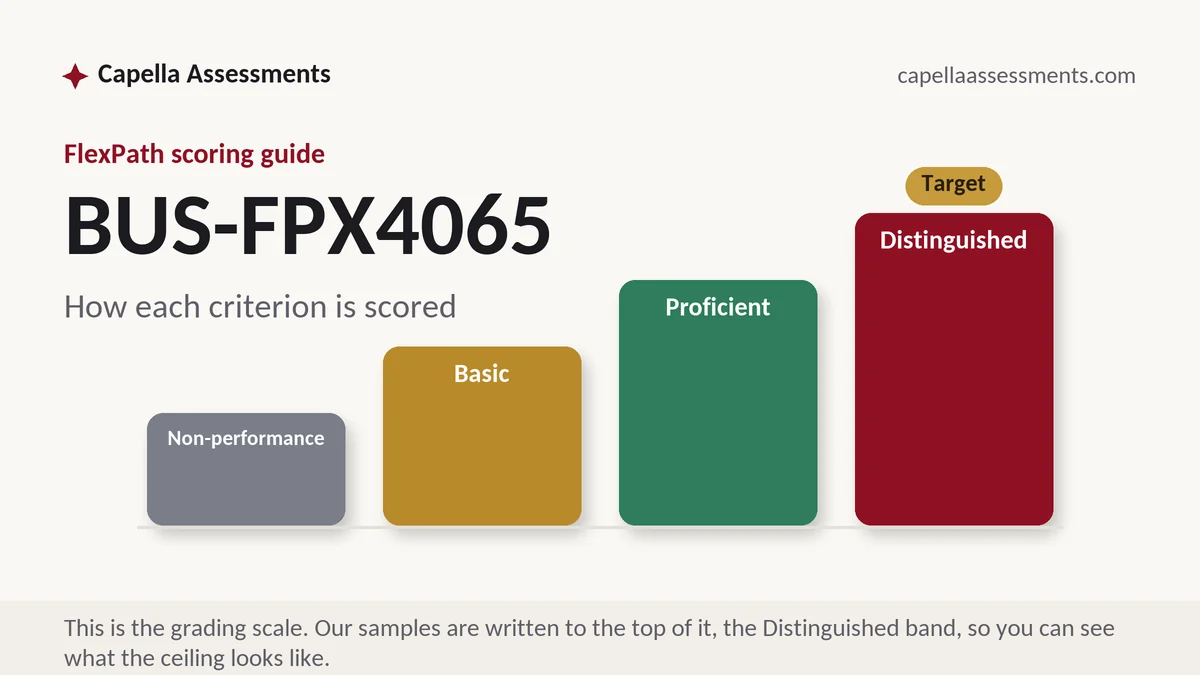
The method behind every paper on this shelf: criteria first, structure from the criteria, evidence current, APA exact, and annotations that show which paragraph answers which criterion. Send your courseroom's scoring guide with a request and the custom sample matches it exactly, revisions included.
BUS-FPX4065 questions, answered
Which sources count as authority?
The code, the regulations, revenue rulings and court decisions carry weight, roughly in that order for most questions at this level. Publications and instructions are useful for understanding and weak as support. Commercial tax sites are research aids rather than citations: use them to find the provision, then read and cite the provision itself.
Do rates change often enough to matter for my paper?
Often enough that you should state the year on every figure. Thresholds, standard amounts and phase out ranges move annually, and a paper using last year's numbers without saying so reads as careless even when the reasoning is sound. Naming the tax year once, early, protects the whole analysis from that particular criticism.
Is a BUS-FPX4065 sample available for my assessment?
Yes, free the first time and normally ready in 24-48h once your instructions and scoring guide arrive. Send the fact pattern your version uses, because a tax answer is only as transferable as its facts, and a model built on a different taxpayer would show you the structure of the reasoning while reaching a conclusion that is not yours.