Send the exact assignment or rubric from your classroom and a custom sample written to it lands in 24 to 48 hours, the first one free. BUS-FPX4068 is Capella’s Contemporary Auditing Using Investigative Accounting Practices course. It centers on gathering enough evidence about a control or a balance to support a conclusion somebody could review afterwards. Searches like "bus fpx 4068 assessment 3 assignment example", "BUSFPX4068 sample paper", and "BUS-FPX4068 assessment samples" land on this page.
What BUS-FPX4068 is really about
Auditing is not accounting done again more carefully. It is a separate discipline about evidence: what would have to be true, what would show it, and how much of that showing is enough. BUS-FPX4068 turns on professional skepticism, which is easy to define and difficult to write. It does not mean assuming dishonesty. It means declining to accept an explanation because the person offering it is credible, and asking what independent thing would corroborate it. Papers improve immediately when they stop describing procedures and start saying what each procedure would reveal, because that is the sentence the criteria are built to find, and it is the one usually missing.
The investigative side adds a second question: if somebody wanted to take money from this organization, how would they do it and what would be left behind. That is a design exercise rather than an accusation, and the standard framework of pressure, opportunity and rationalization is only useful when attached to a specific role with specific access. A clerk who both receives payments and records them has an opportunity that no policy statement removes. Assessments reward writers who identify the opportunity in the process they were given, name the record that would expose it, and recommend a separation somebody could actually staff.
What BUS-FPX4068’s assessments ask for
A typical assessment describes an organization or a process and asks you to plan or evaluate work on it. That means identifying where the risk of misstatement sits, selecting procedures that address those specific risks, and stating what evidence each procedure would produce. Where internal control is the subject, the criteria want the weakness located in an actual duty rather than in a general absence of oversight. Documentation sections are read as if somebody would review them later, so a working paper needs its purpose, its source and its conclusion. Where fraud is in scope, expect a question about detection: what would surface this scheme and what would let it continue.
Where students lose points in BUS-FPX4068
The dominant loss is the procedure listed without a purpose, a page of audit steps that would be identical for any client. Second is the control weakness described as a lack of oversight, which names nobody and changes nothing. Third is the fraud section that identifies a scheme and never says how anybody would notice it, which leaves the detection criterion untouched. Marks also go for evidence treated as equally persuasive regardless of source, for working papers with no conclusion at the bottom, for recommendations requiring staff the organization does not have, for sampling described in general terms with no size, basis or population stated, and for skepticism claimed as an attitude rather than demonstrated by a corroborating step.
The BUS-FPX4068 drawers
BUS-FPX4068 Assessment 1 risk and control evaluation example
Assessment 1 typically finds the weakness in a duty somebody actually holds. On request, free, 24-48h.
BUS-FPX4068 Assessment 2 audit procedures and evidence example
Assessment 2 often ties each procedure to the risk that justified it. On request, free, 24-48h.
BUS-FPX4068 Assessment 3 fraud examination write up example
Assessment 3 usually says how the scheme would surface and what record would show it. On request, free, 24-48h.
Your classroom shows something else?
Capella University revises courses; assessment counts and deliverables shift between terms. Send what your classroom shows and the desk matches it exactly.
Using a BUS-FPX4068 sample the right way
Read a sample for the link between risk and procedure. Every step in a strong one exists because of something named earlier, and if you can delete a procedure without leaving a gap, the sample has padded rather than planned. Then look at a working paper and check it has a conclusion, since that line is what makes the document evidence rather than notes. Build yours on a process you can describe at the level of who does what, because control weaknesses live in the handoffs between people and are invisible when the process is written as a department.
How these samples are written
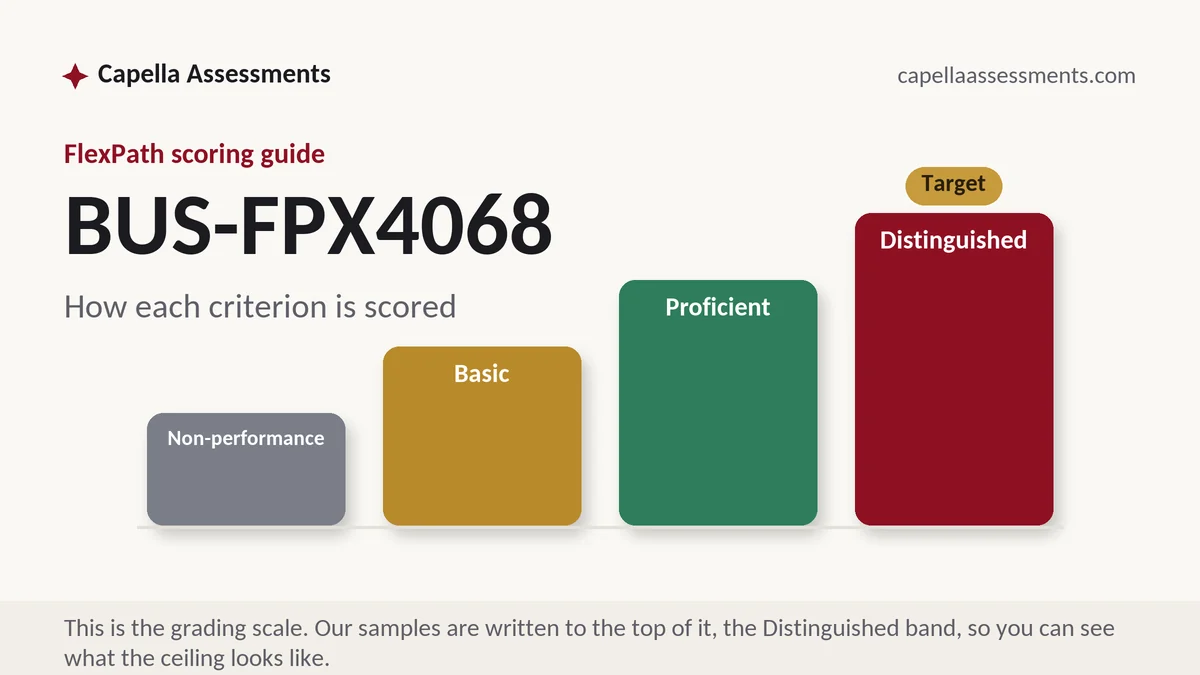
Every sample in this drawer is written the same way our custom ones are: the scoring guide decoded criterion by criterion, a subject-matched writer drafting to the Distinguished column, APA checked line by line, and the reasoning annotated so the paper teaches while it shows. Capella revises scoring guides, so a custom request is always written to the guide in YOUR courseroom, never from a stale template.
BUS-FPX4068 questions, answered
Am I allowed to write about a fraud that really happened?
Yes, and published cases are excellent material because the facts are established and the failures are documented. Use the court record, the regulator's findings or the company's own filings rather than press summaries. What the criteria want from a case is not the story but the control that was missing and the procedure that would have surfaced it.
How much detail belongs in a working paper?
Enough that a reviewer who was not there could repeat the work and reach the same conclusion. In practice that means the purpose, the population and how it was selected, what was examined, what was found and what you concluded. Anything beyond that is usually padding, and anything missing from that list is usually where the marks went.
Can I get a BUS-FPX4068 sample written to my instructions?
Yes. The first custom sample costs nothing and is normally delivered inside 24-48h of the scoring guide reaching the desk. Send the scenario or the case your assessment names, since audit work is planned against particular risks and a plan built for a different organization would show the reasoning while addressing risks yours does not have.