Send the exact assignment or rubric from your classroom and a custom sample written to it lands in 24 to 48 hours, the first one free. DB-FPX8720 is Capella’s Strategic Digital Transformation course. It centers on arguing how digital capability rearranges a firm's operating model and where value moves once a market changes shape. Searches like "db fpx 8720 assessment 3 assignment example", "DBFPX8720 sample paper", and "DB-FPX8720 assessment samples" land on this page.
What DB-FPX8720 is really about
Almost every first draft in DB-FPX8720 is a technology paper. It compares platforms, sequences a migration, lists the analytics tools a firm should adopt, and reads like something a vendor could have written. The criteria are asking a different question, which is what the organization becomes: how work flows through it afterwards, which decisions move closer to data, what the customer relationship turns into, and which activities stop being worth doing inside the firm at all. Technology appears in that argument as a cause, never as the subject. The distinction is not stylistic. A paper about tools can be entirely accurate and still leave every criterion about strategy unanswered, because nothing in it says what changed about the business.
The research behind the course is older than the current vocabulary and unusually consistent. Investment in information technology has repeatedly produced little on its own and a great deal when it arrived alongside changes in process, skills and decision rights, which is why a transformation argument that stops at procurement is arguing against the evidence. Legacy is the other half of that finding. Old systems encode old procedures, including the exceptions and workarounds nobody documented, so replacing the system without settling what the procedure should be tends to reproduce it at higher cost. Doctoral papers here are expected to say which organizational changes have to happen for the technology to pay, and who inside the firm loses something when they do.
What DB-FPX8720’s assessments ask for
Assessments generally ask you to assess where an organization stands, argue what it should become, and defend the sequence between the two. Expect the current state to be described as capability rather than as an inventory: what the firm can do with data it holds, how quickly it can change a process, where its customers actually meet it. Where the criteria ask for a target state, they want the business model consequences stated, including which revenue the change puts at risk. Most sections want measurement handled, and the useful measures are operational rather than budgetary, since money spent is an input and proves nothing. Where governance or risk appears, expect questions about who decides, what data the firm is holding, and what it owes the people it came from.
Where students lose points in DB-FPX8720
The largest loss is the vendor comparison, three platforms weighed on features with no claim about what the firm would do differently afterwards. Second is the roadmap with phases and no argument, where quarters are labeled and nothing explains why that order and not another. Third is maturity asserted, a model borrowed and a level assigned with no evidence that anyone examined the work being done. Marks also disappear where benefits are quoted from suppliers, where data is called an asset without saying what decision it improves, and where the people whose jobs change are handled in a single paragraph about training. Papers also fall short when disruption is described as something happening to an industry rather than as competitors making specific moves a firm could answer.
The DB-FPX8720 drawers
DB-FPX8720 Assessment 1 digital maturity assessment example
Assessment 1 typically evidences what an organization can currently do, not what it has bought. On request, free, 24-48h.
DB-FPX8720 Assessment 2 operating model redesign example
Assessment 2 often argues how work, decisions and customer contact would be arranged afterwards. On request, free, 24-48h.
DB-FPX8720 Assessment 3 transformation roadmap critique example
Assessment 3 usually defends a sequence and states what each step puts at risk. On request, free, 24-48h.
Your classroom shows something else?
Capella University revises courses; assessment counts and deliverables shift between terms. Send what your classroom shows and the desk matches it exactly.
Using a DB-FPX8720 sample the right way
Read a sample for the before and after. Find where the paper describes how a piece of work is done now and where it says how the same work would be done later, and check that something other than the tool has changed between them. That pair of descriptions is where the criteria live. Then look at what the paper admits will be hard, because a transformation argument with no losers in it has not been thought through. Your own case should be an organization whose current process you can describe accurately, since the accuracy of the before is what makes the after worth reading.
How these samples are written
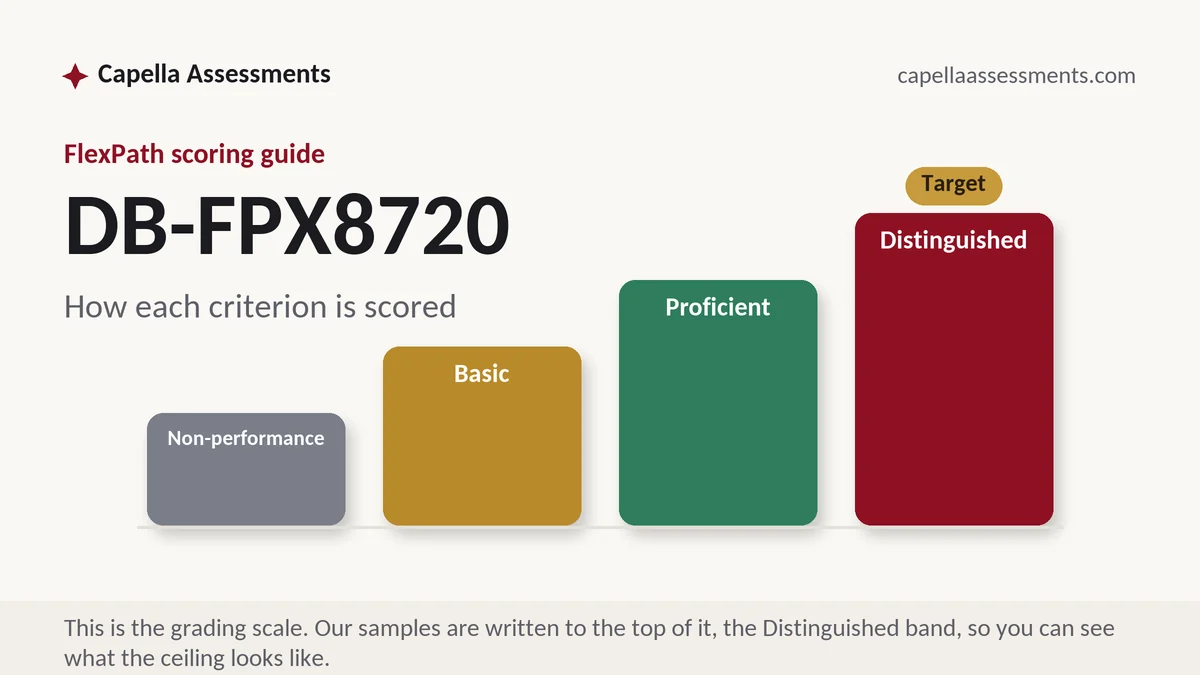
Every sample in this drawer is written the same way our custom ones are: the scoring guide decoded criterion by criterion, a subject-matched writer drafting to the Distinguished column, APA checked line by line, and the reasoning annotated so the paper teaches while it shows. Capella revises scoring guides, so a custom request is always written to the guide in YOUR courseroom, never from a stale template.
DB-FPX8720 questions, answered
Do I need a technical background for DB-FPX8720?
No. The criteria ask about capability, work and value rather than architecture, and the strongest papers are usually written by people who can describe how a process really runs. What you do need is enough understanding to avoid claiming a system can do something it cannot. Where a technical detail carries your argument, cite research or documentation rather than a supplier's summary of it.
Is there a DB-FPX8720 example built on my own employer?
The first custom sample is free and is written to the instructions and scoring guide you send, using whatever case your section requires. Keep your employer unidentifiable in what you submit and describe the work rather than the company. Expect it back inside 24-48h, and read it for how the current state is evidenced before any target state is proposed.
Can I write about artificial intelligence adoption?
Where your instructions allow it, yes, with one caution. Fast moving subjects tempt writers into sources that are barely a year old and mostly promotional, and doctoral criteria still expect peer reviewed evidence behind a claim. Anchor the argument in research on adoption, complementary change and decision quality, then use current material to describe what firms are currently attempting rather than to prove that it works.