Send the exact assignment or rubric from your classroom and a custom sample written to it lands in 24 to 48 hours, the first one free. HIM-FPX4650 is Capella’s Decision Support and Quality Management in Health Information Management course. It centers on converting a management question into an indicator the existing data can honestly answer, then reporting it so somebody acts. Searches like "him fpx 4650 assessment 3 assignment example", "HIMFPX4650 sample paper", and "HIM-FPX4650 assessment samples" land on this page.
What HIM-FPX4650 is really about
HIM-FPX4650 is the course where records stop being an obligation and start being an argument. A director asks whether discharges are getting slower, and the work is not running a query. It is deciding what discharge means in the data, which patients belong in the count, what period is long enough to show a change, and whether the timestamps in the source were captured when the event happened or when somebody got round to entering them. Submissions jumping straight to the answer skip the part being marked. The criteria in current courserooms reward the specification more than the finding, because a finding built on an undefined question cannot be defended.
The second subject is what happens to the number once it exists. An indicator with no owner changes nothing, and a display showing everything a system can produce informs nobody, so the assessments push toward selection: which few measures a given audience can act on, at what frequency, with what threshold that starts a conversation. Benchmarking gets the same scrutiny, since comparing your figure to a published one works only if both were defined the same way, and frequently they were not. Where decision support tools appear, the honest question is what an alert does to the person receiving it, because an alert everybody dismisses is worse than none.
What HIM-FPX4650’s assessments ask for
Assessments typically ask you to take a quality or operational question and build the reporting that answers it. That means specifying the indicator, its numerator, denominator, inclusions, source and period, then assessing whether the available data is fit for that purpose and saying where it is not. Expect to present the result in a form matched to an audience, with the action each figure supports stated rather than implied. Where benchmarking is in scope, the criteria expect comparability addressed before comparison. Several versions ask for a governance element: who defines the measure, who maintains it, and what happens when two departments report the same indicator with different numbers and neither will move.
Where students lose points in HIM-FPX4650
The dominant loss is the report answering a question nobody specified, where the measure appears undefined and the finding cannot be checked. Second is the display as inventory, listing every available metric so that nothing is prominent and no threshold tells anyone when to react. Third is a benchmark comparison made across incompatible definitions, which produces a gap that is an artefact rather than a finding. Marks also go for data quality treated as an assumption, for recommendations depending on data the organization does not collect, and for indicators with no owner, no review interval and no stated consequence, which leaves a quality program holding a report and no mechanism.
The HIM-FPX4650 drawers
HIM-FPX4650 Assessment 1 quality indicator analysis example
Assessment 1 typically specifies one indicator and tests whether the data fits it. On request, free, 24-48h.
HIM-FPX4650 Assessment 2 reporting and dashboard proposal example
Assessment 2 often selects the few measures an audience can act on. On request, free, 24-48h.
HIM-FPX4650 Assessment 3 decision support evaluation example
Assessment 3 usually assesses what a support tool does to the decision maker. On request, free, 24-48h.
Your classroom shows something else?
Capella University revises courses; assessment counts and deliverables shift between terms. Send what your classroom shows and the desk matches it exactly.
Using a HIM-FPX4650 sample the right way
Read a sample for the specification, not the chart. Look at how the question is restated in terms the data can satisfy, how exclusions are declared, and where the writer admits the source cannot support part of what was asked. That admission is usually the strongest paragraph in the paper and the one most submissions leave out. Then build yours around a question somebody has genuinely put to you, since fit-for-purpose analysis only works with a real source on the other end. What transfers is the order: question, definition, data assessment, result, and the decision the result is meant to inform.
How these samples are written
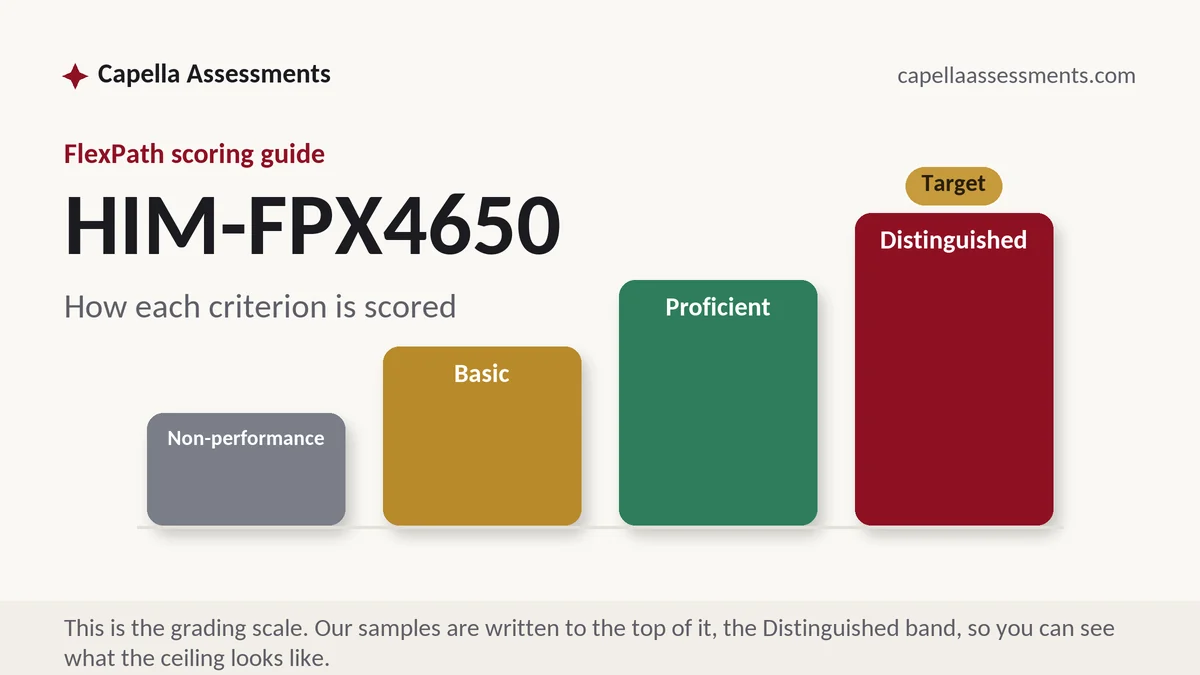
Samples here follow one discipline: the scoring guide is the outline, every criterion gets its section, the Distinguished description decides the depth, and the APA layer ships exact. Because Capella updates courses over time, your free custom sample is drafted against the scoring guide you send, not against an archive.
HIM-FPX4650 questions, answered
What do I do when the data I need does not exist?
Say so, in the paper, at the point it matters. Naming the gap and what it prevents is treated as analysis, and proposing what would have to be captured to close it is often worth more than an answer built on a proxy nobody trusts. Silently substituting whatever measure was available is what loses the fitness criterion.
How many measures should a dashboard carry?
Few enough that each has an owner, an interval and a threshold meaning somebody acts. The failure these assessments look for is the display showing everything the system can produce, which spreads attention evenly and changes nothing at all. Ask what decision each measure supports, and cut every one that answers nothing a reader could do.
Is using a HIM-FPX4650 sample as a model acceptable?
As a study model, yes. Read how the specification is built, how the data limits are declared and how the reporting is aimed at a decision, then write your own analysis against your own source. The first custom sample is free and comes back in 24-48h, written to the scoring guide in YOUR courseroom.