Each drawer below is one MBA-FPX5006 assessment. Where a sample is live, read it in full, true APA form with the reasoning annotated. Where it is not, request it free: send your assessment number and the scoring guide from your courseroom, and a custom sample written to your exact criteria arrives in 24 to 48 hours. Searches like "MBA FPX 5006 assessment 2 example", "MBA FPX 5006 sample paper", and "MBAFPX5006 sample" all land here, because this page is the drawer they belong in.
What MBA-FPX5006 is really about
MBA-FPX5006 is where the Capella MBA forces a decision. The course walks you through external analysis, competitive positioning, and strategic options for a real company, often your own employer, and then asks the question most papers try to dodge: which option, and why this one instead of the others. Strategy writing fails in a characteristic way, by being thorough about the environment and timid about the choice, and the scoring guide is built to catch exactly that. Analysis criteria reward depth, but the evaluation and recommendation criteria reward commitment, a position taken and defended with numbers. Working professionals usually have the industry knowledge already; what the course tests is whether you can turn knowledge into a defensible bet.
In current courserooms the arc typically runs from an environmental and competitive scan, through an options analysis where alternatives are weighed against explicit criteria, to a synthesis that commits the company to a direction. Each assessment inherits the last one's homework, so a thin scan produces an unsupported recommendation two papers later. The tools are the standard strategy kit, PESTLE, five forces, SWOT, and the course cares less about which you use than whether the tool's output actually feeds the decision. A Distinguished paper reads like a strategy memo a leadership team could act on: the market described in evidence, two or three real options priced, one chosen, and the reasoning traceable from scan to commitment.
What MBA-FPX5006’s assessments ask for
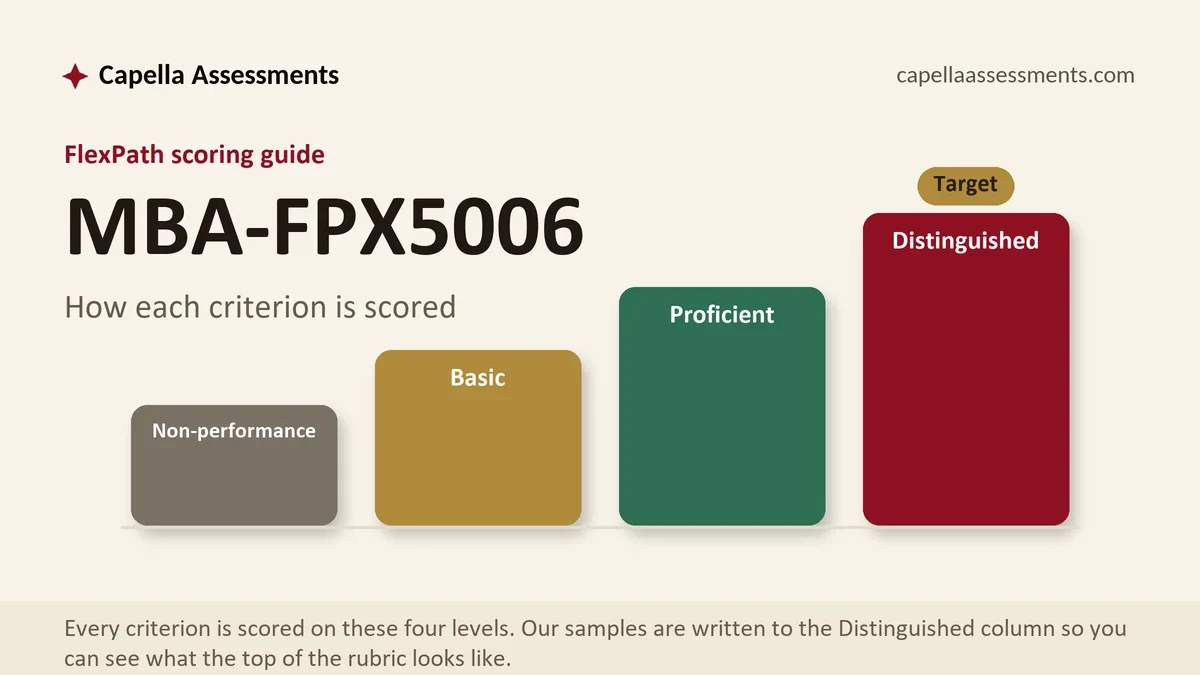
The assessments ask for strategy as a chain of custody. The scan has to establish facts worth deciding on: market forces named with sources, competitors profiled on what they actually do, the focal company's position stated without flattery. The options assessment asks for genuine alternatives, not one real choice flanked by two straw men, each evaluated against the same criteria with numbers attached, revenue implications, cost, risk, fit. The synthesis asks you to recommend, plan the execution at a high level, and acknowledge what would have to be true for the strategy to work. Across all of them the scoring guide verbs escalate from analyze to evaluate to recommend, and the level you land on tracks how visibly and how rigorously each verb was performed.
Where students lose points in MBA-FPX5006
The signature 5006 failure is the SWOT that never chooses. Four quadrants, twenty bullets, every observation defensible, and then the recommendation section changes the subject, because nothing in the matrix was weighted, connected, or allowed to eliminate an option. The scoring guide criterion on strategic analysis wants the matrix to do work: this strength meets that opportunity, therefore this move. A second loss is the recommendation without a risk paragraph, a confident strategy with no account of what could break it, which most guides read as Proficient at best. Third is the numberless option: alternatives compared entirely in adjectives. Samples counter all three by showing analysis that closes doors, a commitment with its risks priced, and at least rough math behind the winner.
The MBA-FPX5006 drawers
MBA-FPX5006 Assessment 1 example
In current courserooms this assessment typically appears as "Strategic Process and Analysis". The environmental and competitive scan. On request, 24-48h.
MBA-FPX5006 Assessment 2 Business Strategy example
In current courserooms this assessment typically appears as "Business Strategy". Strategic options weighed until one wins, with numbers. On request, 24-48h.
MBA-FPX5006 Assessment 3 Strategy Implementation example
In current courserooms this assessment typically appears as "Strategy Implementation". The strategy synthesis that closes the course. On request, 24-48h.
Your courseroom shows something else?
Capella revises courses; assessment counts and titles shift between versions. Send what your courseroom shows and the desk matches it exactly.
Using a MBA-FPX5006 sample the right way
Read an MBA-FPX5006 sample the way an analyst reads a good equity report, for the reasoning architecture. Notice where the scan stops describing and starts implying, how the options table forces every alternative through identical criteria, and where the writer plants the risk paragraph so the recommendation looks considered rather than brave. Then map those moves onto your own company and your own scoring guide. If your courseroom's version differs, request a free custom sample written to the exact guide you send; it arrives in 24-48h. The strategy you submit must be your own call on your own evidence, which is precisely what makes it gradeable.
How these samples are written
Samples here follow one discipline: the scoring guide is the outline, every criterion gets its section, the Distinguished description decides the depth, and the APA layer ships exact. Because Capella updates courses over time, your free custom sample is drafted against the scoring guide you send, not against an archive.
MBA-FPX5006 questions, answered
Can I write my MBA-FPX5006 strategy papers about the company I work for?
Most courserooms allow and even encourage it, though your scoring guide and instructions decide. Using your employer gives you real numbers and real stakes, which strengthens the options analysis. A custom sample can model the same structure on a comparable company so you see the genre without your own data in it. Check any confidentiality expectations your employer has before you commit.
Why do MBA-FPX5006 papers lose points even when the analysis is thorough?
Because thoroughness is the entry fee, not the grade. The higher scoring guide levels reward analysis that produces a decision: options eliminated, trade-offs priced, one strategy defended against the runner-up. A SWOT or five forces section that ends without consequences reads as description, and description sits at Basic or Proficient. The samples show the pivot sentence where analysis becomes commitment.
How fast can I get an MBA-FPX5006 sample for the options analysis?
Send the scoring guide and the assessment instructions from your courseroom and the custom sample is typically ready in 24-48h; the first one is free. Naming your industry helps, because an options analysis is only instructive when the alternatives feel real. You will get a model that weighs choices with numbers, which is the part most learners have never seen written down.