Each drawer below is one MBA-FPX5012 assessment. Where a sample is live, read it in full, true APA form with the reasoning annotated. Where it is not, request it free: send your assessment number and the scoring guide from your courseroom, and a custom sample written to your exact criteria arrives in 24 to 48 hours. Searches like "MBA FPX 5012 assessment 2 example", "MBA FPX 5012 sample paper", and "MBAFPX5012 sample" all land here, because this page is the drawer they belong in.
What MBA-FPX5012 is really about
MBA-FPX5012 treats marketing as an allocation problem, not an art department. The course asks who the customer is, why that customer and not another, and how product, price, place, and promotion should follow from the answer, all argued about a real company with market data underneath. That surprises learners who arrive expecting campaign brainstorms; the scoring guide criteria use analysis and evaluation verbs, and they are pointed at choices. Which segment, at what size, against which competitor, on what evidence. Working professionals tend to have marketing opinions already, since everyone is somebody's customer, and the course's job is to replace opinion with argument. The samples on this shelf show what that replacement looks like on paper.
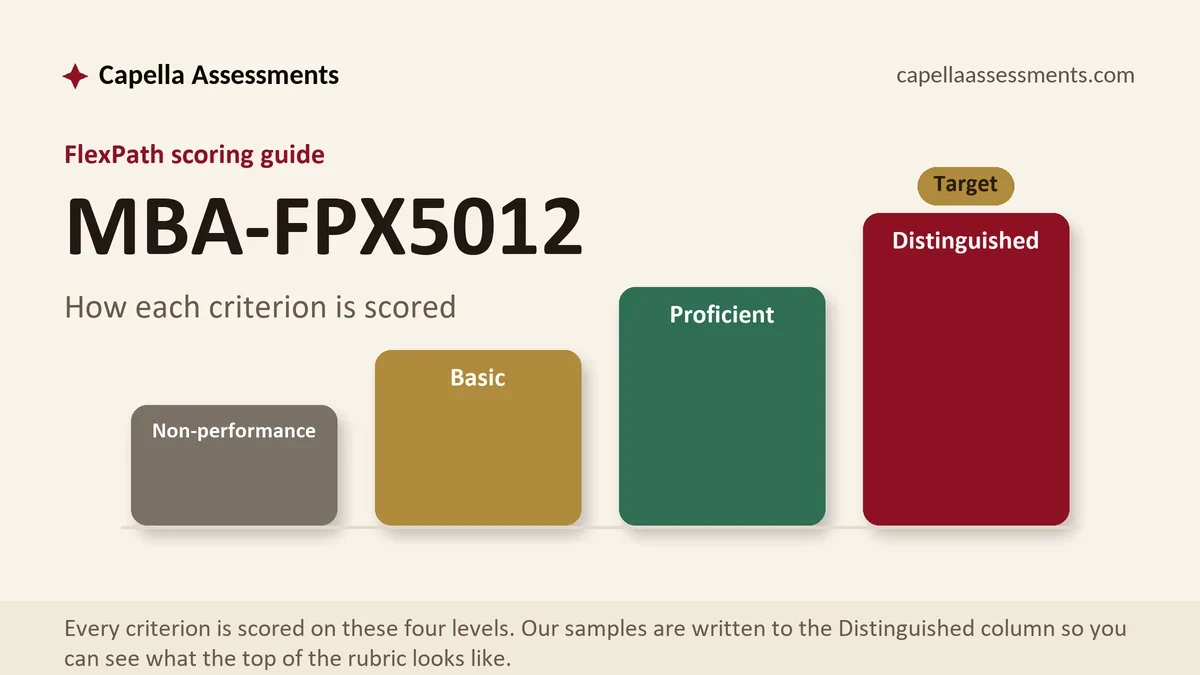
In current courserooms the sequence typically opens with segmentation and targeting built from market data, moves to positioning and mix decisions defended against alternatives, and closes with a marketing synthesis. The logic is cumulative on purpose: a vague segment makes the positioning unfalsifiable, and unmoored positioning turns the mix into a wish list. Capella's four performance levels separate on specificity here more than anywhere else in the MBA core. Proficient says the company should target young professionals; Distinguished names the segment, estimates its size and value, explains why competitors serve it badly, and lets every later decision cite that paragraph. FlexPath rewards writers who build that spine early, because each assessment can then stand on the one before it.
What MBA-FPX5012’s assessments ask for
The assessments ask for a marketing strategy that could survive a budget meeting. Segmentation work wants the market divided on variables that matter, then one target chosen and justified with data: how many buyers, spending what, reachable how. Positioning asks for a claim staked against named competitors, distinctive, defensible, and phrased so you could test whether customers believe it. The mix assessment asks for product, price, channel, and promotion decisions that visibly descend from the positioning, each defended against at least one alternative you rejected. The synthesis gathers it into one coherent plan and asks what you would measure to know it is working. Scoring guide criteria reward the connective tissue, the because-clauses between decisions, as much as the decisions themselves.
Where students lose points in MBA-FPX5012
The 5012 paper that grades worst is the marketing plan with no segment sizing. It names a target, health-conscious millennials, urban small businesses, and never attaches a number: no market size, no growth figure, no revenue potential, so the targeting criterion cannot rise past Proficient because nothing shows the segment is worth serving. Its sibling is the everyone segment, a target so broad it excludes no one and therefore decides nothing. A third loss is the decorative mix, four tidy P sections that never mention the positioning they supposedly serve, which assessors read as a template filled rather than a strategy extended. The samples push against all three habits with sized segments, narrow targets defended with data, and mix decisions that quote the strategy they came from.
The MBA-FPX5012 drawers
MBA-FPX5012 Assessment 1 segmentation and targeting example
Segmentation and targeting argued with market data. On request, 24-48h.
MBA-FPX5012 Assessment 2 positioning and mix defense example
Positioning and mix decisions defended against alternatives. On request, 24-48h.
MBA-FPX5012 Assessment 3 marketing synthesis example
The marketing synthesis that closes the course. On request, 24-48h.
Your courseroom shows something else?
Capella revises courses; assessment counts and titles shift between versions. Send what your courseroom shows and the desk matches it exactly.
Using a MBA-FPX5012 sample the right way
An MBA-FPX5012 sample earns its keep in the segmentation section. Study how it sizes a market with public data, industry reports, census figures, trade sources, because that sourcing move is the one most learners have never practiced. Then trace one thread end to end: segment to positioning to a single mix decision, and notice the sentence in each section that points backward. Rebuild that thread for your own company and your own scoring guide. If your courseroom frames the deliverables differently, send the guide and request a free custom sample, first one free, typically 24-48h, then write your plan on your own market evidence.
How these samples are written
Samples here follow one discipline: the scoring guide is the outline, every criterion gets its section, the Distinguished description decides the depth, and the APA layer ships exact. Because Capella updates courses over time, your free custom sample is drafted against the scoring guide you send, not against an archive.
MBA-FPX5012 questions, answered
Where do MBA-FPX5012 samples get market size numbers from?
From sources you can cite too: government statistics, industry association reports, trade publications, and company filings, each named in the reference list so you can follow the trail. The point is to model estimation you can defend, a segment bounded, counted, and valued with stated assumptions. Your own paper should rebuild the estimate for your market rather than borrow the sample's figure.
Can my MBA-FPX5012 plan use an invented company, or does it have to be real?
Your courseroom instructions decide, and most versions point you at a real organization, often your employer, because the assessments ask for market data an invented firm cannot generate. If you have flexibility, pick a company whose industry you know and whose numbers are findable. A custom sample written to your scoring guide can model either setup before you commit.
What makes a Distinguished MBA-FPX5012 positioning statement different from a slogan?
A slogan is a promise; a positioning statement is an argument. The Distinguished version names the target, the frame of reference, the point of difference, and the reason to believe, then defends each part against a competitor who would dispute it. It also stays consistent, every mix decision that follows should be explainable by pointing at it. The samples show that consistency stretched across a full plan.