Each drawer below is one MBA-FPX5016 assessment. Where a sample is live, read it in full, true APA form with the reasoning annotated. Where it is not, request it free: send your assessment number and the scoring guide from your courseroom, and a custom sample written to your exact criteria arrives in 24 to 48 hours. Searches like "MBA FPX 5016 assessment 2 example", "MBA FPX 5016 sample paper", and "MBAFPX5016 sample" all land here, because this page is the drawer they belong in.
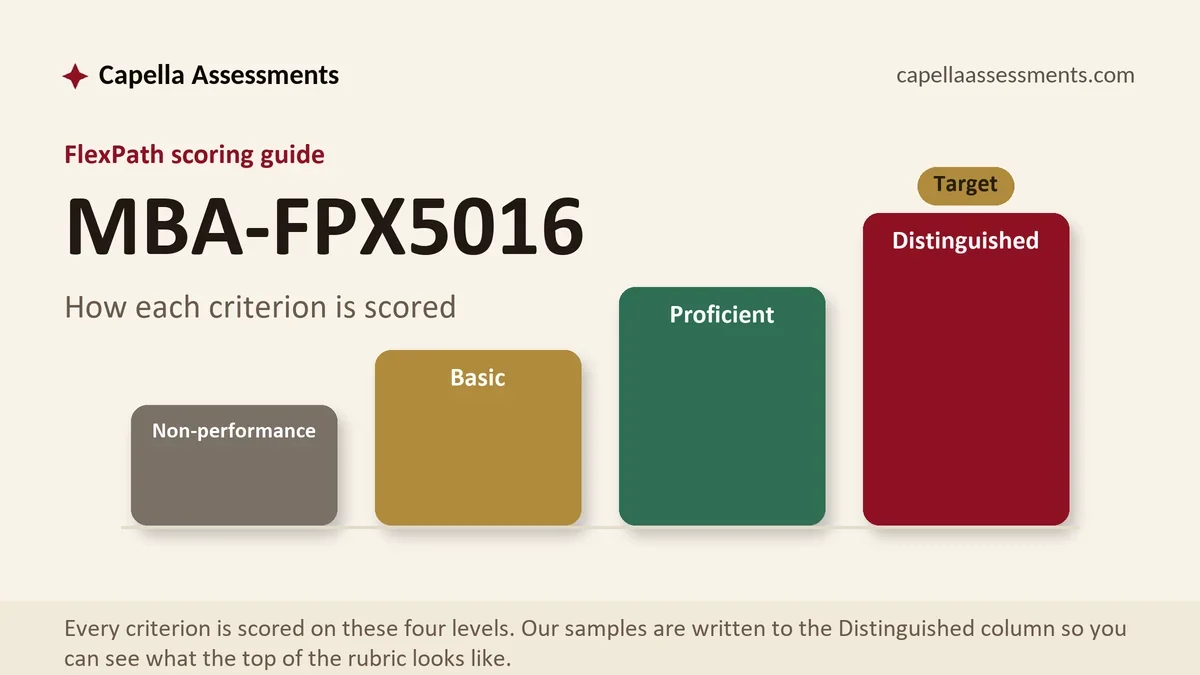
What MBA-FPX5016 is really about
MBA-FPX5016 turns the way work flows through an organization into something you can measure, and then insists you write about it that way. Process mapping, capacity, constraints, quality, improvement: the concepts are familiar to anyone who has run anything, which is exactly the trap. The course grades the formal version, a process drawn step by step, the bottleneck located by arithmetic, an improvement defended with cost and sequence, not the veteran's instinct that the intake step feels slow. The scoring guide criteria ask for analysis and evaluation of operations, and both verbs require numbers. For working professionals this is the most immediately usable writing in the MBA core, because the paper you draft is one memo away from your own floor.
In current courserooms the arc typically moves from process analysis, where a real operation is mapped and its constraint computed, into an improvement case that is quantified, costed, and sequenced, and closes with an operations synthesis. The intellectual through-line is the difference between naming a problem and measuring one. Operations vocabulary is easy to acquire and the course knows it, so the levels separate on whether the concepts do arithmetic: cycle time actually timed, capacity actually calculated, the cost of waiting actually priced. A Distinguished paper reads like the proposal a plant manager would fund, modest about scope, exact about numbers, honest about implementation order. The samples on this shelf are written to that standard because the genre collapses without it.
What MBA-FPX5016’s assessments ask for
The assessments ask you to take one operation apart and put it back together better, in writing. The process analysis wants the operation mapped at a useful grain, inputs, steps, decision points, outputs, with the constraint identified by computation: this step processes so many units per hour, demand is higher, therefore the queue forms here. The improvement assessment asks for a change proposal with the gain quantified, the cost estimated, the sequence of implementation laid out, and the tradeoffs acknowledged, including what the improvement makes worse. The synthesis connects operational thinking to leadership, how you will keep measuring after the course ends. Scoring guide criteria are specific about evidence, so each claim about the process needs a number, an observation, or a source standing behind it.
Where students lose points in MBA-FPX5016
The characteristic 5016 loss is the bottleneck asserted rather than computed. The paper declares that scheduling is the constraint because everyone complains about it, but no capacity arithmetic appears, no rate per step, no demand comparison, and the analysis criterion settles at Basic for missing the one calculation the genre exists to show. Close behind is lean vocabulary worn as decoration: waste, kaizen, and Six Sigma invoked in the introduction and never applied to a single mapped step, which reads as name-dropping to any assessor. Third, the improvement case without a risk or tradeoff paragraph, a proposal that costs nothing, disrupts nothing, and cannot fail, which no operations reader believes. The samples run the arithmetic, apply one improvement lens properly, and price both the gain and the pain.
The MBA-FPX5016 drawers
MBA-FPX5016 Assessment 1 Process Improvement Plan example
In current courserooms this assessment typically appears as "Process Improvement Plan". The process analysis with the bottleneck computed. On request, 24-48h.
MBA-FPX5016 Assessment 2 costed improvement case example
The improvement case: quantified, costed, sequenced. On request, 24-48h.
MBA-FPX5016 Assessment 3 operations synthesis example
The operations synthesis that closes the course. On request, 24-48h.
Your courseroom shows something else?
Capella revises courses; assessment counts and titles shift between versions. Send what your courseroom shows and the desk matches it exactly.
Using a MBA-FPX5016 sample the right way
The most productive way to use an MBA-FPX5016 sample is next to a process you actually know. Read the sample's process map, then sketch your own operation at the same grain and try the same capacity arithmetic on it; where the sample computes units per hour, compute yours. That exercise converts the sample from reading into rehearsal. Keep its improvement case as a template for shape, gain, cost, sequence, tradeoff, and fill every slot with your own figures. If your assessment differs, send the scoring guide from your courseroom and request a free custom sample, typically delivered in 24-48h.
How these samples are written
Every sample in this drawer is written the same way our custom ones are: the scoring guide decoded criterion by criterion, a subject-matched writer drafting to the Distinguished column, APA checked line by line, and the reasoning annotated so the paper teaches while it shows. Capella revises scoring guides, so a custom request is always written to the guide in YOUR courseroom, never from a stale template.
MBA-FPX5016 questions, answered
Can I write my MBA-FPX5016 process analysis about a service operation instead of a factory?
Yes, and many of the strongest papers do. Queues, capacity, and constraints behave the same in a clinic intake, a help desk, or a loan approval flow as on a production line, and courseroom instructions usually leave the choice open. Pick an operation you can observe and measure. A custom sample can be written to a service scenario if that matches your assessment.
How much math does an MBA-FPX5016 paper actually require?
Less than learners fear and more than most first drafts contain. The core is arithmetic: rates, capacity, utilization, simple cost totals, the kind you can run in a basic spreadsheet. What the scoring guide punishes is not weak math but absent math, claims about the process with no computation attached. A sample shows exactly where the numbers belong and how briefly each can be presented.
Will an MBA-FPX5016 sample match the exact process scenario in my courseroom?
Only a custom one will, which is why the request exists. Send your scoring guide and the assessment instructions, note whether your operation is manufacturing or service, and the sample is written to those criteria, first one free, typically 24-48h. Study it for the mapping grain, the constraint calculation, and the costing of the improvement, then build your own paper on your own process.