Each drawer below is one MHA-FPX5006 assessment. Where a sample is live, read it in full, true APA form with the reasoning annotated. Where it is not, request it free: send your assessment number and the scoring guide from your courseroom, and a custom sample written to your exact criteria arrives in 24 to 48 hours. Searches like "MHA FPX 5006 assessment 2 example", "MHA FPX 5006 sample paper", and "MHAFPX5006 sample" all land here, because this page is the drawer they belong in.
What MHA-FPX5006 is really about
Money is where healthcare administration gets specific, and MHA-FPX5006 is the FlexPath course that demands the specificity in writing. It covers how healthcare organizations are actually paid: Medicare and Medicaid structures, commercial payers, the movement from fee-for-service toward value-based arrangements, and what each model does to revenue. Assessments turn that content into analyst work, asking for financial statements read correctly, reimbursement environments explained, and budget or revenue problems worked through with figures rather than adjectives. The scoring guides are blunt about it: criteria ask you to calculate, interpret, and recommend. A paper that discusses financial health without producing a single computed number sits at Basic no matter how fluent the prose around it is.
The typical sequence in this course opens with the reimbursement system itself, how public and private payers set and pay rates, then moves into applied financial analysis for a department or organization, and closes with a decision-facing deliverable such as a financial plan or proposal argued to leadership. Exact titles vary by revision, so your scoring guide decides the assignment; the genre does not change. Every version asks the writer to behave like the administrator who owns a budget: state the numbers, show where they came from, and say what they force the organization to do. Our samples are built in that voice, with tables where tables help and the arithmetic visible enough to audit.
What MHA-FPX5006’s assessments ask for
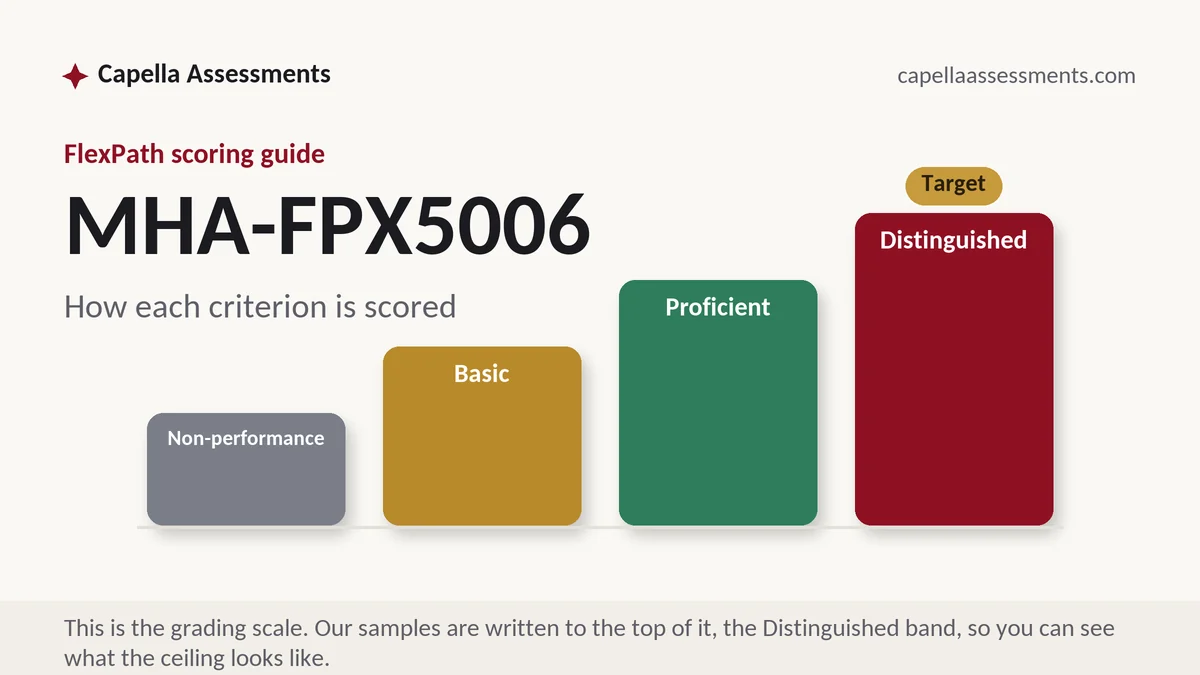
MHA-FPX5006 criteria typically ask for three moves in sequence. First, explain the payment mechanics honestly: who the payers are, what they reimburse, and how a shift in payer mix or rates changes revenue. Second, analyze real or scenario financials, reading statements, computing the measures the assessment names, and comparing results against something meaningful. Third, recommend: a criterion near the end of most versions wants the analysis converted into a funded, defensible management action. Distinguished work is separated from Proficient by traceability. An assessor should be able to follow every figure from source to calculation to conclusion without guessing. Cite the reimbursement rates you apply, label what each computation measures, and keep the recommendation proportionate to what your numbers can actually support.
Where students lose points in MHA-FPX5006
Two failures account for most lost points in MHA-FPX5006. The first is finance without arithmetic: a paper describes an organization as "financially strained", discusses reimbursement "pressure", and never computes a payer mix percentage, applies a rate, or subtracts cost from revenue to show a margin. The criterion said analyze; the assessor finds narration. The second is the ratio dropped in a vacuum: a current ratio of 1.4 or an operating margin of 2 percent reported as if the number spoke for itself, with no benchmark, prior period, or industry median beside it. A ratio only means something against a comparison, and scoring guides reward the writer who states one. Our samples show the calculation and the yardstick every time.
The MHA-FPX5006 drawers
MHA-FPX5006 Assessment 1 Financial Basics example
In current courserooms this assessment typically appears as "Financial Basics". Most versions open with the reimbursement foundation: payment models and payer behavior explained with rates made concrete. On request, free, 24-48h.
MHA-FPX5006 Assessment 2 financial analysis and benchmarking example
The middle position usually holds the applied analysis: statements read, measures computed, results benchmarked for a healthcare organization. On request, free, 24-48h.
MHA-FPX5006 Assessment 3 Cost-Benefit Analysis example
In current courserooms this assessment typically appears as "Cost-Benefit Analysis". The close is typically a financial proposal: a plan or recommendation costed and argued to executives who control the budget. On request, free, 24-48h.
Your courseroom shows something else?
Capella revises courses; assessment counts and titles shift between versions. Send what your courseroom shows and the desk matches it exactly.
Using a MHA-FPX5006 sample the right way
Open the sample next to your own scenario data, because the value of a MHA-FPX5006 model is the method, not the figures. Note how the paper sets up each computation before performing it, how sources for rates and benchmarks are cited, and how the recommendation is sized to the margin the math actually produced. Then run the same method on the numbers in your courseroom, which will differ from the sample's. If your assessment uses a scenario or spreadsheet the drawers do not cover, request a free custom sample written to your exact scoring guide and dataset; it arrives within 24-48 hours.
How these samples are written
Samples here follow one discipline: the scoring guide is the outline, every criterion gets its section, the Distinguished description decides the depth, and the APA layer ships exact. Because Capella updates courses over time, your free custom sample is drafted against the scoring guide you send, not against an archive.
MHA-FPX5006 questions, answered
How fast can I get a MHA-FPX5006 sample for my exact assessment?
Within 24-48 hours of sending your scoring guide, and the first custom sample is free. That window covers the numeric setup too: if your version includes a scenario budget or reimbursement dataset, the writer works those figures so the sample's calculations match the assessment you were actually given.
Do the MHA-FPX5006 samples show actual calculations or just discuss finance in general terms?
Actual calculations. Payer mix worked out in percentages, reimbursement rates applied to volumes, margins and ratios computed and then compared to a stated benchmark. Capella's finance criteria ask for analysis and interpretation, and both die without arithmetic, so every sample keeps its math visible and cites where each rate or benchmark came from.
I can read financial statements but freeze when writing about them. Will a sample help?
That gap is exactly what a sample closes. Most MHA-FPX5006 students lose points on the writing around the numbers, not the numbers: framing the computation, interpreting the result, attaching a decision. The samples model those connecting sentences at Distinguished level, so you can see how an analyst moves from figure to finding to recommendation, then write your own.