Each drawer below is one MHA-FPX5010 assessment. Where a sample is live, read it in full, true APA form with the reasoning annotated. Where it is not, request it free: send your assessment number and the scoring guide from your courseroom, and a custom sample written to your exact criteria arrives in 24 to 48 hours. Searches like "MHA FPX 5010 assessment 2 example", "MHA FPX 5010 sample paper", and "MHAFPX5010 sample" all land here, because this page is the drawer they belong in.
What MHA-FPX5010 is really about
MHA-FPX5010 teaches the planning discipline behind healthcare growth decisions: reading an organization's market and regulatory environment, assessing internal capacity, generating strategic options, and committing to a direction that the evidence can carry. The writing genre is the strategic plan and its supporting analyses, which makes this one of the most integrative papers in the MHA before the capstone. A single deliverable may need demographic data, competitor context, payer trends, mission alignment, and a financial case, each handled competently. Scoring guides reward the chain of reasoning: Distinguished work shows why this strategy, for this organization, in this environment, while weaker papers present a generic initiative that could have been proposed for any hospital in any city.
Current courserooms typically stage the work from analysis toward commitment: an environmental or organizational assessment first, then development of strategic options or a proposed initiative, then the assembled plan argued to decision-makers. Because Capella revises assessment titles between versions, your scoring guide decides what each deliverable is called; treat the drawers below as positions in that arc rather than official names. Whatever the version, the constant is evidence density. A strategic claim in this course needs a source: population figures from census or state health data, utilization trends from published reporting, regulatory factors tied to the agency that enforces them. Our samples carry that density while staying readable, which is the balance the Distinguished column actually describes.
What MHA-FPX5010’s assessments ask for
Expect MHA-FPX5010 criteria to ask you to analyze before you propose. Typical scoring guides want the environment assessed with named tools, internal strengths and constraints weighed honestly, and a strategy selected with the alternatives acknowledged, not hidden. The financial dimension recurs in most versions: criteria ask what the initiative costs, what revenue or savings it produces, and how the organization funds it, which means a feasibility passage with real numbers. Communication criteria sit on top, since the plan is addressed to executives or a board and is graded partly on whether it persuades. Across all of it, the Distinguished level asks for specificity of fit: every recommendation traceable to a finding in your own analysis, every projection tied to a cited figure.
Where students lose points in MHA-FPX5010
Where MHA-FPX5010 papers bleed points is the seam between evidence and money. The most common failure is the feasibility section written entirely in prose: a strategy is declared "financially viable" with no cost estimate, no revenue projection, no payer mix behind the volume assumptions, and the assessor scores the criterion as unsupported because nothing was computed. Close behind is the data dump that decides nothing: pages of demographic and utilization figures, dutifully cited, that never resolve into a stated implication for the strategy. Analysis criteria are scored on the conclusion the data forces, not the data's presence. Samples in these drawers model both fixes, a costed financial case and a one-sentence "so the organization should" landing after every evidence block.
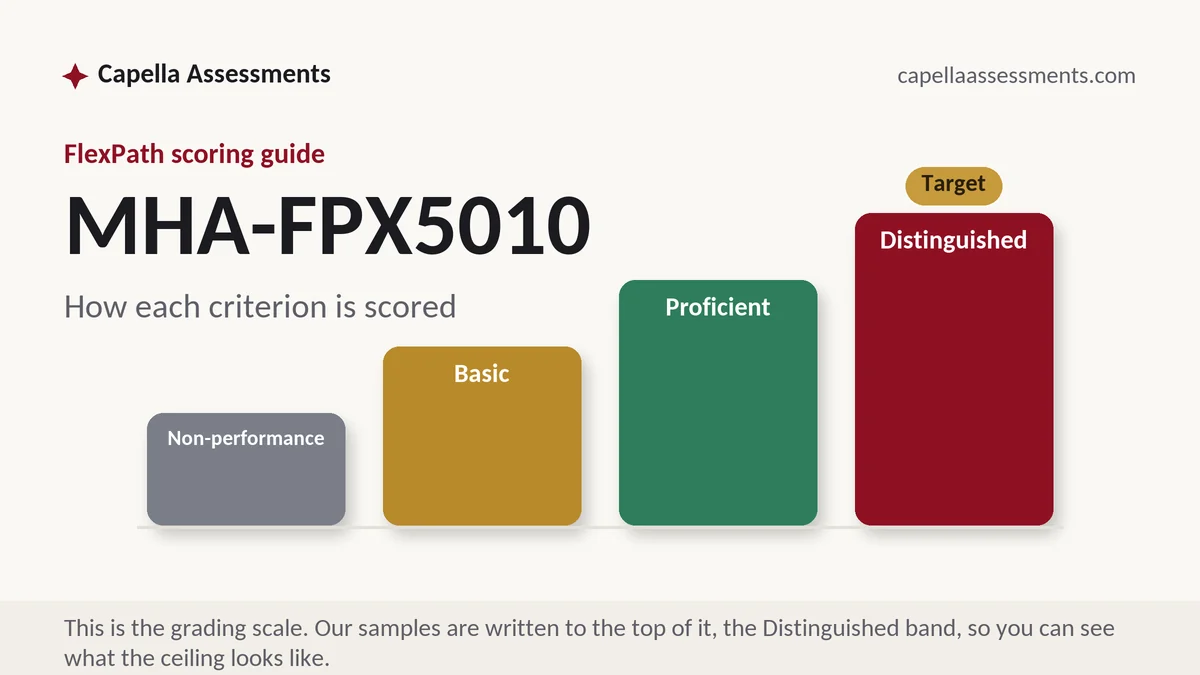
The MHA-FPX5010 drawers
MHA-FPX5010 Assessment 1 example
In current courserooms this assessment typically appears as "Current Environmental Analysis". Commonly the environmental assessment: market, community, and regulatory forces analyzed with cited data. On request, free, 24-48h.
MHA-FPX5010 Assessment 2 strategic options against capability example
In current versions the middle work develops strategic options and weighs them against organizational capacity. On request, free, 24-48h.
MHA-FPX5010 Assessment 3 Directional Strategies example
In current courserooms this assessment typically appears as "Directional Strategies". Most often the full plan: strategy, evidence, and financial case assembled for a board-level reader. On request, free, 24-48h.
Your courseroom shows something else?
Capella revises courses; assessment counts and titles shift between versions. Send what your courseroom shows and the desk matches it exactly.
Using a MHA-FPX5010 sample the right way
A strategic plan sample is most useful before you draft, as an anatomy lesson. Trace how the MHA-FPX5010 model moves from environmental finding to option to commitment, and notice what evidence sits behind each turn; that architecture transfers to any organization. Then build your own plan around a different setting, your employer, your community's data, your courseroom scenario, so the fit analysis is genuinely yours. Check the finished draft against your scoring guide's exact criteria, because versions differ in what they weight. If yours asks for a deliverable the drawers do not match, send the scoring guide and a free custom sample comes back in 24-48 hours.
How these samples are written
The method behind every paper on this shelf: criteria first, structure from the criteria, evidence current, APA exact, and annotations that show which paragraph answers which criterion. Send your courseroom's scoring guide with a request and the custom sample matches it exactly, revisions included.
MHA-FPX5010 questions, answered
Is there a MHA-FPX5010 strategic plan example based on a real healthcare organization?
The drawer samples use realistic organizational scenarios with cited public data, the same kind of evidence your assessment expects. If your courseroom assigns a specific scenario or asks you to use your own workplace, request a free custom sample and we will write to that context and your scoring guide, delivered in 24-48 hours.
My MHA-FPX5010 assessment wants a financial justification inside the plan. Do samples cover that?
Yes, and it is where the samples earn their keep. Each plan's feasibility section shows the arithmetic: estimated costs, projected volumes and revenue with the payer assumptions stated, and a break-even or margin figure the recommendation stands on. You see how a strategy criterion and a finance criterion get satisfied in the same document.
How current is the market and regulatory data in MHA-FPX5010 samples?
Each sample is written fresh against the scoring guide you send, so the evidence is pulled at writing time: recent census and state health department figures, current payer trends, and regulatory factors attributed to the agency responsible. Nothing is recycled from an old paper, which matters in a course that grades how well evidence fits the environment you analyzed.