Each drawer below is one MHA-FPX5028 assessment. Where a sample is live, read it in full, true APA form with the reasoning annotated. Where it is not, request it free: send your assessment number and the scoring guide from your courseroom, and a custom sample written to your exact criteria arrives in 24 to 48 hours. Searches like "MHA FPX 5028 assessment 2 example", "MHA FPX 5028 sample paper", and "MHAFPX5028 sample" all land here, because this page is the drawer they belong in.
What MHA-FPX5028 is really about
MHA-FPX5028 asks a question most administrators never get time to sit with: what do other countries' health systems actually do differently, and what would transfer? The course works through the classic structural models, tax-funded national services, social insurance systems, mixed and market-driven arrangements, and pushes you past labels into mechanics: who pays, who is covered, how providers are organized, and what the population gets for it. The writing genre is comparative analysis. Every assessment expects you to hold at least two systems in frame at once and to compare them on stated dimensions rather than general impressions, which is a more disciplined structure than most graduate papers ever require.
The comparison only works when the numbers behind it are real. Spending per capita, coverage rates, workforce density, outcome measures: these exist in published datasets from the WHO, the OECD, and the Commonwealth Fund, and scoring guides in this course quietly separate students who cite those sources from students who write 'studies show'. Our samples treat the data layer as the spine of the paper. Each one names its indicators, states the year and source for every figure, and keeps the comparison honest when a number cuts against the argument. That habit, benchmark only against data you can point to, is the single transferable skill the course is built around, and it is exactly what evaluators reward.
What MHA-FPX5028’s assessments ask for
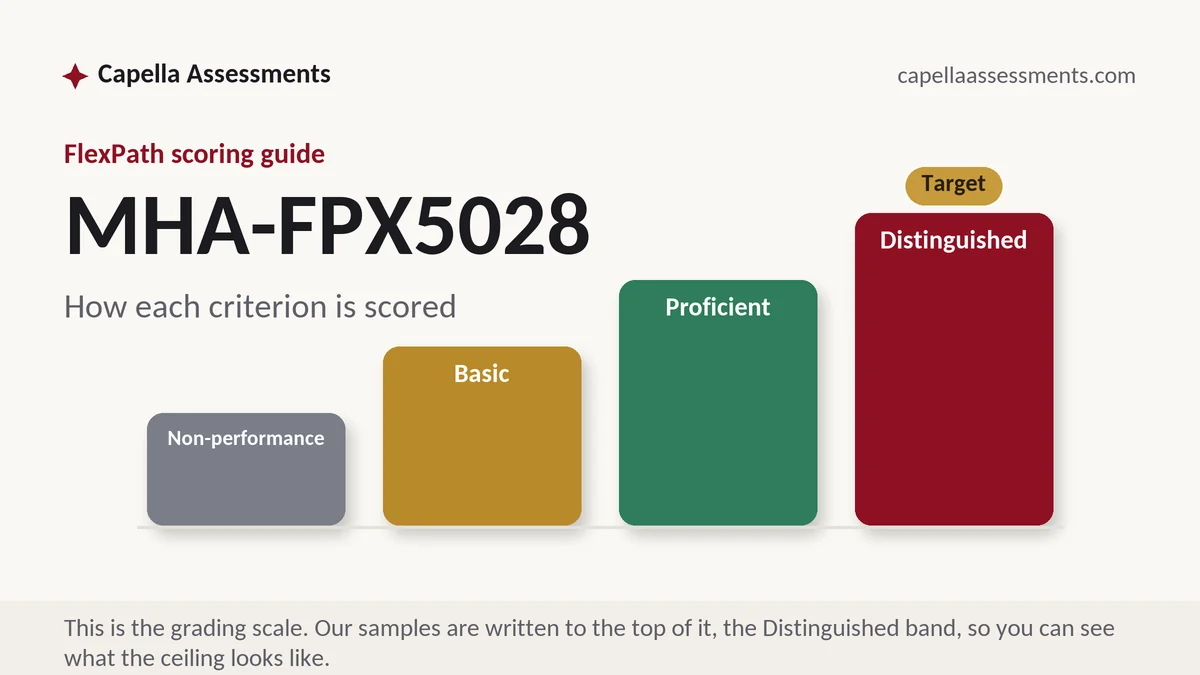
Expect three moves in every MHA-FPX5028 scoring guide. First, describe: lay out how each selected system is financed, organized, and governed, accurately enough that a reader from that country would nod. Second, compare: put the systems against shared criteria, access, cost, quality, equity are the usual axes, with published indicators doing the measuring. Third, apply: draw out what a US health organization or policymaker should take from the contrast, framed as an administrator's judgment rather than a political opinion. Criteria also reward structure, a comparison table or parallel headings that keep dimensions aligned, and scholarly support at the graduate level. Distinguished work typically adds the limits of the comparison: where data years differ, where definitions do not match, and what that does to the conclusion.
Where students lose points in MHA-FPX5028
Point loss in MHA-FPX5028 is almost always a sourcing problem wearing an analysis costume. The paper declares one system 'more efficient' or 'better performing' and benchmarks it against nothing: no dataset named, no indicator defined, no year given. An evaluator cannot score a comparison criterion at Distinguished when the comparison rests on reputation, so the work settles at Basic or Proficient even when the prose is strong. The same failure has a quieter variant: real numbers appear, but from different years or incompatible definitions, spending measured one way in one country and another way in the second, with no acknowledgment. And papers that praise a foreign model without asking what it would take to transfer any part of it leave the application criterion empty. Named sources, matched indicators, honest limits: that is where the points live.
The MHA-FPX5028 drawers
MHA-FPX5028 Assessment 1 health system profile example
Openers in this course typically profile a single health system model in depth, financing, coverage, and governance mapped before any comparison begins. On request, free, 24-48h.
MHA-FPX5028 Assessment 2 systems comparison example
The middle assessment usually carries the comparison itself, two or more systems held against shared indicators with every figure sourced. On request, free, 24-48h.
MHA-FPX5028 Assessment 3 lessons for US administration example
Closing work tends toward application, what the contrast teaches a US administrator, argued as transferable lessons with stated limits. On request, free, 24-48h.
Your courseroom shows something else?
Capella revises courses; assessment counts and titles shift between versions. Send what your courseroom shows and the desk matches it exactly.
Using a MHA-FPX5028 sample the right way
Read a MHA-FPX5028 sample with a highlighter for sources. Mark every place a figure carries a dataset name and a year, then notice how the argument leans on those marked points and nowhere else. That is the pattern to copy into your own draft, with your own country pair and your own indicators. Do not reuse the sample's systems or its numbers; your courseroom prompt and scoring guide set the terms, and data ages fast. When you request a free custom sample, send that scoring guide and tell us which systems you chose, and we will build the comparison to your criteria in 24-48h.
How these samples are written
The method behind every paper on this shelf: criteria first, structure from the criteria, evidence current, APA exact, and annotations that show which paragraph answers which criterion. Send your courseroom's scoring guide with a request and the custom sample matches it exactly, revisions included.
MHA-FPX5028 questions, answered
Where do MHA-FPX5028 samples get their health system data?
From the published international datasets evaluators expect to see cited: WHO statistics, OECD health data, and Commonwealth Fund comparisons, each named in text with the reporting year. We never present an unsourced benchmark, because that is precisely the habit the course is grading against. Your own paper should draw current figures from the same public sources so your numbers stay defensible.
Can I get a MHA-FPX5028 sample comparing the two countries my assessment assigned?
Yes. Country choice changes the whole paper, so a generic pair helps less than people expect. Send the assessment instructions and scoring guide from your courseroom, name the systems you are working with, and the first custom sample is free, written to those criteria and delivered in 24-48h. If your prompt leaves the choice open, we can model a defensible selection rationale too.
Do I need a comparison table in a MHA-FPX5028 paper, or is prose enough?
Check your scoring guide first; it decides. Most criteria in current courserooms score the quality of the comparison, not the format, but a table with matched indicators makes alignment visible to the evaluator, and misaligned dimensions are one of the fastest ways papers slide to Basic. Our samples usually show both: a compact table for the data, prose for the judgment.