Each drawer below is one NHS-FPX6008 assessment. Where a sample is live, read it in full, true APA form with the reasoning annotated. Where it is not, request it free: send your assessment number and the scoring guide from your courseroom, and a custom sample written to your exact criteria arrives in 24 to 48 hours. Searches like "NHS FPX 6008 assessment 2 example", "NHS FPX 6008 sample paper", and "NHSFPX6008 sample" all land here, because this page is the drawer they belong in.
What NHS-FPX6008 is really about
Money decides more care questions than pathophysiology does, and NHS-FPX6008 is where the MSN admits it. The course asks nurses to reason like stewards of scarce resources: what an economic issue costs a community, who bears that cost unevenly, and what an organization should fund first. The writing genre is decision support. Papers succeed when they move from describing an issue to pricing it, projecting it, and recommending against alternatives, which is a colder style than most clinical writing. Supply, demand, opportunity cost, and value-based payment appear not as vocabulary to define but as instruments to use on a problem you have personally seen in practice.
The arc in current courserooms usually runs from issue to investment: an economic problem chosen from your own setting, examined for its effect on patients, staff, and organization; then deeper analysis of disparities and drivers; then the argument for what to do, costed and defended. Equity is a graded thread, not a garnish, because economic harm lands hardest on populations already underserved, and the scoring guides ask you to say so with evidence. What surprises learners is how personal the course is. Assessments keep pulling the analysis back to your workplace and your community, so generic national essays underperform papers built on one named setting with numbers attached.
What NHS-FPX6008’s assessments ask for
Expect to be asked for numbers you must go find. The assessments want an economic issue described with local data, uninsured rates, readmission penalties, staffing costs, whatever your issue implies, and they want sources for every figure. Analysis criteria ask how the issue affects different stakeholder groups and why disparities persist. Recommendation criteria ask for a defensible course of action: projected costs, projected benefits, a timeline, and the ethical case for spending the money. Later pieces often ask you to anticipate the objections a chief financial officer would raise and answer them in advance. Throughout, scoring guides reward feasibility over ambition; a modest proposal with honest math outscores a sweeping one with hand-waved figures at every level of the guide.
Where students lose points in NHS-FPX6008
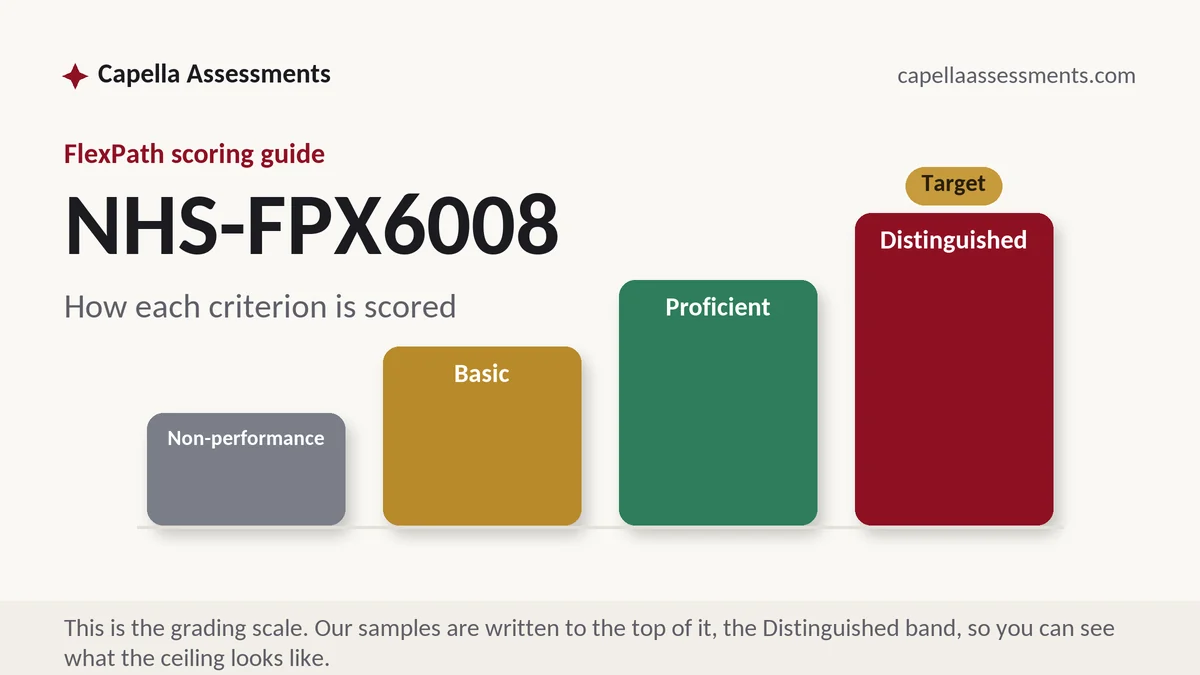
The expensive habit in NHS-FPX6008 is merging two criteria into one section because they feel like the same thought. Analyze the economic issue and analyze its impact on stakeholders read as one job, so the learner writes one blended discussion. The evaluator, scoring row by row, now has to excavate which sentences serve which criterion, and blended paragraphs rarely give either row its full performance; both land at Basic when each could have been Distinguished alone. The same merge happens between costs and benefits, and between the recommendation and its ethical justification. Keep one heading per criterion even when the content overlaps. Redundancy between sections costs nothing in this course; ambiguity about which row a paragraph answers costs twice.
The NHS-FPX6008 drawers
NHS-FPX6008 Assessment 1 local economic issue identified example
In current courserooms this assessment typically appears as "Identifying a Local Health Care Economic Issue". The first drawer typically holds orientation-stage work: an economic issue framed from the learner's own setting, with the people it affects traced concretely. On request, free, 24-48h.
NHS-FPX6008 Assessment 2 needs analysis for change example
In current courserooms this assessment typically appears as "Needs Analysis for Change". Assessment 2 samples usually deepen the analysis, following the issue into disparities, drivers, and the data that proves the problem is worth money. On request, free, 24-48h.
NHS-FPX6008 Assessment 3 business case for change example
In current courserooms this assessment typically appears as "Business Case for Change". Assessment 3 samples tend to occupy the proposal stage, modeling the costed argument for a specific intervention with benefits projected honestly. On request, free, 24-48h.
NHS-FPX6008 Assessment 4 lobbying the change to a decision-maker example
In current courserooms this assessment typically appears as "Lobbying for Change". Assessment 4 samples generally close the arc at synthesis, defending the full economic case, objections answered, ethics argued, feasibility shown. On request, free, 24-48h.
Your courseroom shows something else?
Capella revises courses; assessment counts and titles shift between versions. Send what your courseroom shows and the desk matches it exactly.
Using a NHS-FPX6008 sample the right way
Use a sample as a math model as much as a writing model. Look at how figures enter sentences, always sourced, always dated, and how projections stay conservative enough to defend. Notice that each criterion owns a section even where content overlaps, then mirror that discipline in your own draft with your own local numbers. Your setting's data is the part no sample can supply. Send the scoring guide from your courseroom and a note about your chosen issue, and a fresh sample comes back in 24-48h, free the first time, built on that exact guide.
How these samples are written
Samples here follow one discipline: the scoring guide is the outline, every criterion gets its section, the Distinguished description decides the depth, and the APA layer ships exact. Because Capella updates courses over time, your free custom sample is drafted against the scoring guide you send, not against an archive.
NHS-FPX6008 questions, answered
Can I get an NHS-FPX6008 sample on the economic issue I already picked?
Yes, that is the preferred way to request one. Name your issue and setting, attach the scoring guide from your courseroom, and the sample is written to both, first one free, delivered in 24-48h. A sample built on your actual issue shows you where local data belongs, which is the hardest part of this course to see in someone else's paper.
Why did two of my NHS-FPX6008 criteria both score Basic when the content was there?
Check whether you merged them into one section. When one discussion serves two rows, the evaluator has to split your sentences between criteria, and neither row gets a complete performance. Separate the headings, even if the sections echo each other. In the samples here every criterion has its own labeled block precisely to make that separation visible.
I am not a finance person. Will the sample math be beyond me?
No. NHS-FPX6008 expects clinician-grade economics: percentages, cost per event, projected savings, break-even reasoning, all of it explainable in plain sentences. Samples keep every calculation visible and sourced so you can follow the arithmetic and rebuild it with your own numbers. If a figure cannot be traced to a source, it does not go in the paper.