Each drawer below is one NURS-FPX8022 assessment. Where a sample is live, read it in full, true APA form with the reasoning annotated. Where it is not, request it free: send your assessment number and the scoring guide from your courseroom, and a custom sample written to your exact criteria arrives in 24 to 48 hours. Searches like "NURS FPX 8022 assessment 2 example", "NURS FPX 8022 sample paper", and "NURSFPX8022 sample" all land here, because this page is the drawer they belong in.
What NURS-FPX8022 is really about
Doctoral informatics starts from a blunt premise: technology is an intervention, and interventions must justify themselves. NURS-FPX8022 sits at the meeting point of information systems and doctoral practice, electronic records, decision support, telehealth, analytics, and the policies wrapped around them, all examined for their effect on outcomes, workload, safety, and equity rather than for their feature lists. That framing changes the writing. An evaluation is not a product review; it is an evidence-based judgment about fit between a system, a workflow, and a population, with the limits of the evidence stated. Learners who write about technology as clinicians responsible for consequences, not as enthusiasts or skeptics, tend to find the criteria straightforward to satisfy.
Currency is the quiet organizing principle of this course. Health information technology outdates its own literature quickly, so an argument about telehealth or predictive analytics leaning on sources past the five-year mark is arguing about a different product generation, and criteria in current courserooms tend to say so explicitly. The second principle is honest measurement: adoption metrics and outcome trends around a go-live move for many reasons at once, and doctoral prose keeps association and causation strictly apart. Add the policy layer, privacy, security, interoperability, governance, cited to the actual regulations, and you have the full register NURS-FPX8022 grades. The samples on this shelf are built to demonstrate all three at once.
What NURS-FPX8022’s assessments ask for
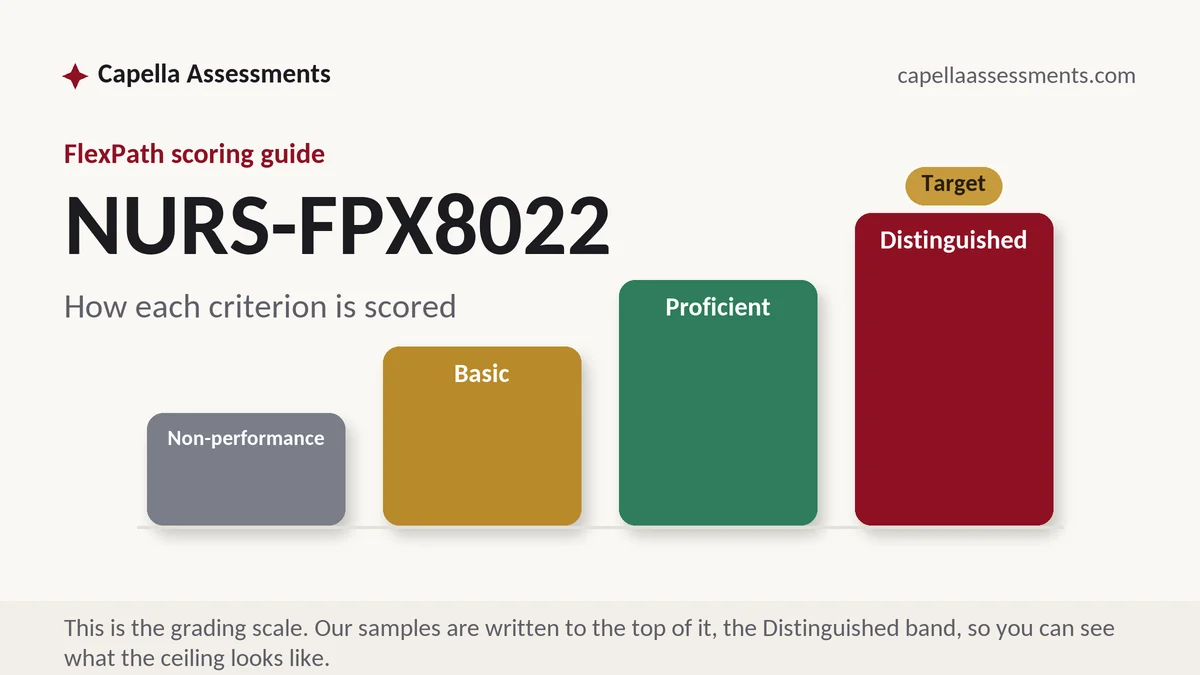
Criteria in NURS-FPX8022 generally ask you to do three kinds of work in sequence, whatever your courseroom titles them. First, analysis: a technology or information system examined against evidence for its effect on care, with workflow and human factors treated as part of the system. Second, application: a proposal or optimization plan for a specific setting, complete with stakeholders, training, data governance, and the privacy and security obligations named precisely. Third, evaluation: how you would measure whether the technology improved anything, framed as improvement measurement for one organization. Scoring guides reward synthesis of practice evidence over vendor claims, current citations over classics, and Distinguished columns often hinge on connecting the technical argument to policy and equity. As ever, your scoring guide decides; write to its wording.
Where students lose points in NURS-FPX8022
Citation age is the signature failure in NURS-FPX8022. Technology evidence from six or eight years ago describes interfaces, adoption barriers, and regulations that have since changed, and when a criterion asks for current evidence, those sources cost a level on their own. The causal trap follows close behind: readmissions fell after the new documentation platform went live, and the paper crowns the platform responsible, ignoring every concurrent initiative; doctoral reviewers want the associational framing and the confounders named. Mechanics complete the triad. Informatics writing cites reports, standards, and software documentation, and APA 7 handles each differently, so reference lists drift, DOIs lose their https://doi.org form, hanging indents collapse, and a technically sharp paper leaves polish points behind at the writing criterion.
The NURS-FPX8022 drawers
NURS-FPX8022 Assessment 1 recommendation derived from the organization's own data example
In current courserooms this assessment typically appears as "Using Data to Make Evidence-Based Technology Recommendations". In most courserooms the first assessment analyzes a technology or information system against evidence of its effect on care and workflow. On request, free, 24-48h.
NURS-FPX8022 Assessment 2 optimization of a system already in place example
The second assessment typically moves to an implementation or optimization plan for a specific setting, with stakeholders and the privacy obligations named precisely. On request, free, 24-48h.
NURS-FPX8022 Assessment 3 failure modes and downtime planning example
In current courserooms this assessment typically appears as "Risk Mitigation Plan". The final assessment usually turns to evaluation, asking how you would know the technology improved care in one setting. On request, free, 24-48h.
Your courseroom shows something else?
Capella revises courses; assessment counts and titles shift between versions. Send what your courseroom shows and the desk matches it exactly.
Using a NURS-FPX8022 sample the right way
A NURS-FPX8022 sample is most useful opened beside the actual system you plan to write about. Map its structure and evaluation logic, check how it handles evidence age, and audit your own source list the same way before you draft. Borrow its citation patterns for standards and reports, since those formats trip most writers. For work matched to your assessment, send the scoring guide from your courseroom, name the technology and setting, and a free custom sample comes back in 24-48h. Then write your own evaluation with your own data points; the sample shows the shape, and your submission stays yours.
How these samples are written
The method behind every paper on this shelf: criteria first, structure from the criteria, evidence current, APA exact, and annotations that show which paragraph answers which criterion. Send your courseroom's scoring guide with a request and the custom sample matches it exactly, revisions included.
NURS-FPX8022 questions, answered
Are the sources in NURS-FPX8022 samples recent enough for a technology course?
Recency is treated as a correctness issue here, not a preference. Current-practice claims cite inside the five-year window, regulations cite the standing version, and anything describing a product generation gets checked against what is actually deployed now. Because a custom sample is written at the time you ask for it, a NURS-FPX8022 sample requested this month cites this month's evidence base.
How do NURS-FPX8022 samples handle APA 7 for standards, agency reports, and software documentation?
Each source type is formatted to its own APA 7 pattern: reports with group authors and publishers, standards with numbers and issuing bodies, journal sources with DOIs in the https://doi.org form, all on hanging indents that hold. Informatics reference lists are where doctoral formatting usually slips, so the samples are built to be copied as patterns, with your own sources substituted.
Can I get a NURS-FPX8022 sample written around the system my organization runs?
You can. Name the system and the setting, attach the scoring guide from your courseroom, and the free custom sample is written to that combination in 24-48h, evaluation logic and policy layer included. Keep organizational specifics generic enough to share safely; the sample needs the system's class and context, never your internal data.