Send the exact assignment or rubric from your classroom and a custom sample written to it lands in 24 to 48 hours, the first one free. PM-FPX4050 is Capella’s Communication and Stakeholder Management course. It centers on identifying who can help or stop the project and planning what each of them hears, when, and from whom. Searches like "pm fpx 4050 assessment 3 assignment example", "PMFPX4050 sample paper", and "PM-FPX4050 assessment samples" land on this page.
What PM-FPX4050 is really about
Stakeholder work is scored on discrimination. Everyone can list the sponsor, the team, the customer and the vendor; the criteria in PM-FPX4050 ask what each one wants, what they can do about it, and how much attention they get as a result. The power and interest grid exists to force that ranking, and it only earns marks when placement is justified: this manager sits high on power because they control the budget line, that group sits high on interest because the change lands on their process. Placement without reasoning is decoration. The second discrimination is between the stakeholder who has to approve, the one who has to be consulted before a decision, and the one who only needs to know afterwards.
The communications plan is where the course becomes concrete, and the test is whether someone else could run it. Each line should carry an audience, the information they need, the channel, the frequency, the owner and the format, so a plan entry reads as an instruction rather than a wish. Regular updates as required is the phrase that costs the most marks in this shelf. The harder criterion, and the one that separates strong papers, is escalation and bad news: what triggers a message the sponsor will not enjoy, who delivers it, and how quickly. Most submissions plan the good reporting thoroughly and leave the difficult message unwritten, which is the moment the plan would actually be tested.
What PM-FPX4050’s assessments ask for
Assessments typically ask for a stakeholder analysis and a communications plan for a project, with the analysis feeding the plan. That means a register with each stakeholder's interest, influence and current attitude, a grid or equivalent with justified placement, and an engagement approach that differs by group rather than applying one style to all. The plan is then expected in a form someone could execute: audience, message, channel, frequency, owner. Where the criteria reach reporting, they usually want a status format specified and the escalation path named. Several versions ask you to draft an actual communication, a status update, a difficult message to a resistant stakeholder, and that is graded on audience fit and clarity, so producing the message beats describing your approach to it.
Where students lose points in PM-FPX4050
The dominant loss is the plan built out of frequencies nobody owns, where updates are provided regularly and no line says by whom. Second is the stakeholder list that treats everyone as equally important, which produces an engagement approach identical for the sponsor and the end user and shows no analysis at all. Third is the grid with no justification, where names are placed in quadrants and the reasoning stays in the writer's head. Marks also go for attitudes recorded as supportive or neutral with no evidence, for escalation left undefined so no message ever has a trigger, and for a drafted communication written in the vocabulary of the project team rather than of the audience receiving it. Resistance described without a reason for it loses marks too.
The PM-FPX4050 drawers
PM-FPX4050 Assessment 1 stakeholder analysis example
Assessment 1 typically registers who matters and justifies where each one sits. On request, free, 24-48h.
PM-FPX4050 Assessment 2 communications plan example
Assessment 2 often turns that analysis into lines someone else could execute. On request, free, 24-48h.
PM-FPX4050 Assessment 3 status report example
Assessment 3 usually drafts the reporting itself, including the message nobody wants. On request, free, 24-48h.
Your classroom shows something else?
Capella University revises courses; assessment counts and deliverables shift between terms. Send what your classroom shows and the desk matches it exactly.
Using a PM-FPX4050 sample the right way
Read a sample by taking one stakeholder and following them through it. Find them in the register, find the placement and its justification, then find the lines in the plan that exist because of them. If that thread holds, the paper is integrated in the way the criteria reward; if the plan would look the same without the analysis, it is two documents stapled together. Then look at the escalation trigger and the drafted message, which are the two places most submissions run out of specificity. Build yours around a project with at least one stakeholder who does not want it, since a plan for a cooperative audience proves nothing.
How these samples are written
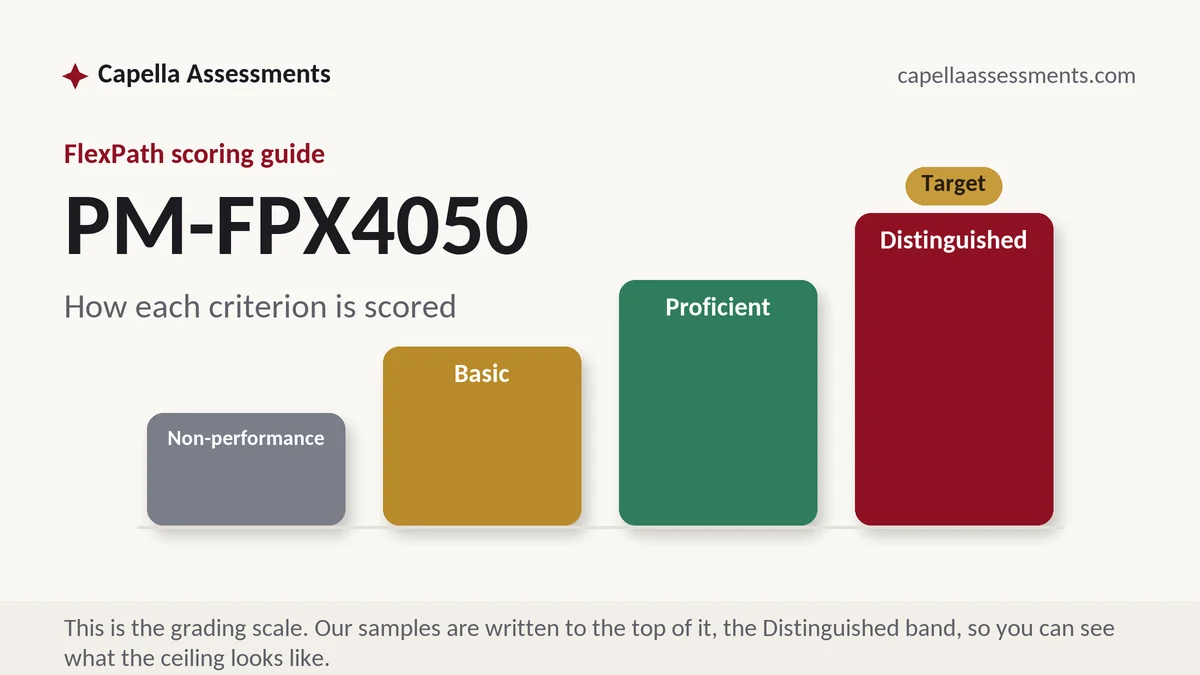
Samples here follow one discipline: the scoring guide is the outline, every criterion gets its section, the Distinguished description decides the depth, and the APA layer ships exact. Because Capella updates courses over time, your free custom sample is drafted against the scoring guide you send, not against an archive.
PM-FPX4050 questions, answered
How many stakeholders should the register include?
Enough that the ranking means something, which is usually more than the obvious four and fewer than everyone touched by the project. Include at least one who can block the work and one who is affected but has no power, because the difference in how you treat them is what the engagement criteria are looking for. A register of three cannot demonstrate prioritisation.
What does a communications plan line need to contain?
Audience, information, channel, frequency, owner and format. Six columns, filled specifically: the steering group receives a one page status by email every other Friday from the project manager. Anything vaguer than that cannot be executed by someone else, and executability is the standard the criteria apply. Add the trigger for unscheduled messages, since that is where most plans stop short.
How fast can I get a PM-FPX4050 sample?
24-48h for the first custom one, at no cost. Send the assessment instructions and the scoring guide from your courseroom, and say whether your section supplies a scenario or expects you to bring your own project. If it supplies one, the sample is built on that scenario so the stakeholder analysis matches the names your criteria will be graded against.