Send the exact assignment or rubric from your classroom and a custom sample written to it lands in 24 to 48 hours, the first one free. PM-FPX5018 is Capella’s Project Management Foundations course. It centers on choosing and defending a project approach for one organization, against its structure, maturity and appetite for change. Searches like "pm fpx 5018 assessment 3 assignment example", "PMFPX5018 sample paper", and "PM-FPX5018 assessment samples" land on this page.
What PM-FPX5018 is really about
PM-FPX5018 covers the same territory as an undergraduate introduction and is scored on a different question. The entry course asks whether you can tell a project from operations; this one asks which approach a named organization should use and why the alternative was rejected. That means the organization has to be on the page: how it is structured, who holds authority when the functional manager and the project manager disagree, how much process it will tolerate before it routes around you. Submissions that describe process groups and knowledge areas accurately, with no organization in sight, read as an undergraduate paper written at graduate length. The criteria in current courserooms are worded around selection and justification, which is a judgment call rather than a recall exercise.
Sourcing is the second thing that separates this course from its undergraduate sibling. A master's scoring guide expects claims about methodology to rest on published work rather than on a standards glossary, and it expects you to say where the evidence is thin. The professional dimension carries real weight too: what the practitioner owes a sponsor who wants a date before the estimate exists, what gets disclosed when the status is worse than the last report said. Written as principles, that section is filler. Written as a situation with a decision in it, it satisfies several criteria at once. Graduate papers also lose ground when they stay abstract, so name the industry, the size and the constraint that makes the choice difficult.
What PM-FPX5018’s assessments ask for
Assessments here typically ask for an analysis of how project work is actually run inside an organization and a recommendation about how it should be. That means describing the current practice with specifics, comparing at least two approaches on dimensions that matter to this organization, and recommending one with the trade-offs stated. Where the criteria reach process groups, they usually want them mapped onto a real case rather than defined. Where they reach the professional and ethical layer, they want a situation worked through to a decision. Most versions also expect the recommendation to address adoption: who resists it, what it costs them, and what would have to change in reporting lines for it to hold. Scholarly support is expected throughout, at the claims rather than at paragraph ends.
Where students lose points in PM-FPX5018
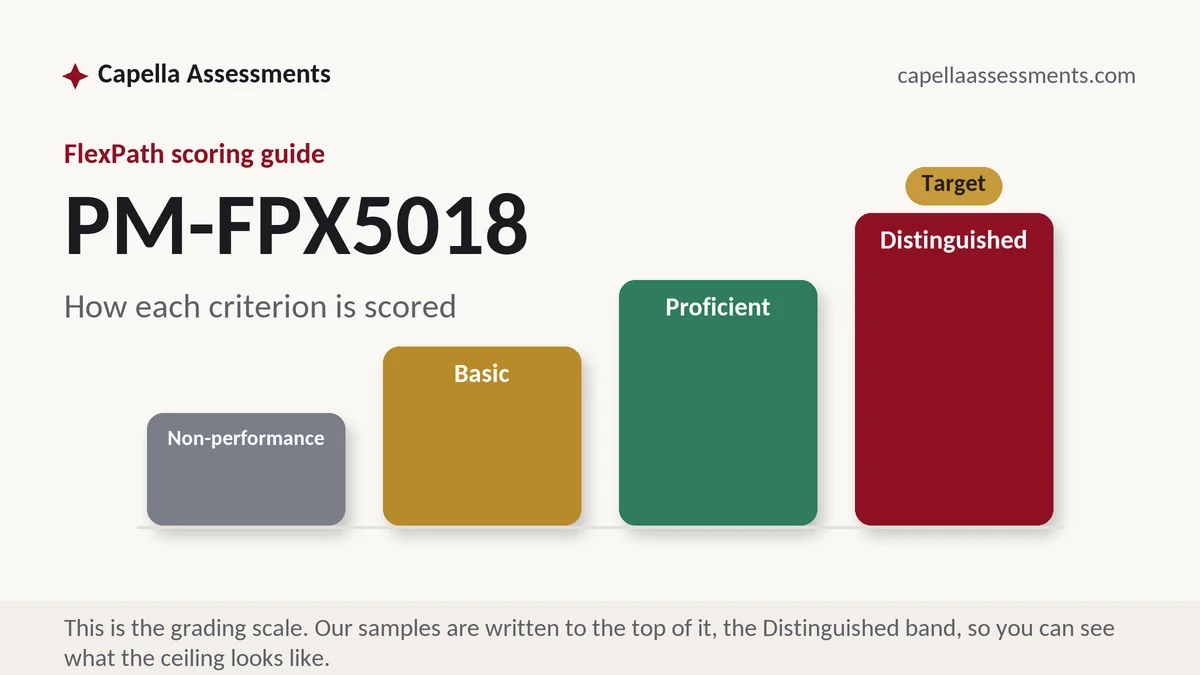
The characteristic loss at this level is the textbook paper: process groups and knowledge areas explained at graduate length, with no organization, no choice and nothing at stake. Second is the recommendation with no rejected alternative, which reads as preference rather than analysis, because a method chosen without a comparison cannot be defended. Third is a professional-conduct section listing principles the practitioner should uphold, unattached to any situation. Marks also go for organizational description that stops at the industry, for adoption ignored so the recommendation assumes compliance, and for support drawn from vendor pages and certification blogs where a graduate scoring guide expects peer-reviewed work. Papers that would read the same for any employer are the ones that stall at Basic on the analysis criteria.
The PM-FPX5018 drawers
PM-FPX5018 Assessment 1 organizational project analysis example
Assessment 1 typically describes how project work runs inside one organization today. On request, free, 24-48h.
PM-FPX5018 Assessment 2 methodology comparison example
Assessment 2 often weighs two approaches against that organization's structure and constraints. On request, free, 24-48h.
PM-FPX5018 Assessment 3 professional practice paper example
Assessment 3 usually works an ethical or accountability situation through to a decision. On request, free, 24-48h.
Your classroom shows something else?
Capella University revises courses; assessment counts and deliverables shift between terms. Send what your classroom shows and the desk matches it exactly.
Using a PM-FPX5018 sample the right way
Use a sample to see how much organizational detail a graduate paper needs before the recommendation stops sounding generic. Count how early the structure, the authority problem and the tolerance for process appear, then check that every later section refers back to them. Read the comparison closely, since the dimensions it chooses are the part of the craft that transfers. Then write yours about an employer or a client you know from the inside, because that detail is the one thing a sample cannot supply and the criteria weight it heavily. Notice too where the sample admits a limit in its own evidence, which reads as graduate judgment rather than hedging.
How these samples are written
The method behind every paper on this shelf: criteria first, structure from the criteria, evidence current, APA exact, and annotations that show which paragraph answers which criterion. Send your courseroom's scoring guide with a request and the custom sample matches it exactly, revisions included.
PM-FPX5018 questions, answered
How is PM-FPX5018 different from the undergraduate introduction?
Same knowledge areas, a different question. The entry course asks you to identify and define; this one asks you to select an approach for a named organization and defend it against the one you rejected. The scoring guide also expects scholarly support and a professional practice section worked through to a decision. Length is not the difference. Judgment is.
Can I use my current employer as the organization?
Usually yes, and it makes the analysis far sharper. Keep the employer unidentifiable, describe the structure and the decision rights rather than naming people, and leave out anything commercially sensitive. What the criteria need is the constraint that makes the choice hard: a matrix with no clear authority, a sponsor who will not fund planning, a team spread across time zones.
What sources does a graduate scoring guide accept here?
Peer-reviewed work for claims about how methods perform, and recognized standards for terminology. Vendor white papers and certification blogs can describe a practice but cannot support an argument that one approach outperforms another, and graders read that distinction closely at this level. Put the citation at the claim it supports, and say plainly where the published evidence is limited.