Send the exact assignment or rubric from your classroom and a custom sample written to it lands in 24 to 48 hours, the first one free. BUS-FPX4014 is Capella’s Operations Management for Competitive Advantage course. It centers on measuring an internal process closely enough to name its constraint, then pricing what relieving that constraint would actually return. Searches like "bus fpx 4014 assessment 3 assignment example", "BUSFPX4014 sample paper", and "BUS-FPX4014 assessment samples" land on this page.
What BUS-FPX4014 is really about
Operations is the part of a business a customer never sees and always feels. BUS-FPX4014 is built around the work itself: the sequence of steps that turns an order into something delivered, how long each one takes, how often it has to be redone, and how much capacity sits idle while a single station falls behind. The criteria reward measurement before judgment. A paper calling a process inefficient has offered an opinion. A paper reporting that four of the seven steps wait on the same approval has offered evidence, and every later section can be built on it. Competitive advantage arrives at the end of that logic rather than the beginning.
The second idea worth writing carefully is that an operation is only an advantage if copying it is slow. Anybody can buy the same equipment, so equipment is rarely the answer the criteria are looking for. What resists copying is an arrangement: a layout, a scheduling rule, a supplier agreement, a quality routine embedded in how people work. Quality is treated the same way, as a cost that has already been paid somewhere rather than as an aspiration. Rework consumes capacity twice, inspection catches defects after the money is spent, and prevention is the only category that reduces the total. Papers that price those three separately usually satisfy the analysis criteria without effort.
What BUS-FPX4014’s assessments ask for
Most versions ask you to take a process apart and recommend an operational change. That means presenting the process as steps with durations and owners, locating the constraint, and showing what throughput does when it is relieved. Where quality is the focus, the criteria want defects counted and the cost assigned to prevention, appraisal or failure rather than described as a problem. Capacity questions ask what the operation can produce at its current arrangement and what the next unit would cost. Where technology or automation is proposed, expect to be asked which step it removes and what happens to the people currently doing it. Recommendations are scored against a figure, not against an intention.
Where students lose points in BUS-FPX4014
The first loss is the process described with no numbers in it, where steps are listed and nothing is timed, which leaves every improvement unprovable. Second is the improvement aimed at a step that was never the constraint, so the paper speeds up work that then waits somewhere else. Third is quality treated as attitude, a recommendation to build a culture of quality with no defect rate, no cost and no routine attached. Marks also go for capacity discussed without a unit of output, for automation proposed as a saving with the implementation cost missing, and for a recommendation whose benefit is asserted rather than calculated from the figures the paper already established.
The BUS-FPX4014 drawers
BUS-FPX4014 Assessment 1 process analysis with timings example
Assessment 1 typically times each step and shows where the work sits waiting. On request, free, 24-48h.
BUS-FPX4014 Assessment 2 quality and capacity study example
Assessment 2 often counts defects and assigns the cost to prevention or failure. On request, free, 24-48h.
BUS-FPX4014 Assessment 3 operations improvement proposal example
Assessment 3 usually relieves one constraint and calculates what that is worth. On request, free, 24-48h.
Your classroom shows something else?
Capella University revises courses; assessment counts and deliverables shift between terms. Send what your classroom shows and the desk matches it exactly.
Using a BUS-FPX4014 sample the right way
Read a sample by looking for the arithmetic. Find the point where a duration or a defect rate turns into a figure that justifies the recommendation, because that connection is what most submissions never make and what the criteria are built to detect. Notice how the writer names one constraint rather than several problems. Then check whether the improvement is defended against the obvious objection about cost or staffing. Build yours around a process you can watch, at work, in a queue, in a kitchen, since observed steps give you durations, and durations are what turn an operations paper from description into analysis.
How these samples are written
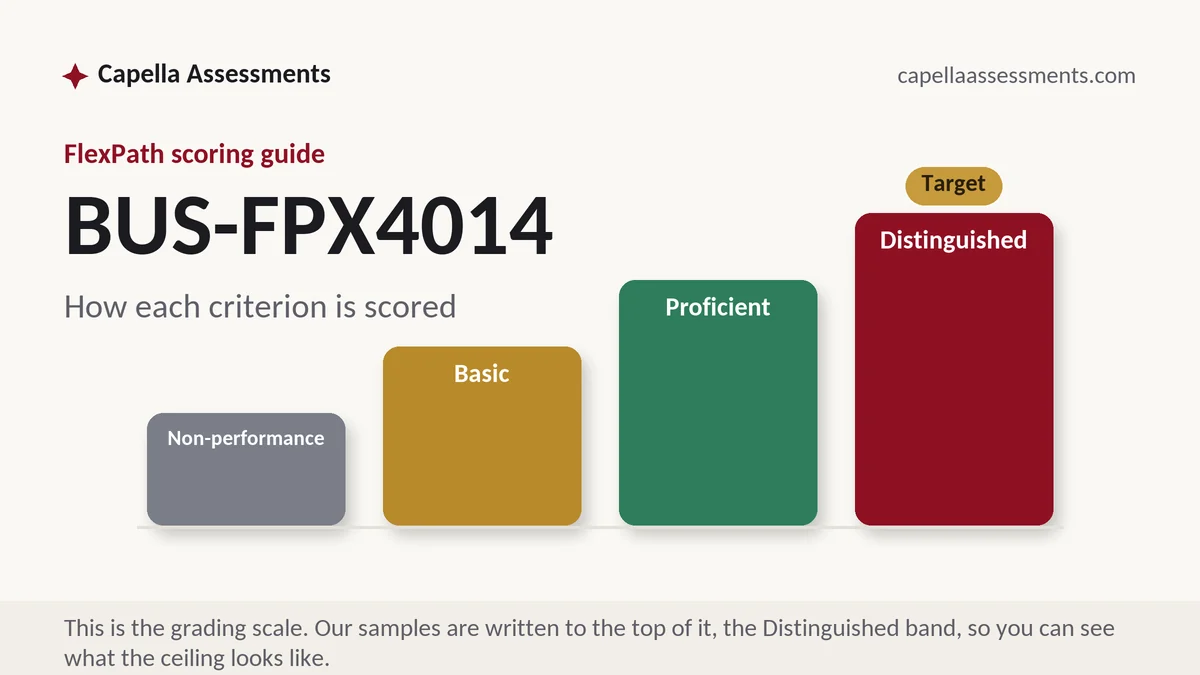
Every sample in this drawer is written the same way our custom ones are: the scoring guide decoded criterion by criterion, a subject-matched writer drafting to the Distinguished column, APA checked line by line, and the reasoning annotated so the paper teaches while it shows. Capella revises scoring guides, so a custom request is always written to the guide in YOUR courseroom, never from a stale template.
BUS-FPX4014 questions, answered
Can I estimate the timings if I cannot measure them?
Yes, provided you say they are estimates and explain the basis. An observed sample of five orders, a published industry figure or a supervisor's own account are all defensible. What the criteria penalize is an unsourced number presented with false precision, so a rounded estimate you can account for is safer than a decimal you cannot.
Does the process have to be manufacturing?
No. Service processes work well and are often easier to observe, since admissions, claims handling, dispatch and food preparation all have steps, queues and rework. The analytical moves are identical: time the steps, find where work waits, count what has to be done twice. Check your instructions in case yours specifies a setting.
Is there a BUS-FPX4014 Assessment 3 example I can request?
Yes. The first custom one costs nothing and normally arrives in 24-48h once the instructions and your scoring guide are in. If your assessment supplies a case with figures in it, send that too, since an operations paper is largely an argument about numbers and a sample built on different numbers argues a different case.