Send the exact assignment or rubric from your classroom and a custom sample written to it lands in 24 to 48 hours, the first one free. BUS-FPX4070 is Capella’s Foundations in Finance course. It centers on establishing what a firm's capital costs, then judging a project or a structure against that figure rather than against instinct. Searches like "bus fpx 4070 assessment 3 assignment example", "BUSFPX4070 sample paper", and "BUS-FPX4070 assessment samples" land on this page.
What BUS-FPX4070 is really about
Finance at this level rests on one uncomfortable idea: money already in the business is not free. Retained earnings feel costless because nobody sends an invoice, but the shareholders who left them there expect a return, and a project earning less than that return has destroyed value while appearing profitable. BUS-FPX4070 builds most of its assessments on that idea. Once a writer accepts it, the weighted average cost of capital stops being a formula to memorize and becomes the number every proposal has to clear. Papers that treat it as an arithmetic exercise usually produce it correctly and then never use it again, which the criteria notice.
Risk is the second pillar and the one that makes the first one work. Investors require more return where outcomes are less certain, which is why a stable utility and an early stage venture cannot be discounted at the same rate, and why using one company's cost of capital to evaluate a project in a different business is a real error rather than an approximation. Assessments reward writers who justify their rate before applying it. Capital structure follows the same logic: debt is cheaper until the leverage itself makes every claim on the firm riskier, and the interesting question is always where that turn happens for this particular business.
What BUS-FPX4070’s assessments ask for
Assessments here usually establish a cost of capital and then make something depend on it. That means computing the components from figures you can source, weighting them by the structure the firm actually has, and stating the assumptions the result rests on. Project evaluation sections want the decision rule applied consistently and the answer expressed as a recommendation rather than as a value. Where valuation appears, the criteria are reading the inputs more than the model, since a growth rate assumed casually will swing the output further than the choice of method. Financing questions ask what the firm should raise and what that choice does to the people already holding claims on it.
Where students lose points in BUS-FPX4070
The costliest habit is the discount rate that appears from nowhere, ten percent used because it is a round number, which makes every figure downstream unverifiable. Second is the cost of capital computed correctly and then abandoned, so the project is judged on payback or on enthusiasm instead. Third is the valuation whose growth assumption exceeds what the business could sustain, producing a number the paper never questions. Marks also go for market values and book values used interchangeably, for tax ignored in the cost of debt, for risk discussed in adjectives rather than in the rate, and for recommendations that never say what the firm should actually do with the money.
The BUS-FPX4070 drawers
BUS-FPX4070 Assessment 1 cost of capital working example
Assessment 1 typically sources each component and states the weights behind the rate. On request, free, 24-48h.
BUS-FPX4070 Assessment 2 project evaluation example
Assessment 2 often runs the project against that rate and says what would reverse the answer. On request, free, 24-48h.
BUS-FPX4070 Assessment 3 capital structure recommendation example
Assessment 3 usually decides what to raise and what it does to existing claims. On request, free, 24-48h.
Your classroom shows something else?
Capella University revises courses; assessment counts and deliverables shift between terms. Send what your classroom shows and the desk matches it exactly.
Using a BUS-FPX4070 sample the right way
Read a sample for the rate and where it came from. Everything else in a finance paper is downstream of that number, so a sample that sources its components and states its weights is showing you the part that earns the marks. Then check whether the recommendation survives a different assumption, because a good one says what would reverse it. Recompute the weighted figure yourself. Build yours around a firm whose capital structure is published, since the components have to come from somewhere and a private company leaves you estimating the inputs the whole paper depends on.
How these samples are written
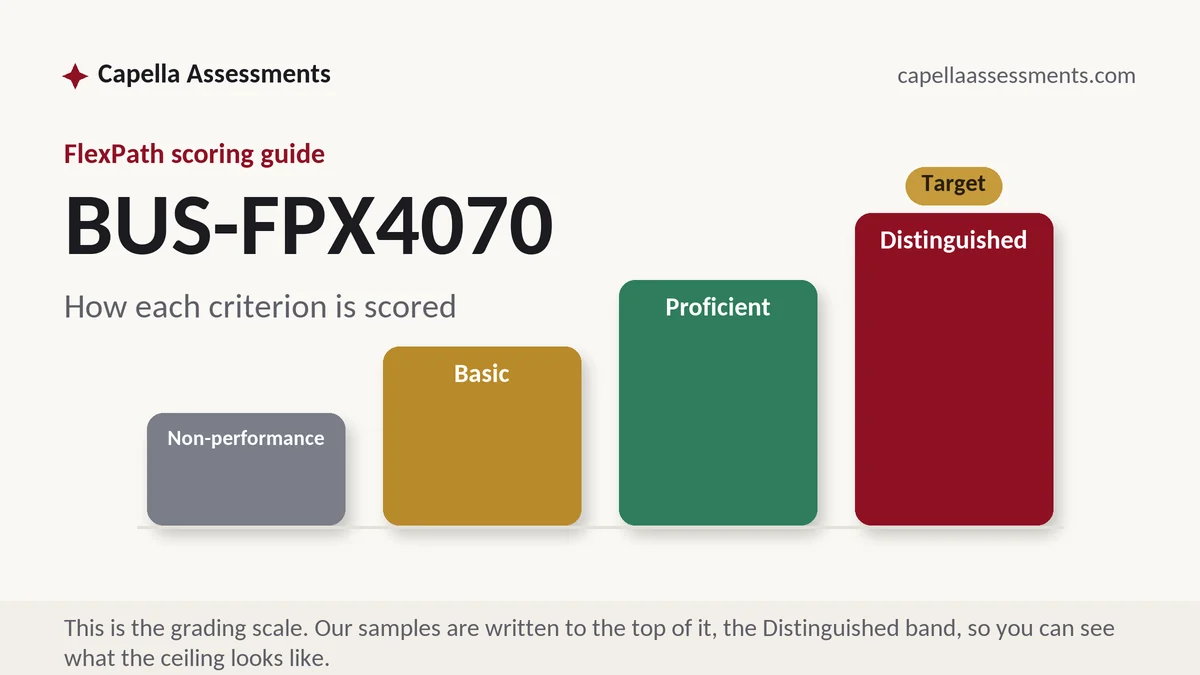
Samples here follow one discipline: the scoring guide is the outline, every criterion gets its section, the Distinguished description decides the depth, and the APA layer ships exact. Because Capella updates courses over time, your free custom sample is drafted against the scoring guide you send, not against an archive.
BUS-FPX4070 questions, answered
Where do I get the inputs for a cost of capital?
Published filings give you the debt balances and the interest expense, market data gives you the share price and the shares outstanding, and the risk free rate comes from government yields with the date noted. Beta is usually available from several sources that disagree, which is worth a sentence rather than a silent choice between them.
Which decision rule should I use when they disagree?
Say that they disagree and explain why, which is usually the most valuable paragraph available. Where net present value and internal rate of return point different ways, the difference normally comes from scale or from the timing of the flows, and naming the cause demonstrates exactly the understanding the criteria are testing. Then recommend one and justify it.
How quickly can I see a BUS-FPX4070 example?
Ask for it with your instructions and scoring guide attached; the first custom sample is free and rarely takes longer than 24-48h. Name the company or send the project data your assessment specifies, because a finance paper is a chain of computations from given inputs, and a model built on another firm's figures would show the chain while every link in it belongs to somebody else.