Each drawer below is one MHA-FPX5016 assessment. Where a sample is live, read it in full, true APA form with the reasoning annotated. Where it is not, request it free: send your assessment number and the scoring guide from your courseroom, and a custom sample written to your exact criteria arrives in 24 to 48 hours. Searches like "MHA FPX 5016 assessment 2 example", "MHA FPX 5016 sample paper", and "MHAFPX5016 sample" all land here, because this page is the drawer they belong in.
What MHA-FPX5016 is really about
MHA-FPX5016 introduces health information systems as objects of management decision: what an EHR, patient portal, or health information exchange actually does for an organization, what it costs to own, and what obligations follow it. The course sits deliberately on the administrator's side of the table. You are not configuring databases; you are evaluating whether a system serves clinical operations, revenue integrity, reporting duties, and the privacy and security requirements HIPAA attaches to electronic health information. Assessments usually take the form of evaluations and recommendations, a system assessed against organizational needs, a technology proposal argued to executives, and the scoring guides reward writers who can translate technical facts into management consequences without dumbing either side down.
The typical arc runs orientation, evaluation, recommendation: an early assessment mapping what health information systems are and how they support operations, a middle analysis evaluating a specific system or capability in an organizational scenario, and a closing deliverable that recommends a technology direction with its implications laid out. Versions differ across courserooms, so the drawers below describe positions and your scoring guide decides the deliverable. The through-line is audience. Every paper in this course is written to decision-makers, which changes what counts as good writing: acronyms defined at first use, technical claims cited, costs and obligations made explicit, and a recommendation an executive could approve or reject on the strength of your page alone.
What MHA-FPX5016’s assessments ask for
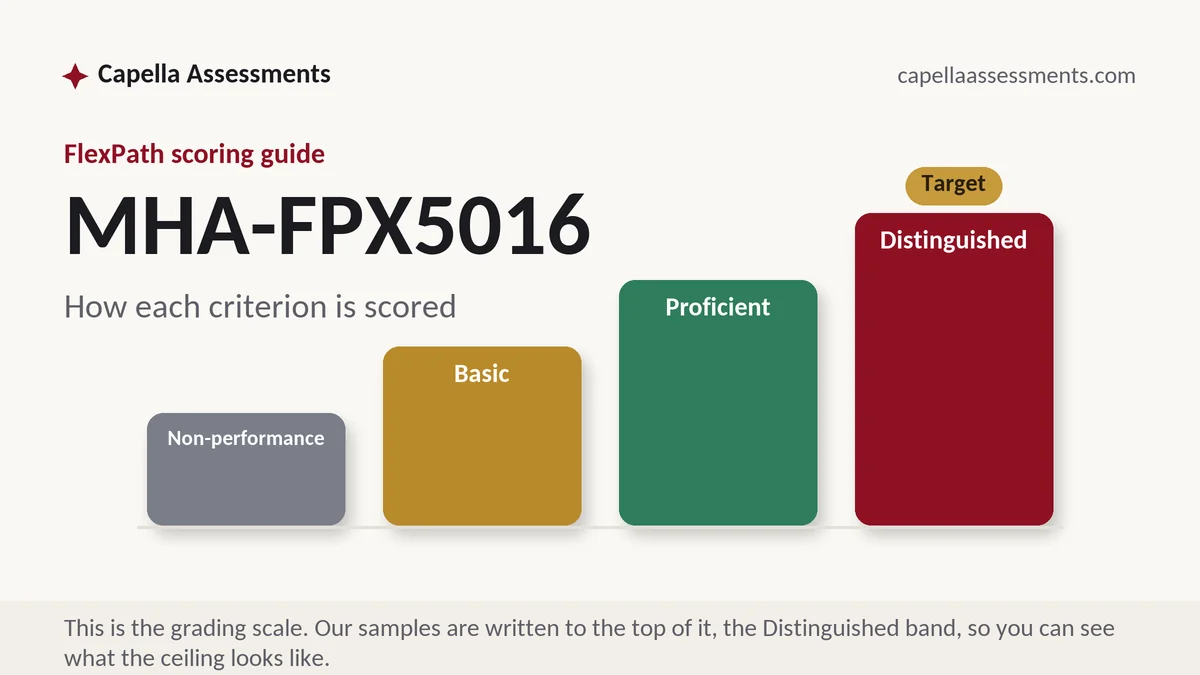
Evaluation with stated standards is what MHA-FPX5016 criteria typically ask for. Describe a system accurately, then judge it against something explicit: workflow fit, interoperability, data quality, total cost, security posture, regulatory duty. Papers are expected to handle the privacy layer as a named obligation, HIPAA's Privacy and Security Rules for protected health information, rather than a vague nod to confidentiality, and where certification or incentive history matters, to attribute it correctly to federal programs. Most versions also ask for a recommendation criterion: given the evaluation, what should the organization buy, fix, or stop, and what will it take. Distinguished work is distinguished by the decision quality, a recommendation with costs acknowledged, obligations covered, and the runner-up option honestly compared.
Where students lose points in MHA-FPX5016
MHA-FPX5016 papers most often lose points where technology talk goes unaccountable. Privacy is the clearest case: a paper promises the proposed system "protects patient privacy" without citing HIPAA's Security Rule or saying which safeguards (access controls, audit logs, encryption) satisfy it, and the compliance criterion scores Basic because nothing was demonstrated. Cost is the second leak: a recommendation calls a system "cost-effective" with no acquisition figure, no maintenance estimate, no arithmetic at all, which turns a management judgment into a slogan. Third is the metric without a verdict, adoption rates or error counts reported and never converted into an evaluation finding. The drawer samples correct all three: safeguards mapped to the rule, costs estimated in numbers, and every figure closed with a judgment.
The MHA-FPX5016 drawers
MHA-FPX5016 Assessment 1 systems mapped to operations example
The opening assessment typically maps health information systems to the operations they support. On request, free, 24-48h.
MHA-FPX5016 Assessment 2 system evaluation against workflow example
Mid-course usually brings the evaluation: a specific system judged against workflow, cost, and named privacy obligations. On request, free, 24-48h.
MHA-FPX5016 Assessment 3 technology direction recommendation example
The close is most often the recommendation: a technology direction argued with costs and safeguards explicit. On request, free, 24-48h.
Your courseroom shows something else?
Capella revises courses; assessment counts and titles shift between versions. Send what your courseroom shows and the desk matches it exactly.
Using a MHA-FPX5016 sample the right way
The fastest way to use a MHA-FPX5016 sample is to steal its evaluation table, not its opinions. Look at the standards the paper judges the system against, where each technical claim gets its citation, and how the HIPAA discussion names safeguards instead of intentions. Then point the same machinery at the system in your own scenario, which will have different strengths and a different cost picture, so your conclusions must be your own. Draft with your scoring guide beside you and check each criterion off as your paper answers it. If your courseroom's version assesses something the drawers do not show, a free custom sample written to your guide arrives in 24-48 hours.
How these samples are written
The method behind every paper on this shelf: criteria first, structure from the criteria, evidence current, APA exact, and annotations that show which paragraph answers which criterion. Send your courseroom's scoring guide with a request and the custom sample matches it exactly, revisions included.
MHA-FPX5016 questions, answered
I am not technical at all. Are MHA-FPX5016 samples readable for a management student?
They are written for exactly that reader, because the course is. Each sample defines systems in operational terms, keeps acronyms under control, and evaluates technology by what it does to workflow, cost, and obligations, the dimensions an administrator owns. If a sample ever needed an IT background to follow, it would be modeling the wrong genre for this course.
Do the MHA-FPX5016 samples cover HIPAA properly or just mention privacy in passing?
Properly, which in this course means specifically: the Privacy Rule for how protected health information is used and disclosed, the Security Rule for administrative, physical, and technical safeguards, and the mapping from each safeguard to a feature of the system being evaluated. Passing mentions of "confidentiality" are precisely what the compliance criteria mark down.
Can I request a MHA-FPX5016 sample for a specific assessment instead of the whole course?
Yes. Send the scoring guide for the assessment you are on, plus the scenario if your courseroom provides one, and a sample written to that exact assessment comes back free within 24-48 hours. A sensible rhythm is to request the assessment ahead of you, read it against the criteria, then draft your own.