Send the exact assignment or rubric from your classroom and a custom sample written to it lands in 24 to 48 hours, the first one free. PM-FPX4070 is Capella’s Procurement Management in Project Management course. It centers on deciding what to buy rather than build and writing the contract terms that decide who absorbs the overrun. Searches like "pm fpx 4070 assessment 3 assignment example", "PMFPX4070 sample paper", and "PM-FPX4070 assessment samples" land on this page.
What PM-FPX4070 is really about
Procurement is the domain where a student's instinct is least reliable, because the interesting question is not which vendor is cheapest. PM-FPX4070 is scored on whether you understand that a contract type is a decision about who absorbs the surprise. A firm fixed price moves overrun risk to the seller, and the seller prices that risk into the quote and defends the boundary when anything changes. Cost reimbursable keeps the risk with the buyer and buys flexibility with it. Time and materials sits between them and rewards nobody for finishing. Papers that pick a type because it is common, then justify it by saying it offers good value, have skipped the only analysis the criteria are looking for.
The make-or-buy analysis has the same shape and is usually undercooked. Comparing a vendor quote against an internal cost is only half of it, because building in-house also consumes capacity that was committed elsewhere and leaves capability behind that buying does not. The criteria want those non-price factors weighed openly, and they want a recommendation rather than a table. The statement of work is the other high-value artifact, and the test is enforceability: a deliverable a reasonable vendor could dispute is a deliverable you cannot reject. Write what is delivered, to what standard, by when, and what acceptance looks like. Selection criteria then have to be set before the proposals arrive, because criteria written afterwards fit whoever you already preferred.
What PM-FPX4070’s assessments ask for
Assessments typically ask you to decide what the project should buy and to build the documents that buy it. That means a make-or-buy analysis with cost, capacity and capability weighed, a contract type selected with the risk allocation argued, and a statement of work specific enough to be enforced. Where the criteria reach solicitation, they want the document type matched to the situation and the evaluation criteria weighted before responses are seen. Vendor management is usually assessed as performance measurement: what gets inspected, at what points, and what remedy applies when a milestone is missed. Several versions close with contract administration or close-out, which wants the conditions for final acceptance, the release of retainage or final payment, and what happens to any residual obligation such as warranty or support.
Where students lose points in PM-FPX4070
The signature loss here is the contract type chosen with no risk argument, usually fixed price because it sounds safe, in a situation where the requirement is still moving and every change becomes a priced amendment. Second is the statement of work written as a description of the vendor's services rather than of the deliverables, which leaves nothing to accept or reject. Third is a make-or-buy comparison run on price alone, ignoring the internal capacity the build would consume. Marks also go for evaluation criteria invented after the proposals, for performance managed by good relationships rather than by inspection points and remedies, and for close-out omitted entirely, so the paper never says what final acceptance requires or who signs it.
The PM-FPX4070 drawers
PM-FPX4070 Assessment 1 make-or-buy analysis example
Assessment 1 typically decides what the project builds and what it purchases. On request, free, 24-48h.
PM-FPX4070 Assessment 2 statement of work example
Assessment 2 often specifies deliverables tightly enough that a vendor cannot argue. On request, free, 24-48h.
PM-FPX4070 Assessment 3 procurement plan example
Assessment 3 usually sets contract type, selection criteria and how performance is measured. On request, free, 24-48h.
Your classroom shows something else?
Capella University revises courses; assessment counts and deliverables shift between terms. Send what your classroom shows and the desk matches it exactly.
Using a PM-FPX4070 sample the right way
Read a sample for the sentence that says who carries the risk, because that one line is the spine of the whole submission and everything else in the paper should agree with it. Then read the statement of work as though you were the vendor looking for room: any deliverable you could argue about is one the sample has not tightened. That adversarial reading teaches more than any summary of contract types. Build yours around something your project would genuinely outsource, and keep the numbers modest and attributed, since the make-or-buy analysis is only persuasive when a reader can see where each figure came from.
How these samples are written
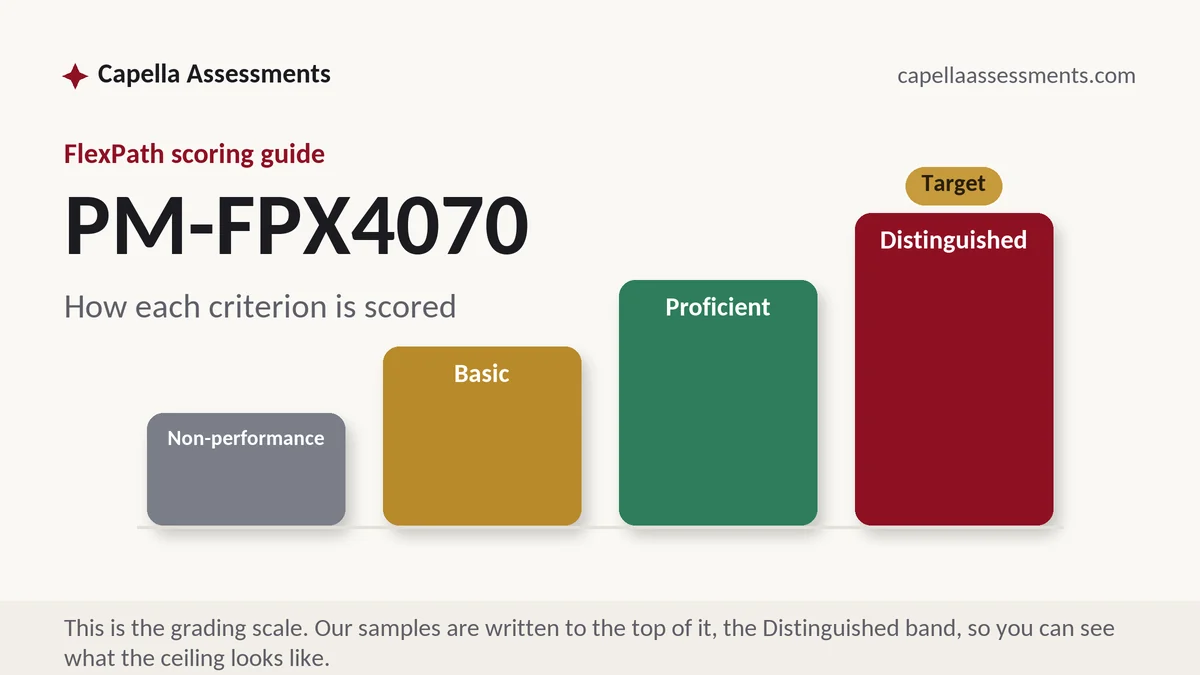
Every sample in this drawer is written the same way our custom ones are: the scoring guide decoded criterion by criterion, a subject-matched writer drafting to the Distinguished column, APA checked line by line, and the reasoning annotated so the paper teaches while it shows. Capella revises scoring guides, so a custom request is always written to the guide in YOUR courseroom, never from a stale template.
PM-FPX4070 questions, answered
Which contract type should I choose for the assessment?
The one that puts the risk where it belongs given how well defined the requirement is. A stable, fully specified deliverable suits fixed price; a requirement that will move suits a reimbursable or time and materials arrangement, with controls on it. What the criteria reward is the argument, so name the alternative you rejected and say what it would have cost the buyer.
How detailed does a statement of work have to be?
Detailed enough that a vendor who wanted to argue could not. Each deliverable needs a description, a standard it must meet, a date and an acceptance test. Where you cannot specify a standard, say how it will be agreed and by when, because an open item acknowledged is manageable and an open item hidden becomes a change order later.
Can I use real vendor quotes in a PM-FPX4070 paper?
Published pricing is fine and it strengthens the make-or-buy analysis. Anything confidential from an employer is not, so use public rate cards, catalogue prices or a clearly labelled estimate instead. What the criteria assess is the reasoning that turns numbers into a recommendation, not whether the figures came from a live procurement you were part of.